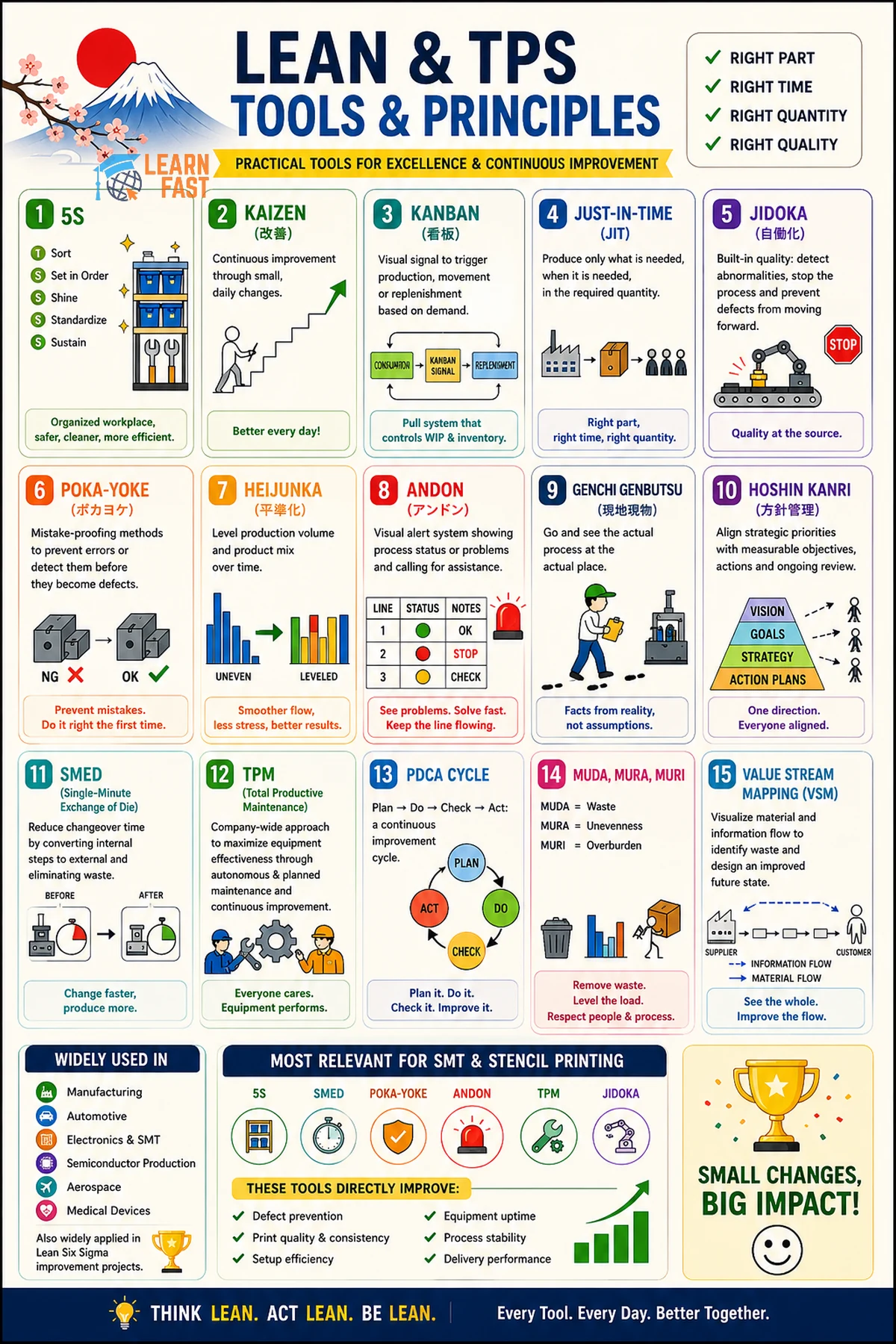
Lean is often introduced as a collection of tools: 5S, Kaizen, Kanban, Just-in-Time, Jidoka, Poka-Yoke, Heijunka, Andon, Gemba, Hoshin Kanri, SMED, TPM, PDCA, Muda-Mura-Muri, and Value Stream Mapping.
Learning the tools individually is useful. The bigger lesson is understanding how they work together.
The Toyota Production System is not a checklist of techniques. It is a connected operating system designed to improve flow, expose abnormalities, protect quality, reduce waste, and respond to customer demand with greater stability.
1. 5S: create visible, stable workplace conditions
5S is commonly summarized as Sort, Set in Order, Shine, Standardize, and Sustain.
Its value goes beyond housekeeping. A well-organized workplace makes normal and abnormal conditions easier to distinguish. Missing tools, leaks, excess material, unsafe conditions, or poor equipment condition become easier to see.
That visibility supports Standard Work, TPM, problem solving, and reliable flow.
2. Kaizen: improve the work continuously
Kaizen creates a habit of ongoing improvement.
The strongest Kaizen activity is not random change. It is disciplined learning: identify a problem, test a countermeasure, check the result, and improve the standard.
Small changes made repeatedly can create major performance gains when they are tied to real process problems.
3. Kanban: signal what needs replenishment
Kanban is a visual or electronic signal that authorizes replenishment or movement.
It helps answer three questions clearly:
- what is needed;
- how much is needed;
- where it is needed.
Kanban supports a pull system by connecting upstream activity to actual downstream consumption.
4. Just-in-Time: connect production to demand
Just-in-Time aims to provide the right item, in the right quantity, at the right time.
JIT depends on several supporting conditions: takt, flow, pull, small lots, short changeovers, stable quality, and reliable equipment.
It should not be reduced to “zero inventory.” The real objective is to reduce unnecessary inventory while improving the instability that made large buffers necessary.
5. Jidoka: build quality into the process
Jidoka means detecting an abnormal condition and preventing defective work from continuing through the system.
The practical logic is:
detect → stop or contain → make the problem visible → correct and learn.
Stopping is not the goal. The goal is to protect the customer and create a trigger for problem solving.
6. Poka-Yoke: prevent mistakes before they become defects
Poka-Yoke is mistake-proofing.
A good Poka-Yoke either prevents an error from occurring or makes the error immediately detectable.
Examples include fixtures that allow only the correct orientation, sensors that detect missing components, software controls that prevent invalid entries, or torque systems that reject an out-of-spec condition.
Poka-Yoke and Jidoka work closely together because both move quality control toward the source.
7. Heijunka: reduce unevenness
Heijunka is production leveling.
Instead of allowing large swings in production volume or product mix, Heijunka seeks a smoother operating pattern.
Reducing unevenness helps prevent periods of waiting followed by periods of rushing, overtime, equipment overload, shortages, and quality problems.
Heijunka therefore attacks Mura and helps reduce Muri and Muda.
8. Andon: make abnormal conditions visible
Andon is a visual or audible signal used to communicate process status and abnormalities.
A useful Andon system does more than flash a light. It defines who responds, how quickly they respond, what condition requires escalation, and how recurring problems are addressed.
Andon makes the problem visible. Jidoka provides the operating principle for containing and learning from it.
9. Genchi Genbutsu: go and see the actual condition
Lean problem solving should be based on facts from the actual process.
Genchi Genbutsu means going to the real place to understand what is really happening. This is closely connected to Gemba.
Dashboards and reports are useful, but direct observation can reveal waiting, workarounds, interruptions, material shortages, poor ergonomics, equipment deterioration, and differences between the written standard and actual work.
Do not solve the process only from a conference room when the evidence exists at the process.
10. Hoshin Kanri: connect strategy to improvement
Hoshin Kanri connects strategic priorities with measurable objectives and coordinated action.
An organization may have hundreds of improvement opportunities. Hoshin Kanri helps decide which priorities require breakthrough focus and how daily improvement activity connects to broader direction.
It gives Lean a strategic dimension rather than leaving improvement as a collection of local projects.
11. SMED: make smaller batches practical
SMED stands for Single-Minute Exchange of Die.
Long changeovers encourage large batches because organizations try to avoid frequent setup losses. Large batches then create excess inventory, longer lead time, slower feedback, and lower flexibility.
Reducing changeover time makes smaller batches and more responsive production practical.
That directly supports Heijunka, flow, pull, and Just-in-Time.
12. TPM: protect equipment effectiveness
Total Productive Maintenance creates a company-wide approach to equipment effectiveness and reliability.
Reliable flow is difficult when equipment performance is unpredictable.
TPM addresses losses caused by breakdowns, minor stops, speed loss, quality defects, startup losses, and deteriorating basic conditions.
Practices such as Autonomous Maintenance and Planned Maintenance help restore and preserve those conditions.
13. PDCA: turn improvement into learning
PDCA stands for Plan, Do, Check, Act.
It creates a disciplined learning cycle:
Plan the change and expected result.
Do the test.
Check what actually happened.
Act on what was learned.
PDCA helps prevent improvement from becoming a sequence of opinions. It encourages teams to make expectations explicit and compare actual results with those expectations.
14. Muda, Mura, and Muri: look beyond visible waste
Muda, Mura, and Muri give Lean a broader diagnostic view.
Muda = waste.
Mura = unevenness.
Muri = overburden.
These conditions interact.
Uneven schedules can overload people and equipment. Overburden can then create defects, breakdowns, waiting, rework, and other forms of waste.
The best improvement is therefore not always to remove the visible waste directly. Sometimes the stronger action is to remove the system condition creating it.
15. Value Stream Mapping: see the complete flow
Value Stream Mapping helps teams visualize the material and information flow required to deliver a product or service.
A current-state map can expose queues, inventory, delays, disconnected information flow, batch production, long changeovers, and scheduling problems.
The future state can then use concepts such as flow, pull, takt, leveling, smaller batches, and better problem visibility.
VSM helps prevent local optimization by forcing the team to look at the entire value stream.
How the tools reinforce one another
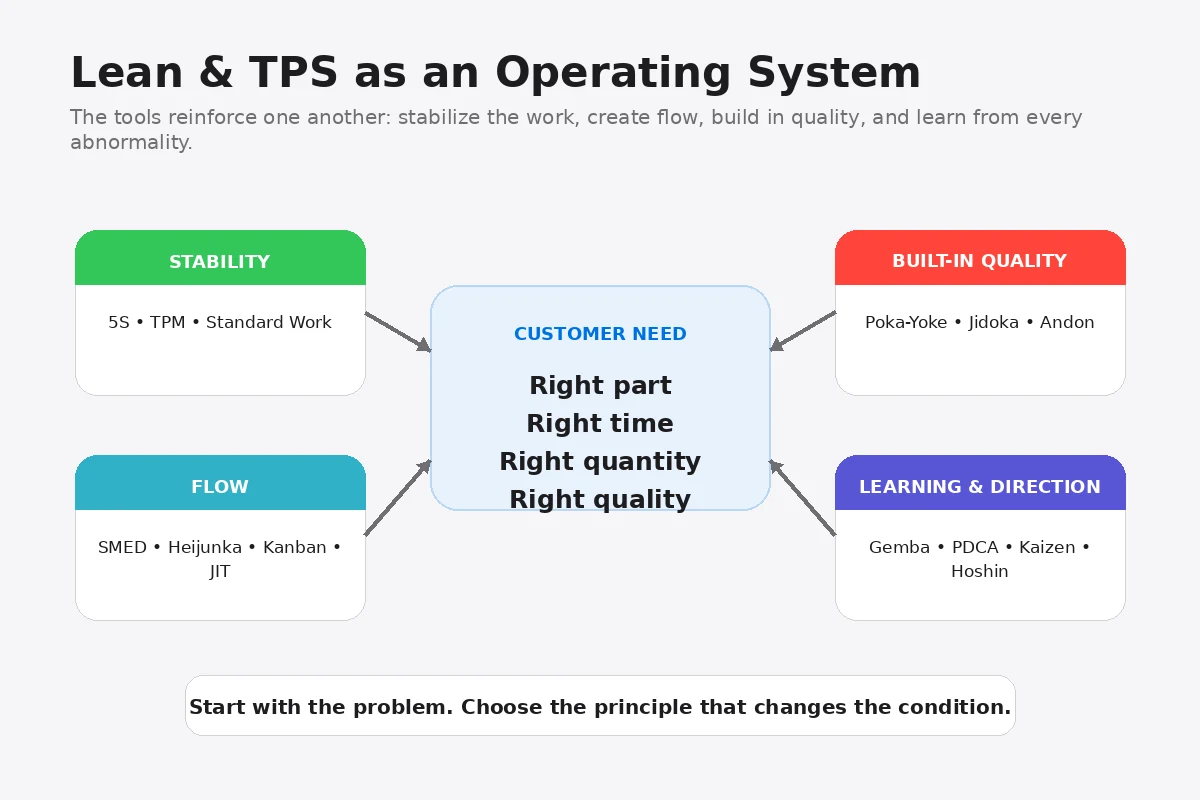
The real strength of Lean comes from the relationships among the tools.
5S creates visible workplace conditions.
TPM protects equipment stability.
SMED enables smaller batches.
Heijunka reduces unevenness.
Kanban supports replenishment.
Pull connects production to consumption.
Just-in-Time coordinates flow with demand.
Poka-Yoke prevents errors.
Jidoka prevents defects from flowing forward.
Andon exposes abnormalities.
Genchi Genbutsu keeps problem solving connected to reality.
PDCA and Kaizen create the learning mechanism.
Value Stream Mapping helps teams see how the complete flow behaves.
Hoshin Kanri connects improvement activity to strategic direction.
The result is a system, not a toolbox.
Four outcomes connect the system
The poster summarizes four useful operating outcomes:
Right part. Produce what the customer actually needs.
Right time. Connect production and replenishment to customer demand.
Right quantity. Control overproduction and excess work-in-process.
Right quality. Prevent defects from being created or flowing downstream.
Different Lean methods contribute to these outcomes in different ways.
Do not start by implementing all 15
A Lean transformation should not begin with a checklist saying every tool must be deployed.
Start with the problem.
If equipment is unstable, TPM may be more important than Kanban.
If long changeovers force enormous batches, SMED may be the priority.
If defects move downstream before anyone reacts, Jidoka and Poka-Yoke may deserve attention.
If schedules create constant peaks and firefighting, Heijunka may be more important.
If nobody understands the complete flow, begin with Value Stream Mapping.
The tool should follow the problem.
The practical lesson
A factory can use 5S without becoming Lean.
It can install Kanban boards without creating pull.
It can calculate OEE without improving equipment.
It can run Kaizen events without developing a continuous-improvement culture.
Tools become powerful when they are connected to a management system, a clearly understood problem, and a disciplined method for learning.
A better question than “Which Lean tool should we implement next?” is:
What prevents this process from delivering what the customer needs, and which Lean principle will help us change that condition?
Additional connections
This topic also connects with What Is Lean. That relationship is useful when the team needs to extend the method into a wider improvement system.