Continuous Improvement
What Is Continuous Improvement?
A practical explanation of Continuous Improvement: what it means, how it works, which methods support it, and how organizations turn improvement into everyday work.
Clear, practical guidance for Lean, problem solving, quality, maintenance, leadership and Operational Excellence.
Three guides that connect the core logic behind improvement work.
A practical explanation of Continuous Improvement: what it means, how it works, which methods support it, and how organizations turn improvement into everyday work.
Lean is a management system for creating more customer value with less waste by improving flow, exposing problems and developing people.
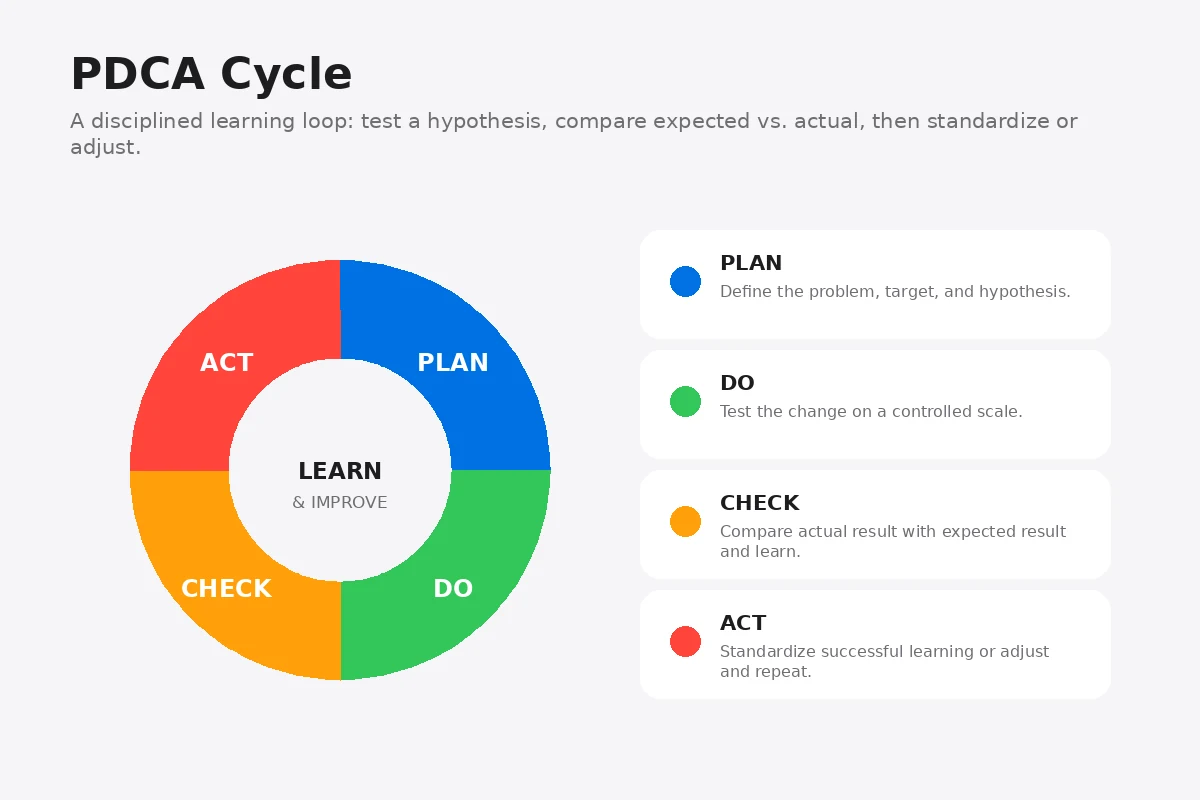
PDCA is a structured learning cycle for testing changes, comparing results with expectations and improving processes through repeated experimentation.
Choose the area that best matches the system, process or problem you want to improve.
Kaizen, PDCA, improvement culture, organizational learning and the management systems that make improvement part of everyday work.
Create value with less waste through flow, pull, takt, Standard Work, 5S, visual systems, SMED, VSM, Kanban and mistake-proofing.
Define problems clearly, investigate causes and test countermeasures using 5 Whys, fishbone, A3, 8D and practical root cause methods.
Understand variation and strengthen process quality with DMAIC, SPC, capability, MSA, Pareto analysis, FMEA and prevention-based thinking.
Improve equipment performance through TPM, OEE, autonomous maintenance, planned maintenance, MTBF, MTTR and reliability practices.
Turn problems into visible daily action through Gemba, tier meetings, KPI boards, Andon, hour-by-hour management and escalation routines.
Build capability through coaching, leader standard work, respect for people, skill development, empowerment and strong improvement habits.
Design better operating systems through line balance, capacity, takt, material flow, scheduling, industrial engineering and production design.
Connect strategy, systems and culture through Hoshin Kanri, performance management, transformation and organization-wide improvement.
Learn how Daily Management Signal Quality improves boards and meetings by making abnormal conditions timely, specific, visible, actionable, and connected to ownership.
Learn how Improvement Pipeline Conversion Rate shows whether qualified opportunities progress into active work while balancing readiness, capacity, and completion.
Learn how Leader Delegation Effectiveness clarifies authority, outcomes, limits, escalation triggers, support, and follow-up while preserving accountability.
Learn how a Maintenance Execution Feedback Loop captures actual labor, parts, access, sequence issues, findings, and completion evidence so future job plans improve.
Learn the difference between measurement uncertainty and Gage R&R, what each method is designed to answer, how they use variation, and when quality teams should use one or both.
Learn how a Problem Definition Quality Review checks the gap, location, timing, scope, evidence, affected condition, and assumptions before root-cause analysis begins.
Templates, calculators, checklists, visual guides and One Point Lessons have reserved places in the site. Approved resources will be added later.
Search across the published knowledge base by method, topic or discipline.