
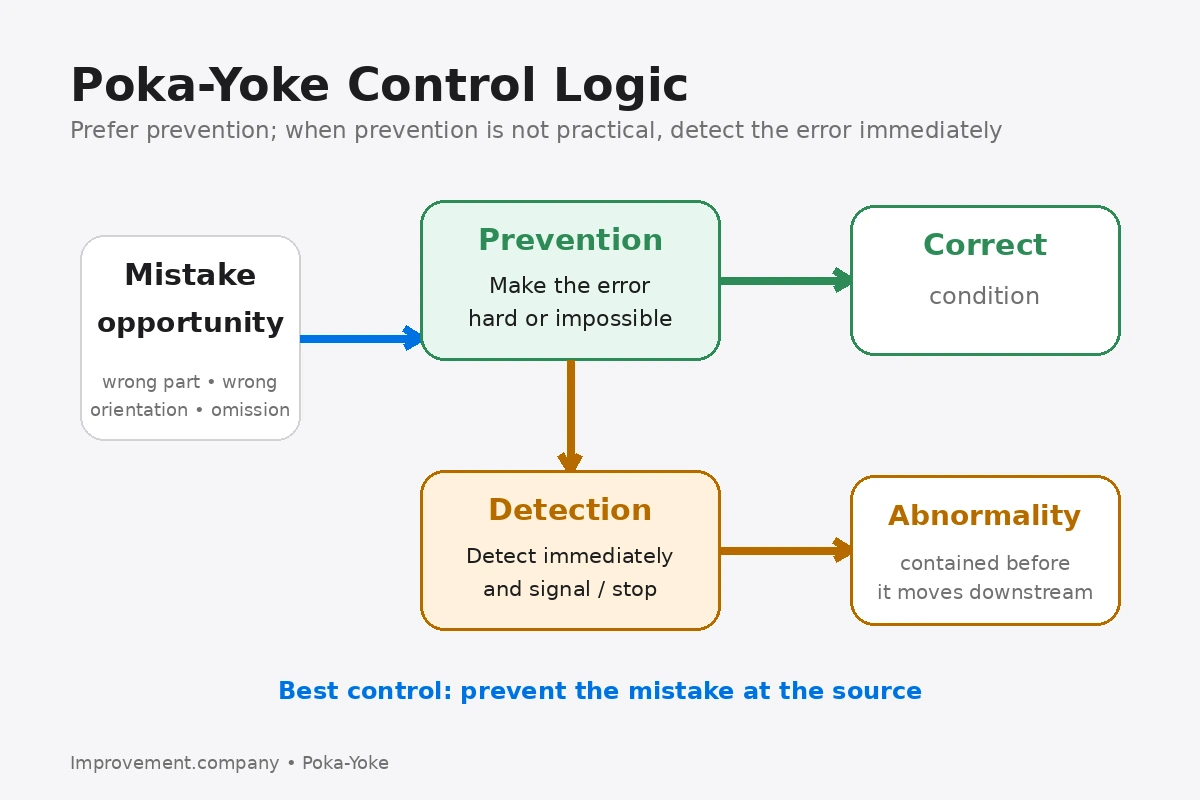
Poka-Yoke is a mistake-proofing approach that helps prevent an error from occurring or detects the error immediately so it cannot continue unnoticed.
The objective is not to demand perfect attention from people. It is to design the process so that common mistakes become difficult, impossible or immediately visible.
Error versus defect
An error is an incorrect action or condition in the process.
A defect is the unacceptable output that can result when the error is not prevented or detected.
Poka-Yoke focuses as close as possible to the error source.
Preventing the incorrect part from being installed is stronger than detecting the completed assembly later.
Prevention and detection
Some Poka-Yoke devices prevent the wrong action entirely.
A connector may only fit in the correct orientation. A fixture may physically block the wrong component.
Other controls detect the error immediately.
A sensor may confirm that a part is present before the machine can cycle, or a counter may show that one fastener is missing.
Prevention is generally stronger, but immediate detection can still be highly effective.
Simple solutions are often best
Poka-Yoke does not require complex automation.
Pins, guides, shaped fixtures, color coding, limit switches, counters, templates and sequence interlocks can all be useful depending on the failure mode.
The best solution is usually simple, reliable and easy to understand.
A complicated control that is frequently bypassed or difficult to maintain may create new problems.
Begin with the failure mechanism
Mistake-proofing should address a specific error.
The team should understand what incorrect condition occurs, why it occurs and where it can be prevented or detected.
Installing a generic alarm without understanding the failure mechanism may add technology without reducing risk.
Avoid blaming the operator
Statements such as “pay more attention” or “retrain the operator” are weak controls when the process makes the error easy to repeat.
Training matters, but robust process design reduces dependence on memory and concentration.
Poka-Yoke is especially valuable for repetitive tasks, similar-looking parts, sequence errors, missing components and conditions where immediate detection is important.
Confirm that the control itself is reliable
A mistake-proofing device can fail too.
Sensors can drift, fixtures can wear and operators may find workarounds if the control makes the task difficult.
The control should therefore be included in maintenance, verification or startup routines where appropriate.
Poka-Yoke supports quality at the source by moving the process away from inspection after the fact and toward prevention at the point where the error could occur.
Connect this concept to the wider system
For deeper application, connect this concept with What Is Lean, 8 Wastes of Lean, and Value Stream Mapping. These methods help move from understanding the topic to managing it as part of a wider improvement system.