
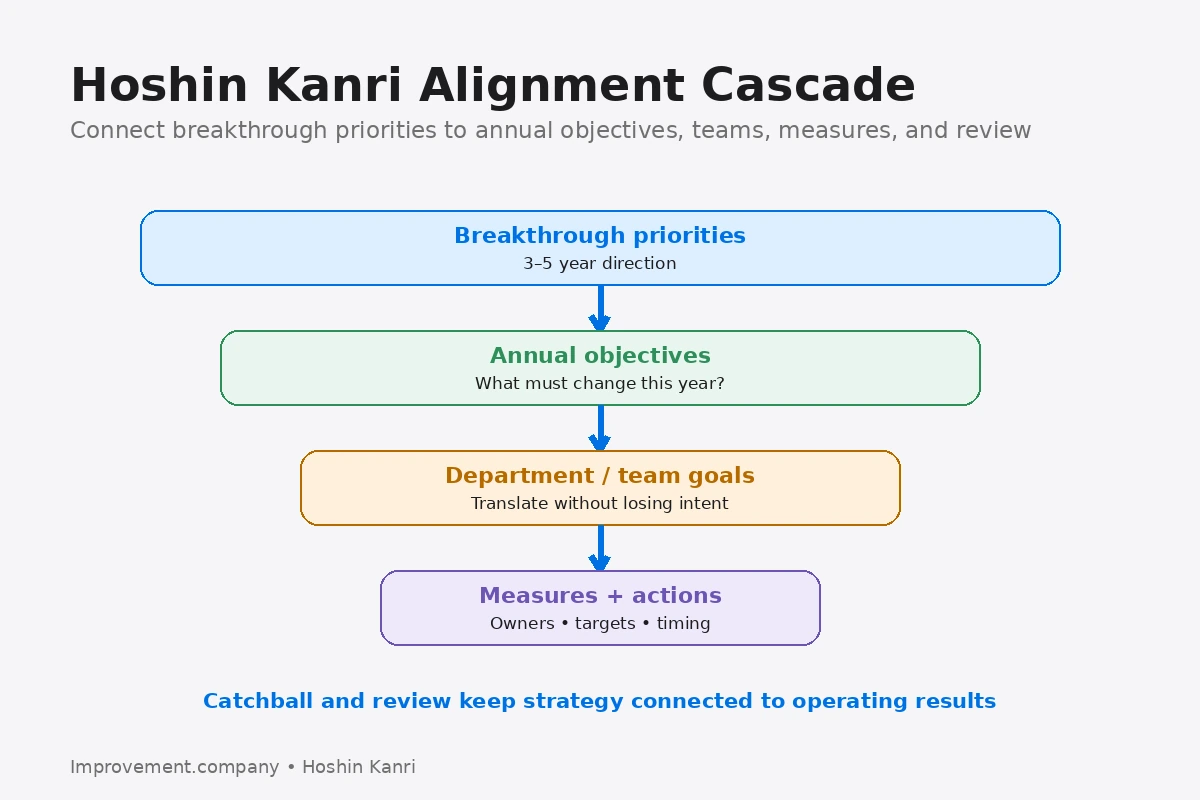
Hoshin Kanri is a strategy-deployment approach used to connect long-term direction with focused priorities and day-to-day improvement.
It helps organizations avoid a common problem: too many initiatives competing for attention without clear alignment.
Focus on vital priorities
Hoshin Kanri does not attempt to make every business objective a breakthrough priority.
A small number of important objectives receive concentrated attention.
This creates space for disciplined execution.
Connect levels of the organization
High-level objectives need to translate into meaningful contributions at lower levels.
Teams should understand how their work supports the larger direction.
The process is not simply top-down target assignment.
Catchball
Catchball refers to the dialogue used to develop and refine plans across levels and functions.
Ideas, targets, resources and practical constraints move back and forth.
This helps create stronger plans and greater ownership.
Link measures and actions
Strategic goals should connect to measurable outcomes and concrete improvement work.
Without this connection, strategy remains separate from operations.
Review and learn
Hoshin Kanri includes regular review.
The organization compares results with expectations, understands gaps and adjusts plans.
In this sense, strategy deployment follows the same learning logic as PDCA.
Connect breakthrough work with daily management
Strategy deployment and Daily Management serve different but connected purposes. Hoshin Kanri focuses attention on the few changes needed to move the organization toward its strategic direction. Daily Management protects and improves the performance required to run the business now.
When the two systems are disconnected, strategic projects can compete with operational reality. Strong deployment makes ownership, measures and review routines visible so that breakthrough work and day-to-day performance reinforce each other.
Catchball creates alignment
Hoshin Kanri is not simply a top-down deployment of targets.
Catchball is the dialogue through which objectives, measures, constraints and resources are discussed across levels and functions.
This allows assumptions to be challenged before commitments are finalized.
The process improves alignment because people understand both what is expected and what conditions are required to achieve it.
Limit the number of breakthrough priorities
If everything is strategic, nothing receives enough focus.
Hoshin Kanri works best when leadership identifies a small number of breakthrough priorities that deserve concentrated attention beyond normal daily management.
Routine operational performance still matters, but it should not crowd out the few changes needed to move the organization materially forward.
Measures should connect strategy to process
A strategic objective needs measures that show whether the organization is moving toward the intended outcome.
Those outcome measures should be supported by process measures that teams can influence.
This creates a line of sight from strategic intent to operational action.
Without that connection, Hoshin can become an annual target-setting exercise with weak daily relevance.
Review is part of deployment
Strategy deployment is not complete when the plan is published.
Regular review should compare actual progress with expected progress, surface barriers and adjust the plan when learning changes the assumptions.
The review process is therefore both a control mechanism and a learning mechanism.
Additional connections
This topic also connects with X-Matrix and Nemawashi. These relationships are useful when the team needs to extend the method into a wider improvement system.
Related application
This topic also connects with Hoshin Review Cadence. Use that method when the improvement requires the related management or operating discipline.