
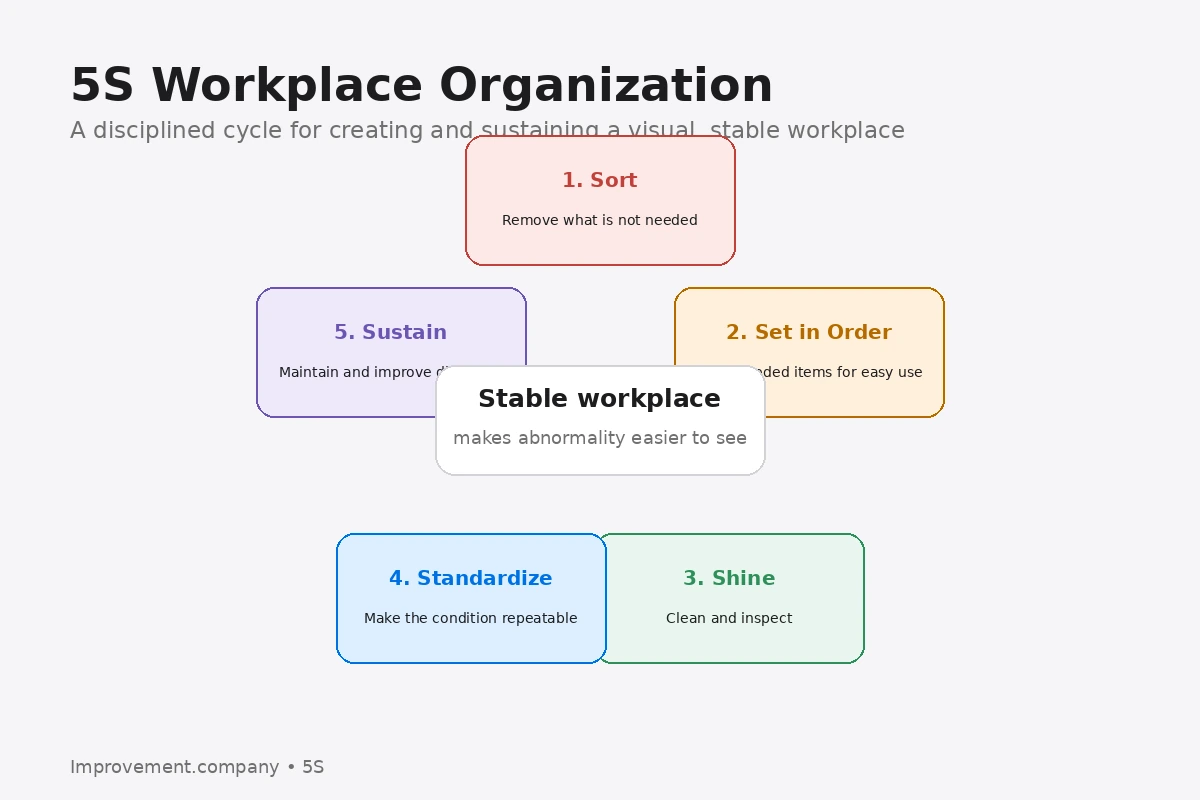
5S is a structured method for organizing the workplace so that work is easier to perform, abnormalities are easier to see and standards are easier to maintain.
The five steps are commonly translated as Sort, Set in Order, Shine, Standardize and Sustain.
Sort
Separate what is needed from what is not needed.
Remove obsolete tools, materials, paperwork and other items that interfere with normal work.
The objective is not simply to clean the area. It is to reduce unnecessary items that create searching, confusion and excess movement.
Set in Order
Arrange necessary items so they are easy to identify, access, use and return.
Good arrangement considers frequency of use, ergonomics, safety and process flow.
Labels, shadow boards, marked locations and clear storage rules can help establish the expected condition.
Shine
Clean the workplace and inspect it while cleaning.
Shine is important because leaks, wear, loose components, contamination and damage often become visible during cleaning.
In equipment-intensive environments, cleaning can therefore support basic inspection.
Standardize
Define how the first three steps will be maintained.
Standards may include photographs, checklists, visual controls, ownership and expected frequencies.
Without standardization, the workplace tends to return to its previous condition.
Sustain
Build the habits and management routines required to maintain and improve the standard.
Audits can support Sustain, but the goal is not the audit score. The goal is a stable workplace where abnormal conditions are noticed and corrected.
5S is not housekeeping
A clean workplace can still have poor flow, unclear standards and hidden problems.
5S should support safety, quality, productivity and problem detection.
The best 5S systems make the normal condition immediately obvious.
5S should reveal abnormalities
A well-organized workplace is useful because abnormal conditions become easier to see.
A missing tool, an oil leak, excess material, an obstructed access point or a misplaced component should stand out against the expected condition. This is more valuable than simply making the area look tidy.
For that reason, the visual standard should support recognition. Labels, locations, quantities and cleaning expectations should make the normal condition obvious enough that a deviation can trigger action.
Sustain requires ownership
The fifth S is often reduced to periodic audits, but audits alone do not sustain a workplace.
Teams need clear ownership for restoring conditions, reviewing repeated abnormalities and improving the standard when the work changes.
A useful audit asks whether the workplace supports safe, reliable and efficient work. A weak audit rewards appearance even when the arrangement creates extra motion or hides process problems.
Do not organize waste
5S can accidentally make an inefficient process look more professional.
Before fixing every item in place, ask whether the item is needed, whether the location supports the work sequence and whether the quantity is appropriate.
The objective is not to create permanent locations for unnecessary inventory, duplicate tools or obsolete materials.
5S should simplify the workplace while making problems easier to detect.
Connect this concept to the wider system
For deeper application, connect this concept with What Is Lean, 8 Wastes of Lean, and Value Stream Mapping. These methods help move from understanding the topic to managing it as part of a wider improvement system.