Total Productive Maintenance, or TPM, is a structured approach to improving equipment effectiveness and reliability.
It connects maintenance, operations, engineering, quality and improvement rather than treating equipment care as the responsibility of the maintenance department alone.
The objective
TPM aims to reduce losses that prevent equipment and processes from performing as required.
Common losses include:
- breakdowns;
- setup and adjustment;
- minor stops;
- reduced speed;
- defects and rework;
- startup losses.
Operator involvement
One important TPM principle is that operators participate in basic equipment care.
Autonomous Maintenance may include cleaning, inspection, lubrication, tightening and early detection of abnormal conditions.
This does not replace skilled maintenance work.
It creates shared ownership and helps detect deterioration earlier.
Planned Maintenance
Planned Maintenance develops maintenance routines based on equipment condition, failure history, risk and operating requirements.
The objective is to move away from repeated emergency response toward more controlled reliability management.
Focused Improvement
TPM also uses structured improvement to eliminate recurring equipment and process losses.
Teams investigate chronic losses, identify causes and implement countermeasures.
TPM is broader than maintenance
Mature TPM systems also connect equipment design, training, quality, safety and administrative processes.
The central idea is that reliable equipment performance is created by the whole operating system.
Build from equipment conditions
TPM works best when improvement begins with the actual condition of the equipment. Cleaning, inspection and restoration can expose leaks, looseness, contamination, wear and inaccessible components that make reliable operation difficult.
Teams can then define standards for normal conditions and decide which tasks belong with operators, maintenance specialists or engineering. This prevents Autonomous Maintenance from becoming a transfer of technical maintenance work to operators and keeps responsibilities aligned with capability and risk.
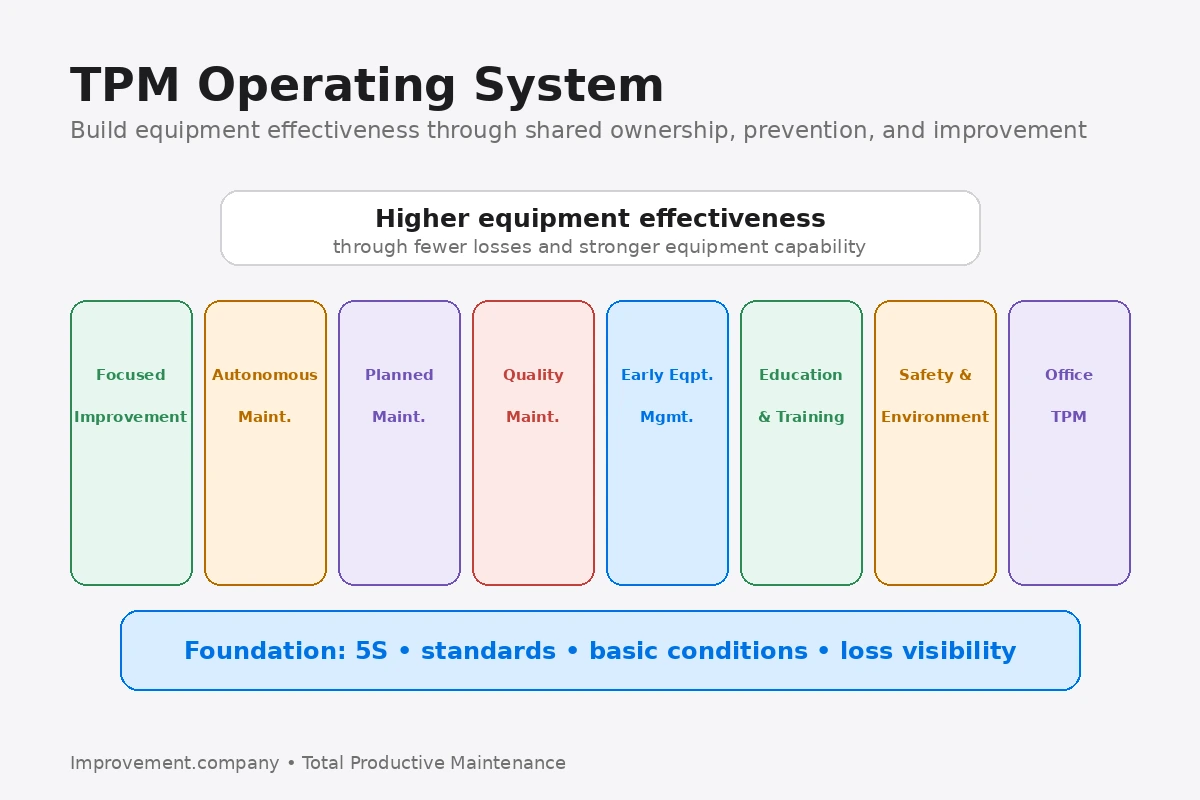
The eight-pillar view of TPM
TPM is commonly described through eight pillars. Naming conventions can vary, but the system typically includes Autonomous Maintenance, Planned Maintenance, Focused Improvement, Quality Maintenance, Early Equipment Management, Training and Education, Safety/Health/Environment, and TPM in administrative or support functions.
The pillars show why TPM is broader than preventive maintenance.
It combines equipment care, loss elimination, capability development and management systems.
Autonomous Maintenance does not replace maintenance trades
Autonomous Maintenance gives operators responsibility for defined basic equipment conditions and early detection of abnormalities.
That responsibility should be matched to training, safety and technical capability.
Specialized repair, diagnostics, electrical work, precision maintenance and regulated tasks still require appropriately qualified personnel.
The purpose is cooperation between operations and maintenance, not transfer of all maintenance activity to operators.
Planned Maintenance should respond to failure behavior
Calendar-based maintenance alone does not guarantee reliability.
Maintenance strategy should consider failure modes, equipment criticality, condition data, operating environment and maintenance history.
Some components are suitable for time-based replacement. Others are better managed through condition monitoring, inspection, run-to-failure or redesign.
TPM provides the operating system in which those decisions can be improved.
Measure losses, not activity
A maintenance department can complete many work orders while equipment performance remains poor.
TPM therefore focuses on losses and equipment effectiveness rather than maintenance activity alone.
Breakdowns, minor stops, speed loss, setup loss, defects and startup problems all consume productive capacity.
The objective is to remove the causes of those losses.
Reliability is created across the equipment lifecycle
Equipment performance is influenced long before a breakdown occurs.
Design choices, installation quality, operating practices, cleaning, lubrication, inspection, spare-parts strategy and maintenance planning all affect reliability.
Mature TPM systems use lessons from existing equipment to improve future equipment design and startup.
This lifecycle view helps prevent recurring maintenance problems from being designed into new assets.
Connect this concept to the wider system
For deeper application, connect this concept with Planned Maintenance and Reliability-Centered Maintenance. These methods help move from understanding the topic to managing it as part of a wider improvement system.