
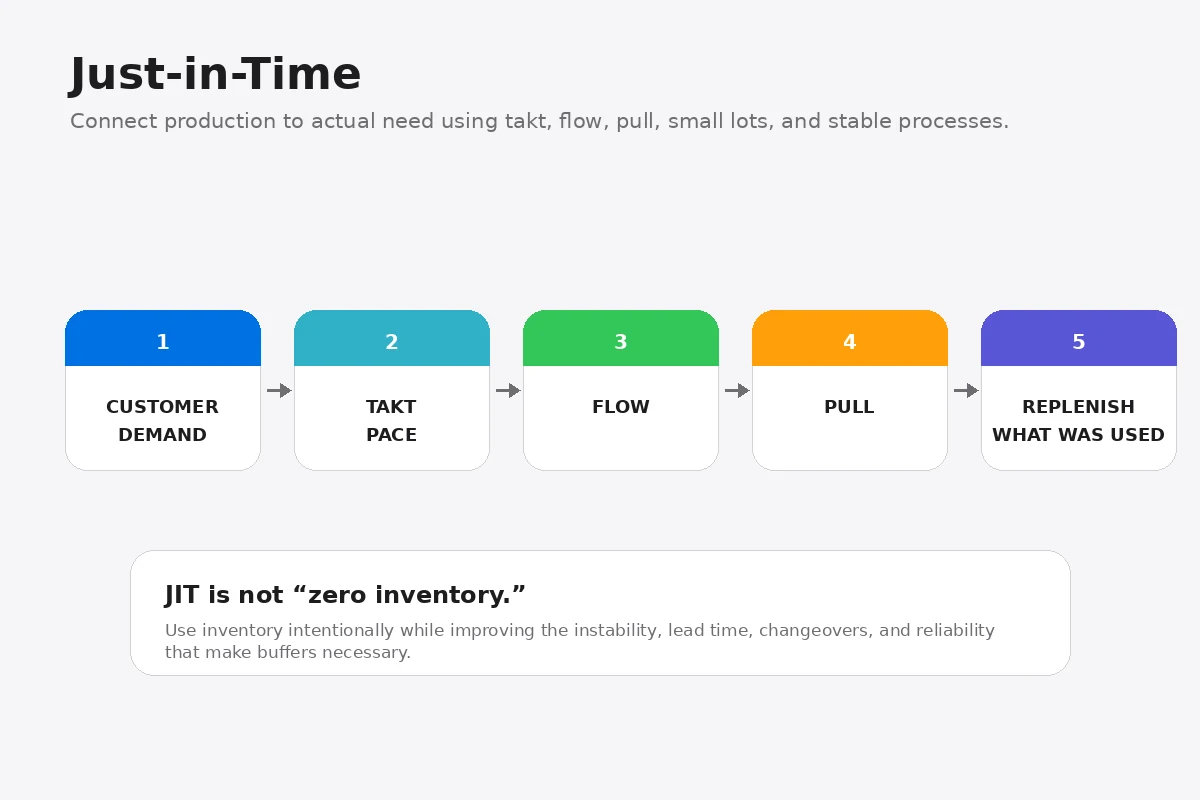
Just-in-Time, or JIT, is a production principle built around a simple objective: provide the right item, in the right quantity, at the right time.
That does not mean running with zero inventory or forcing suppliers to deliver constantly. JIT is a system for aligning production and replenishment with actual demand while reducing the delays, excess inventory, and hidden problems created by traditional push production.
The three questions JIT tries to answer
Every production system must decide:
- what should be produced;
- how much should be produced;
- when it should be produced.
A push system often answers those questions from a schedule or forecast and sends work downstream whether the next process is ready or not.
A JIT system tries to connect those decisions more closely to real consumption.
The operating logic behind JIT
JIT depends on several Lean concepts working together.
Takt time
Takt time translates customer demand into the pace the process should support. It gives the system a demand-based reference point.
Flow
Where practical, work should move continuously from one step to the next instead of waiting in large queues.
Pull
Downstream consumption should trigger upstream replenishment. This is the operating logic of a pull system and helps prevent overproduction.
Small lot sizes
Smaller batches reduce waiting, inventory, and the time required to discover quality problems. They also make production more responsive to changing demand.
Reliable processes
JIT exposes instability. Frequent breakdowns, long changeovers, quality problems, missing materials, and inconsistent work become more visible because excess inventory is no longer masking them.
Why inventory can hide problems
Inventory often provides protection against instability. A large buffer may keep downstream operations running when an upstream process fails.
That protection can be useful in some situations, but it also reduces urgency to solve the cause of instability.
When inventory is reduced thoughtfully, problems such as unreliable equipment, poor scheduling, long changeovers, and supplier variation become easier to see.
JIT should therefore be introduced as a system-improvement strategy, not simply as an inventory-reduction target.
JIT is not “zero inventory”
Every real system contains uncertainty. Some inventory may be necessary because of lead time, variability, transportation constraints, service requirements, or risk.
The purpose is to use inventory intentionally.
A good question is not “How do we eliminate all inventory?” It is “Why is this inventory here, what risk does it protect against, and can we reduce the cause that makes the buffer necessary?”
Prerequisites for effective JIT
JIT becomes fragile when foundational conditions are weak. Before aggressively reducing buffers, organizations should understand process capability, equipment reliability, supplier performance, changeover time, standard work, demand patterns, and response capability.
The more tightly synchronized the system becomes, the more important stability becomes.
Example
Imagine a packaging process that consumes ten trays every hour. An upstream forming process produces trays in batches of 500 because that has always been the schedule.
The large batch creates inventory, storage needs, and long periods before quality problems are discovered.
A JIT redesign might reduce changeover time, establish a smaller replenishment quantity, and use downstream consumption to trigger production. The forming process now produces smaller amounts more frequently.
The result is not just less inventory. It is faster feedback, shorter lead time, and a clearer connection between production and demand.
Common mistakes
The most common mistake is reducing inventory without improving the system that the inventory was protecting.
Another is assuming JIT means every process must operate one-piece flow. Physical constraints, process technologies, curing times, transport distances, or economic realities may require controlled buffers or batches.
A third mistake is using JIT as a purchasing slogan while production planning, changeovers, quality, and maintenance remain unchanged.
JIT is a system, not a purchasing tactic.
What good JIT looks like
A strong JIT system has clear demand signals, controlled work-in-process, short feedback loops, reliable equipment, quick changeovers, stable work methods, and visible problems.
Production is connected to need rather than driven by the desire to keep every resource busy.
That is the deeper purpose of JIT: create a responsive system in which work moves because it is needed, not merely because capacity is available.