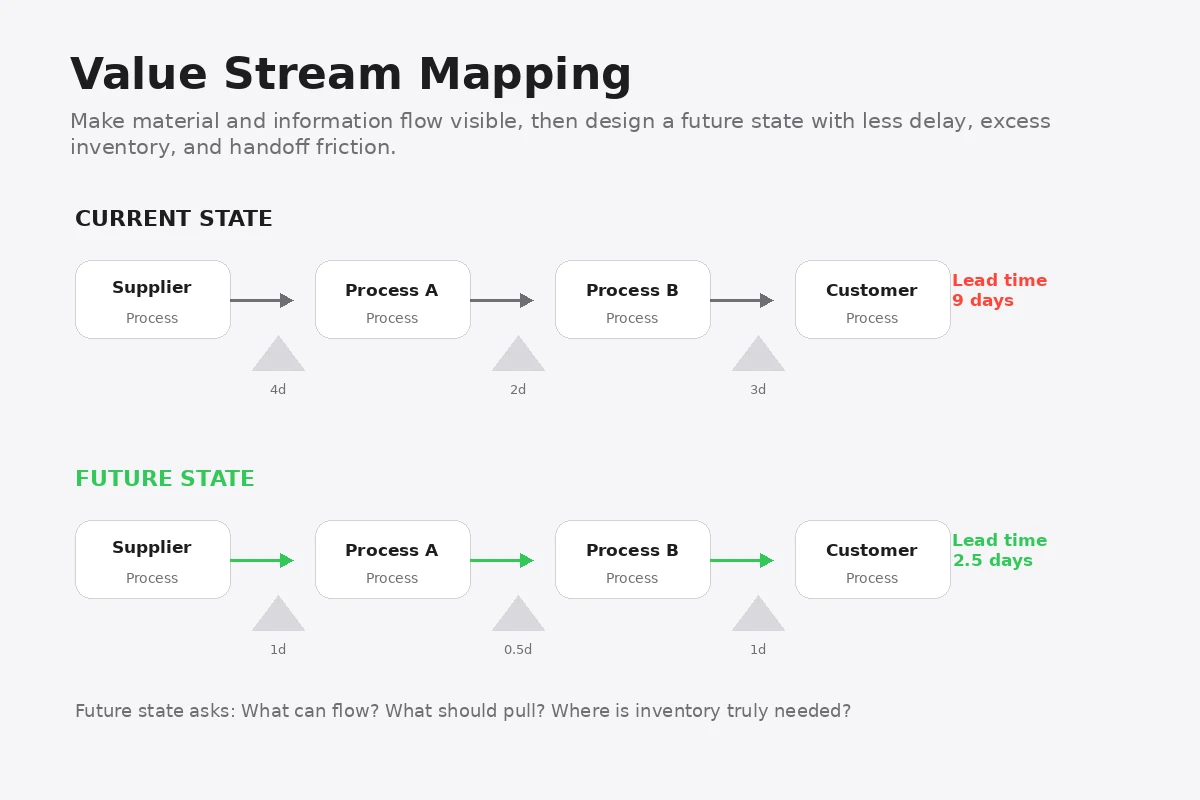
Value Stream Mapping, commonly abbreviated VSM, is a Lean method for understanding how material and information move through an end-to-end process. It helps teams see the relationship between process steps, inventory, waiting, information signals and customer demand.
The purpose is not to create a detailed process drawing. The purpose is to expose how the system behaves and identify where a better future flow can be designed.
What a current-state map shows
A current-state map normally begins with a defined product or service family.
The team then follows the actual flow from customer demand through the process and, where relevant, back toward suppliers. Typical information includes process steps, cycle times, changeover times, uptime, inventory, waiting, staffing, batch sizes and information flows.
The map should reflect what is actually happening, not what procedures say should happen.
That is why VSM is strongest when the team gathers information at Gemba.
Lead time versus processing time
One of the most useful insights from VSM is the difference between total lead time and the time in which value-creating work is actually occurring.
A product may require only minutes or hours of processing while spending days waiting in queues, inventory or handoffs.
This makes delay visible as a system problem rather than a hidden condition between departments.
Designing a future state
The future-state map should represent a better operating system, not simply a cleaner version of the current state.
Teams may examine where continuous flow is possible, where supermarkets or pull systems are appropriate, how to level work, how frequently to schedule, and what process should set the production pace.
The future state should also identify the improvements required to make that design possible.
VSM is not a detailed layout tool
Value Stream Mapping operates at a higher level than many process maps.
It is not intended to capture every operator motion, decision branch or machine detail.
Other tools may be better for those purposes.
The strength of VSM is its ability to connect multiple processes and reveal how local decisions affect the whole value stream.
Common mistakes
A common mistake is mapping too broad a scope. A map covering every product and every routing can become too complex to support action.
Another mistake is drawing the map in a conference room from memory.
A third is treating the future-state map as the final result. The map only becomes useful when it drives a practical implementation plan with ownership and sequence.
When to use VSM
VSM is particularly useful when problems involve long lead time, excessive inventory, disconnected scheduling, batching, poor flow or repeated handoffs across departments.
It can also help leaders see why isolated efficiency improvements have not improved end-to-end performance.
A strong value-stream map turns a fragmented set of processes into a visible system and gives the team a common picture of what should change next.
Connect this concept to the wider system
For deeper application, connect this concept with What Is Lean and 8 Wastes of Lean. These methods help move from understanding the topic to managing it as part of a wider improvement system.
Related application
This topic also connects with Flow Efficiency. Use that method when the improvement requires the related operating or management discipline.