Gemba means the actual place.
In Continuous Improvement, a Gemba Walk means going to the place where value is created and where problems can be observed directly.
The purpose is to understand reality rather than manage only through reports, meetings or assumptions.
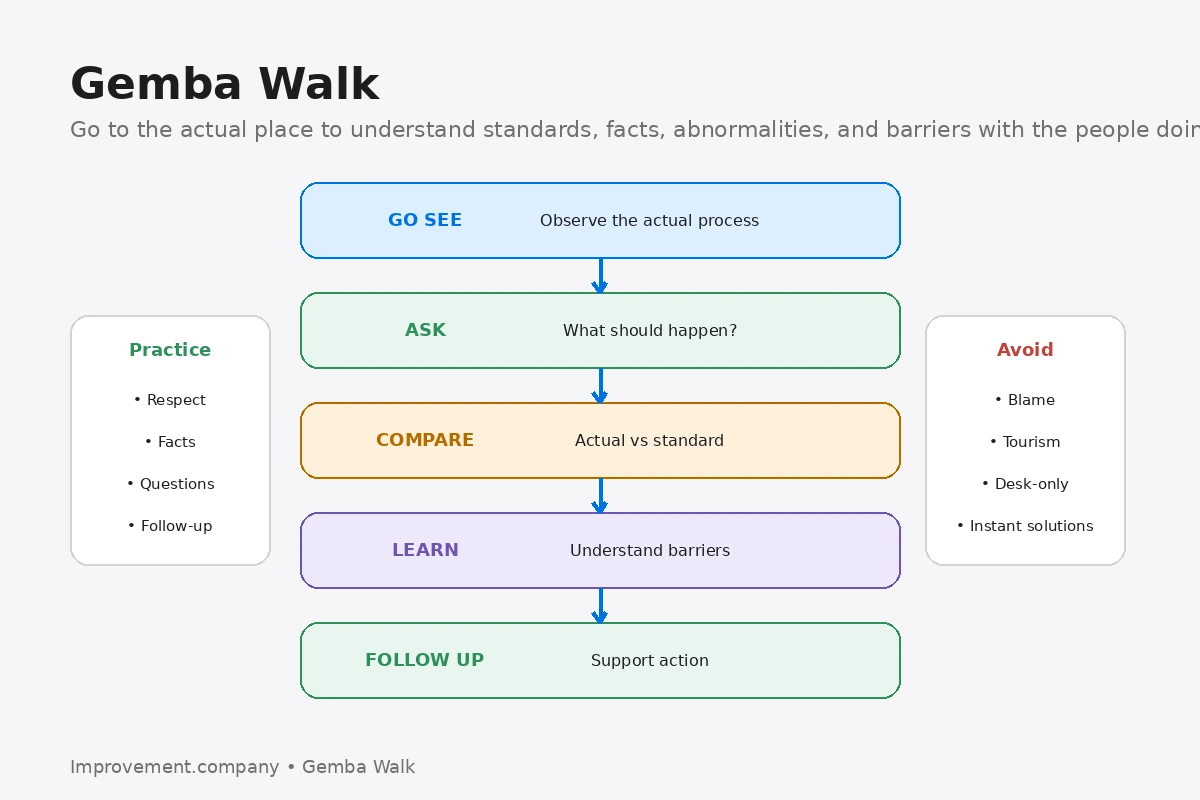
Go and see
A Gemba Walk starts with direct observation.
Follow the process. Watch the work. Look at flow, waiting, movement, quality, safety, information and abnormal conditions.
The objective is not to catch people doing something wrong.
It is to understand how the system actually operates.
Ask questions
Useful Gemba questions include:
- What is the expected condition?
- What is happening now?
- What makes the work difficult?
- Where does the process stop or wait?
- How do you know when something is abnormal?
- What problem are you currently working on?
- What support do you need?
Questions should create learning, not interrogation.
Respect the people doing the work
The people closest to the process often understand details that are invisible in management reports.
A strong Gemba Walk combines observation with respect for their knowledge.
Leaders should avoid immediately prescribing solutions before understanding the problem.
Gemba is not an audit tour
Audits have a purpose, but Gemba should not become a ceremonial checklist.
The value comes from seeing, asking, listening and connecting management decisions to actual operating conditions.
Close the loop
When a Gemba Walk identifies a meaningful issue, ownership and follow-up should be clear.
Repeatedly observing problems without action teaches employees that Gemba is only a management ritual.
Learning must eventually connect to improvement.
Go to see before deciding
A Gemba Walk is most useful when observation comes before explanation.
Leaders should first understand what is actually happening at the process: how work flows, where people wait, what abnormalities are visible, how standards are used and what obstacles employees are working around.
This reduces the risk of forming conclusions from reports alone.
Ask about the process, not the person
Questions should help reveal the system.
Instead of asking who made a mistake, ask what condition made the error possible, what the standard requires, what changed and how the problem is detected.
This keeps the conversation focused on learning and improvement rather than blame.
Respect is part of the method
Gemba should not feel like an inspection tour.
People closest to the work often understand the practical constraints better than anyone else. A useful walk creates space for them to explain problems, risks and ideas.
Leaders should avoid turning every observation into an immediate instruction. Some problems require follow-up, evidence and deeper analysis before action.
Close the loop
If employees repeatedly raise issues during Gemba and never see a response, the routine loses credibility.
Not every problem can be solved immediately, but ownership and next steps should be visible.
Closing the loop shows that observation leads to action and that speaking up about abnormalities is worthwhile.
Connect this concept to the wider system
For deeper application, connect this concept with Daily Management System, Visual Management, and Leader Standard Work. These methods help move from understanding the topic to managing it as part of a wider improvement system.
Related application
This topic also connects with Genchi Genbutsu. Use that method when the improvement requires the related operating or management discipline.
Related application
This topic also connects with Gemba Coaching Questions. Use that method when the improvement requires the related operating or management discipline.