
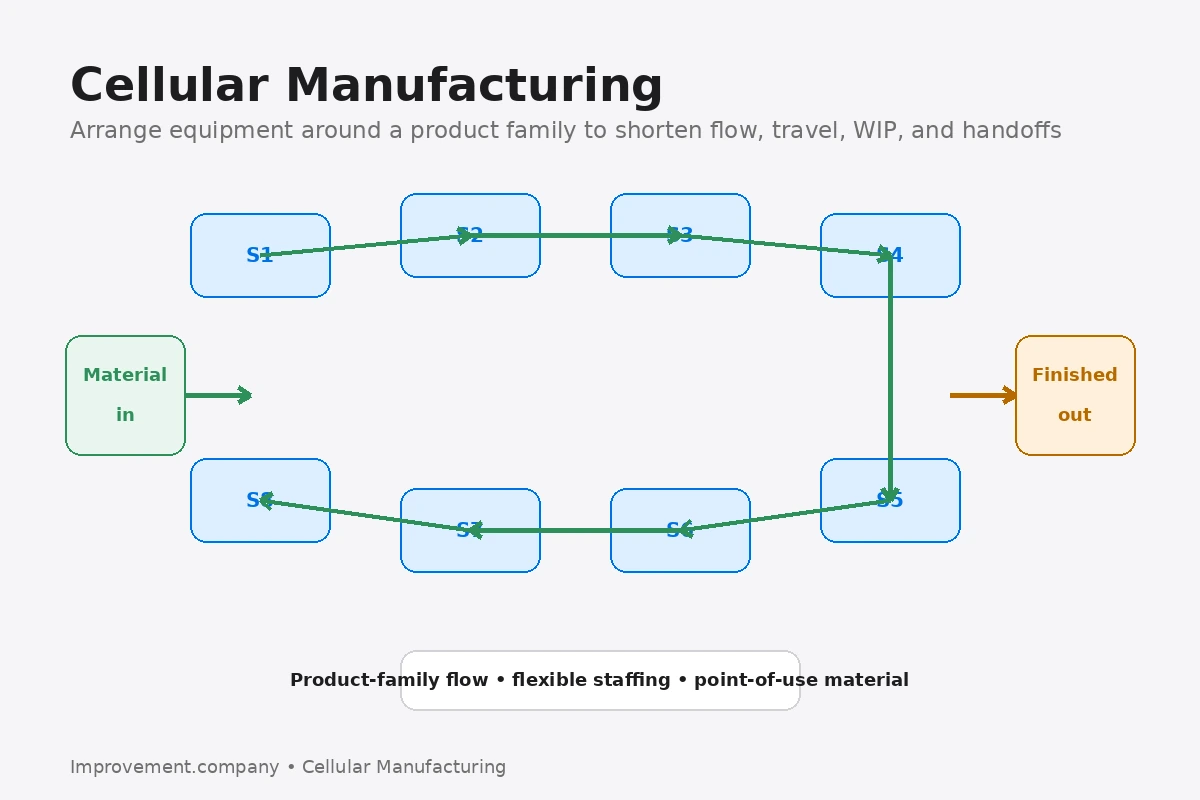
Cellular Manufacturing arranges people, equipment, and workstations around the flow of a product family rather than organizing equipment only by process type.
The objective is to shorten the physical and informational distance required to complete the work.
A good cell can reduce:
- travel;
- WIP;
- waiting;
- handoffs;
- lead time;
- scheduling complexity.
Start with a product family
A cell should serve work with reasonably similar processing requirements.
A product family may share:
- equipment;
- routing;
- work content;
- tooling;
- processing sequence.
Value Stream Mapping can help identify product families and reveal where material currently travels between functional departments.
The family definition should come before the layout.
Design for flow
The layout should support the intended sequence of work.
Common shapes include:
- U-shaped;
- straight line;
- L-shaped;
- parallel workstations.
The best layout depends on:
- process sequence;
- equipment size;
- staffing;
- material handling;
- safety;
- replenishment.
The shape is less important than the flow logic.
Balance work to demand
A cell should be designed around customer demand.
Takt Time provides the required production rhythm.
Work content can then be distributed among operators and stations.
Line Balancing helps compare station workload with takt and identify overload or idle imbalance.
Reduce batch dependence
Cells are often most effective when work moves in small quantities.
One-Piece Flow can reduce waiting and make quality problems visible faster when process conditions allow it.
However, one-piece flow should not be forced where:
- processing physics require batches;
- safety prevents close coupling;
- equipment constraints make direct flow impractical.
The design should fit the actual process.
Plan material presentation
A cell can fail if material delivery remains designed for large functional departments.
Consider:
- point-of-use storage;
- replenishment frequency;
- container size;
- empty-container return;
- finished-goods removal.
PFEP can help define how each part is presented and replenished.
Build flexibility into staffing
A well-designed cell may allow staffing to change with demand.
That requires:
- cross-training;
- clear standard work;
- balanced operator routes;
- safe work combinations.
A flexible cell is not the same as expecting fewer people to absorb unlimited workload.
Design quality into the cell
Shorter flow paths make defects visible faster.
The cell should include:
- clear quality checks;
- reaction methods;
- mistake-proofing;
- stop authority.
Poka-Yoke can prevent or detect recurring errors close to the source.
Avoid moving equipment without changing the system
Relocating machines into a U-shape does not automatically create a cell.
A true cell requires alignment of:
- product family;
- flow;
- staffing;
- material;
- standard work;
- quality;
- maintenance.
Layout is one part of the operating system.
Common mistakes
Grouping unrelated products into one cell, designing layout before understanding demand, moving equipment without changing material replenishment, forcing one-piece flow where process physics do not support it, ignoring maintenance access, and calling any U-shaped layout a cell are common mistakes.
Practical sequence
- define the product family.
- map the current flow.
- calculate takt.
- understand work content.
- select equipment and sequence.
- design the physical layout.
- balance work.
- design material replenishment.
- define standard work and quality controls.
- test and refine the cell at the Gemba.
The practical lesson
Cellular Manufacturing organizes resources around flow rather than departmental boundaries.
Its value comes from reducing distance, waiting, WIP, and handoffs across the complete product family.