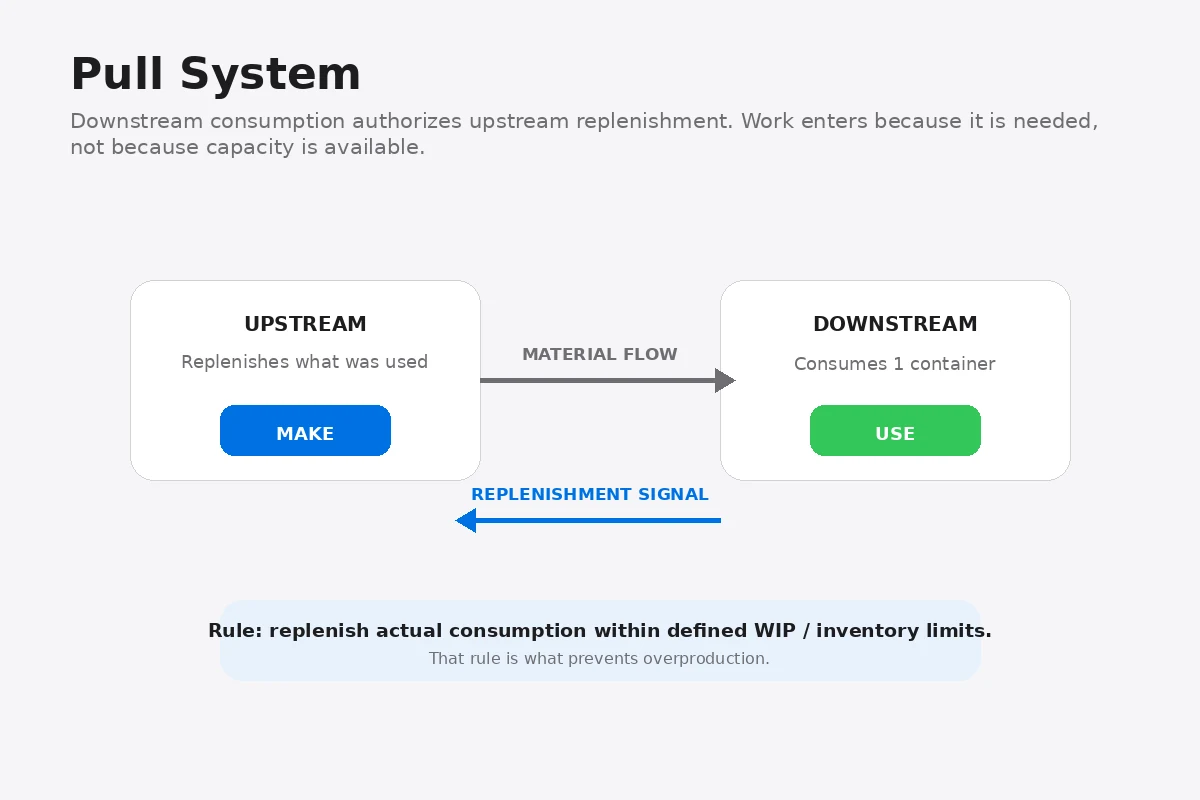
A pull system releases or replenishes work in response to actual downstream consumption.
That sounds simple, but it changes the logic of production. Instead of asking, “What can this process make next?” a pull system asks, “What has the next process actually used, and what now needs to be replenished?”
This distinction matters because overproduction is one of the most damaging forms of waste. Producing too early or in greater quantity than needed creates inventory, hides problems, consumes space, and increases lead time.
Push versus pull
In a push system, work is typically released according to a schedule, forecast, or local production target. Each process may continue producing as long as it has work available.
In a pull system, a downstream process creates a replenishment signal after consuming something. Upstream production responds to that signal within defined limits.
Pull does not eliminate planning. Customer demand still needs to be forecast, capacity still needs to be planned, and materials still need to be procured. Pull changes the execution logic inside the operating system and is a core mechanism of Just-in-Time.
The role of a replenishment signal
A pull system needs a clear signal that defines what should be replenished and how much.
Kanban is one common method. A card, bin, electronic message, empty location, or other visual signal authorizes replenishment.
The signal should answer three questions:
- what item is needed;
- how much is needed;
- where it should go.
Without a clear signal, the system can easily drift back into informal push behavior.
Pull and work-in-process limits
Pull systems usually work with controlled inventory or work-in-process limits. Those limits create discipline.
If a downstream buffer is full, upstream production should not continue making more of the same item merely to stay busy.
This is important because local utilization can conflict with total-system performance. A machine running at 100 percent utilization can make the overall system worse if it creates excess inventory that nobody needs.
When pull works well
Pull is effective when demand is reasonably understandable, replenishment lead times are manageable, product families can be defined, and processes are stable enough to respond predictably.
It is especially useful in repetitive manufacturing, supermarkets, component replenishment, mixed-model production, and material handling systems.
When pure pull may not fit
Not every environment can use a simple replenishment loop.
Very low-volume engineer-to-order work, extremely long external lead times, highly unpredictable demand, batch chemical processes, or one-time project work may require hybrid planning methods.
The principle still applies: release work intentionally, limit work-in-process, and avoid producing simply because a resource is available.
Example
Suppose an assembly cell uses a specific bracket. The cell has two bins of 20 brackets. Operators consume from one bin. When the bin becomes empty, the empty bin acts as the replenishment signal.
Material handling removes the empty bin and replaces it with a full one. The empty bin then authorizes the upstream process to produce or deliver another 20 brackets.
The upstream process does not make brackets because its schedule says “keep running.” It replenishes what was actually consumed.
Common mistakes
One mistake is calling any Kanban board a pull system. A board may visualize work, but true pull requires a controlled release mechanism tied to downstream need.
Another mistake is setting inventory quantities once and never reviewing them. Replenishment quantity should reflect demand, lead time, variability, and service risk.
A third mistake is ignoring process instability. If replenishment frequently fails because of breakdowns, quality issues, or poor changeover capability, teams may increase inventory until the original pull logic becomes meaningless.
Pull is a control mechanism
The deeper value of pull is not the card, bin, or signal.
Pull creates a rule for when work may enter the system. That rule limits overproduction and makes shortages, delays, and instability easier to see.
A well-designed pull system therefore supports both flow and problem visibility. It keeps production connected to real need while giving teams a clearer picture of what prevents reliable replenishment.
Additional connections
This topic also connects with Supermarket Pull System and Little’s Law. These relationships are useful when the team needs to extend the method into a wider improvement system.
Related application
This topic also connects with FIFO Lane. Use that method when the improvement requires the related management or operating discipline.
Related application
This topic also connects with CONWIP. Use that method when the improvement requires the related operating or management discipline.