SMED stands for Single-Minute Exchange of Die. It is a structured method for reducing setup and changeover time so that equipment can switch from one product or condition to another more quickly and reliably.
The phrase “single-minute” refers to achieving changeovers in a single-digit number of minutes where technically feasible. The broader method is valuable even when the final setup remains longer.
Why setup reduction matters
Long changeovers encourage large production batches.
Large batches can increase inventory, lead time and the time required to respond to changing demand.
Reducing setup time makes smaller batches more practical and can improve equipment availability.
It also reduces the operational pressure that often causes teams to postpone necessary product changes.
Internal and external work
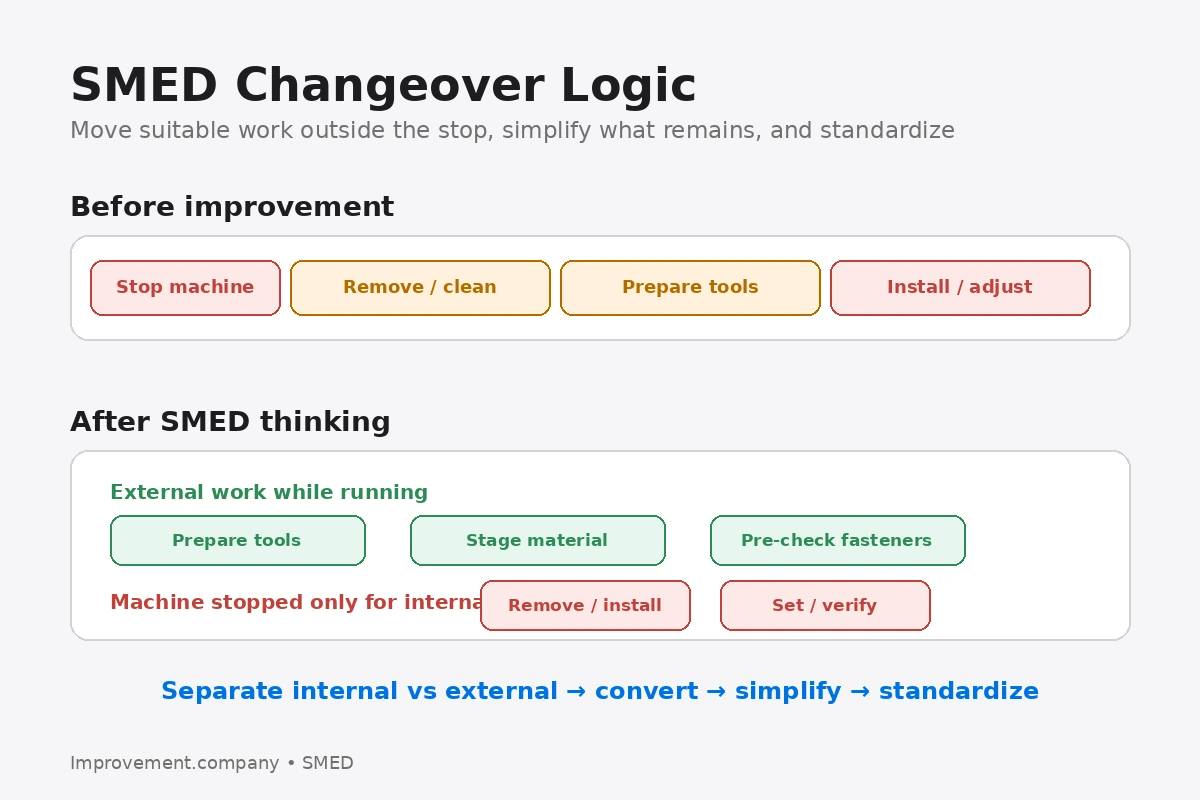
The core SMED distinction is between internal setup work and external setup work.
Internal work can only be performed while the equipment is stopped.
External work can be completed while the equipment is still running.
A strong improvement effort first identifies every setup element and asks whether work currently performed during downtime can be prepared externally.
Tools, materials, settings and fixtures may be staged before the machine stops.
Convert internal work where possible
After separating the elements, the team looks for ways to convert internal work into external work.
Examples may include presetting tools, preparing components, preheating dies, storing parameters or using duplicate fixtures.
The specific solution depends on the process.
The objective is to remove work from the critical downtime window.
Simplify the remaining internal work
The remaining internal elements can then be improved.
Teams may reduce fastening, eliminate unnecessary adjustment, use quick-release mechanisms, standardize connection points or improve access.
Parallel work can also help where it is safe and practical.
The process should be observed carefully because many setup delays come from searching, walking and correcting conditions that should have been prepared earlier.
Quality and safety still govern the changeover
A faster setup is not better if it creates unsafe work, damages equipment or increases startup defects.
Critical checks should remain part of the standard.
The improvement target is a faster and more reliable changeover, not simply a shorter stopwatch time.
Standardize the improved method
Once a better setup sequence is proven, it should become Standard Work.
The team should document roles, sequence, preparation and required checks.
Repeated measurement can then identify the next losses.
SMED is powerful because it changes the economics of production. When changeovers become easier, the process gains flexibility and can move closer to producing what is needed when it is needed.
Connect this concept to the wider system
For deeper application, connect this concept with What Is Lean, 8 Wastes of Lean, and Value Stream Mapping. These methods help move from understanding the topic to managing it as part of a wider improvement system.
Related application
This topic also connects with Changeover Readiness. Use that method when the improvement requires the related operating or management discipline.