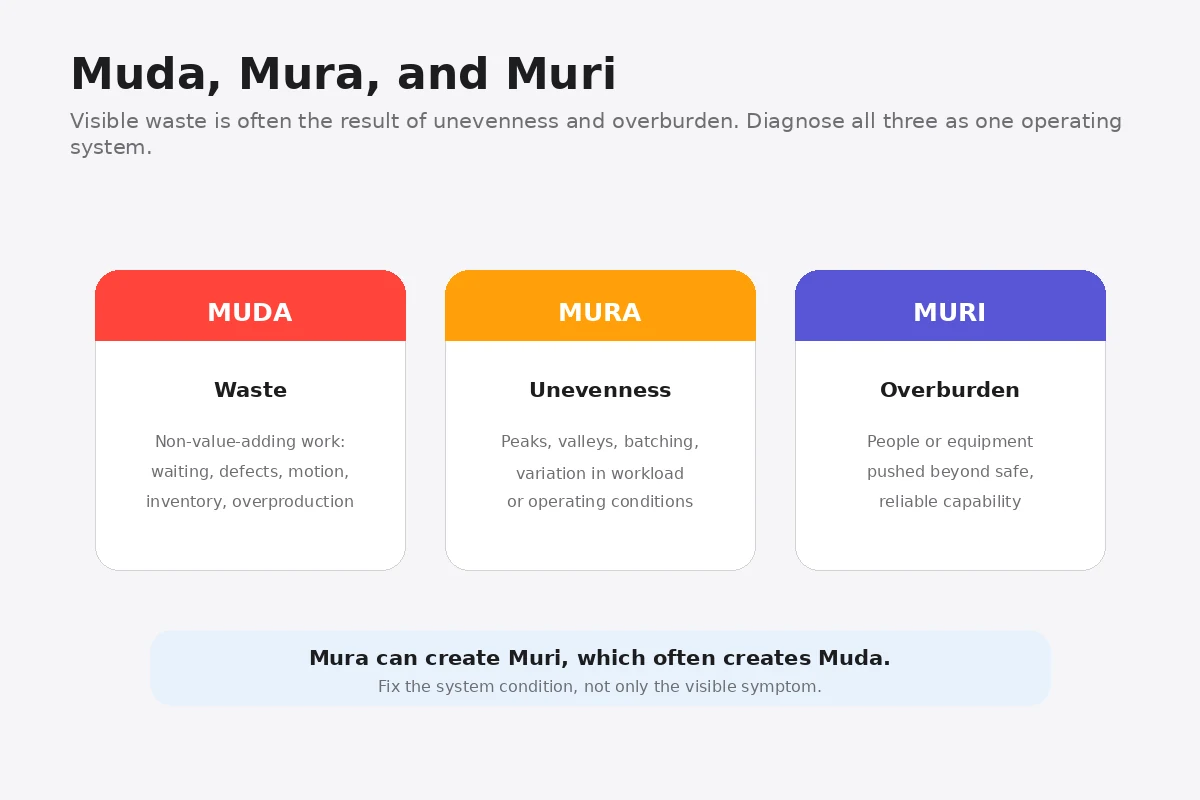
Lean discussions often focus on Muda, the Japanese term commonly translated as waste. But waste is only one part of the operating problem.
Mura refers to unevenness or inconsistency. Muri refers to overburden or unreasonable strain.
These three conditions reinforce one another. A process with uneven demand can create periods of overburden, which then create defects, breakdowns, waiting, and other forms of waste.
Muda: activity that consumes resources without creating value
Muda includes work the customer does not need and activities that do not help transform the product or service in a required way.
The familiar eight wastes of Lean are common examples:
- overproduction;
- waiting;
- transportation;
- overprocessing;
- inventory;
- motion;
- defects;
- unused human potential.
Reducing Muda is important, but attacking visible waste without understanding Mura and Muri can produce short-lived improvements.
Mura: unevenness
Mura occurs when workload, demand, staffing, production pace, or material flow varies unnecessarily.
Examples include a department that is overloaded at the end of each month but underutilized earlier, a line that produces large batches of one model and then rushes another, or a maintenance team that receives most preventive work orders on the same day.
Unevenness creates instability. People and equipment alternate between waiting and rushing.
Muri: overburden
Muri is excessive strain placed on people, equipment, or systems.
Examples include requiring an operator to lift beyond a safe limit, running equipment beyond its intended capability, demanding output above demonstrated capacity, or assigning more work than can be completed within available time.
Overburden increases the probability of errors, injuries, breakdowns, and shortcuts.
How the three interact
Consider a production line with highly uneven scheduling.
At the beginning of the week, demand is low and operators wait. Near the end of the week, the schedule spikes and the team must rush.
The uneven schedule is Mura.
The rushing, overtime, and overloaded equipment are Muri.
The defects, rework, waiting, and extra movement that result are Muda.
If management attacks only the visible waste, the root operating pattern remains.
Why this matters for Lean improvement
A team may conduct a waste walk and identify motion, waiting, and inventory. Those observations are useful, but the stronger question is: what system conditions are creating these wastes?
Sometimes the best improvement is not to remove one visible motion. It may be to level demand, improve scheduling, reduce batch size, balance workload, or redesign capacity.
Those changes address Mura and Muri, which can remove multiple forms of Muda at once.
A practical diagnostic approach
When observing a process, ask three sets of questions.
For Muda:
What work consumes time, space, material, energy, or attention without creating required value?
For Mura:
Where does workload or flow vary more than necessary? What creates peaks, valleys, queues, or sudden changes?
For Muri:
Where are people or equipment being asked to operate beyond a safe, reliable, or sustainable level?
Looking at all three gives a more complete picture of process performance.
Common mistakes
One mistake is treating Muda, Mura, and Muri as three independent checklists. In reality, they often form a causal chain.
Another is removing capacity or inventory immediately after finding waste without understanding the variation those buffers were absorbing.
A third mistake is considering overburden only as a human issue. Equipment, information systems, suppliers, and management processes can also be overloaded.
The broader Lean objective
Lean is not simply about doing more with less.
A better objective is to create stable flow with less waste, less unevenness, and less overburden.
When work is leveled, capacity is realistic, problems are visible, and processes are reliable, many forms of waste decline naturally.
Muda, Mura, and Muri therefore provide a useful reminder: visible waste is often the symptom of a deeper operating-system problem.