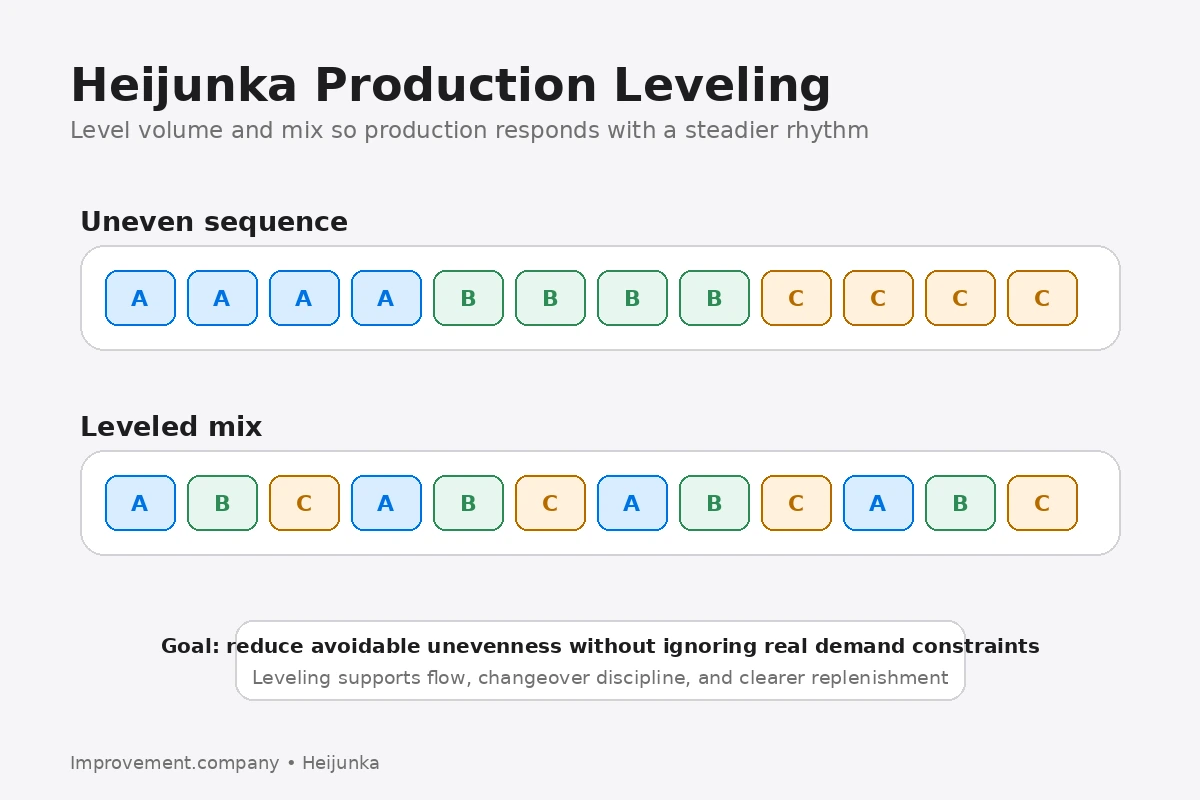
Heijunka is the Lean practice of leveling production to reduce unevenness in volume and product mix.
Instead of producing large batches in a sequence that follows short-term demand spikes directly, a leveled system creates a more regular production pattern over a defined period.
The purpose is to reduce instability across the value stream.
Why unevenness creates problems
Large swings in production demand can create overtime, idle time, material shortages, excessive inventory and unstable staffing.
Upstream suppliers and processes may react with their own batching and expediting.
This creates Mura, or unevenness, and can also create Muri, or overburden.
Heijunka aims to smooth the operating pattern so that flow becomes easier to manage.
Level volume
Volume leveling spreads required production more evenly across available time.
If demand for a product is 500 units over five days, producing roughly 100 per day may create a more stable system than producing all 500 on one day.
Real situations may require safety stock or other protection, but the principle is to avoid unnecessary peaks and valleys.
Level mix
Mix leveling alternates different products in smaller quantities rather than producing very large product-specific batches.
A repeating sequence can make output more responsive to customer demand.
This requires shorter changeovers and stable processes.
Without those conditions, frequent switching can create excessive downtime.
Heijunka depends on SMED and stability
Long setup times are one of the major barriers to leveling.
SMED can reduce that barrier by making smaller batches economically practical.
Reliable equipment, stable quality, predictable work content and disciplined material replenishment are also important.
Heijunka should not be forced onto an unstable process without addressing these conditions.
Use a pitch or repeating pattern
A leveled system often defines a repeating production interval or pitch.
This creates a predictable rhythm for production and material handling.
Heijunka boxes or electronic scheduling tools can make the sequence visible.
The specific mechanism matters less than the discipline of releasing work according to the leveled pattern.
Leveling is not ignoring the customer
Heijunka does not mean refusing to respond to real changes in demand.
It means separating genuine demand change from unnecessary production volatility.
The organization still needs rules for abnormal demand, urgent orders and significant mix changes.
Common mistakes
One mistake is designing a perfect leveling pattern on paper without confirming changeover capability.
Another is leveling only the final process while upstream processes continue producing in large batches.
A third is treating the schedule as rigid even when the underlying demand has materially changed.
Heijunka works best as part of a broader Lean system that includes pull, small batches, reliable processes and disciplined response to customer demand.
Connect this concept to the wider system
For deeper application, connect this concept with What Is Lean, 8 Wastes of Lean, and Value Stream Mapping. These methods help move from understanding the topic to managing it as part of a wider improvement system.
Related application
This topic also connects with EPEI. Use that method when the improvement requires the related operating or management discipline.
Related application
This topic also connects with Model Mix Sequencing. Use that method when the improvement requires the related operating or management discipline.