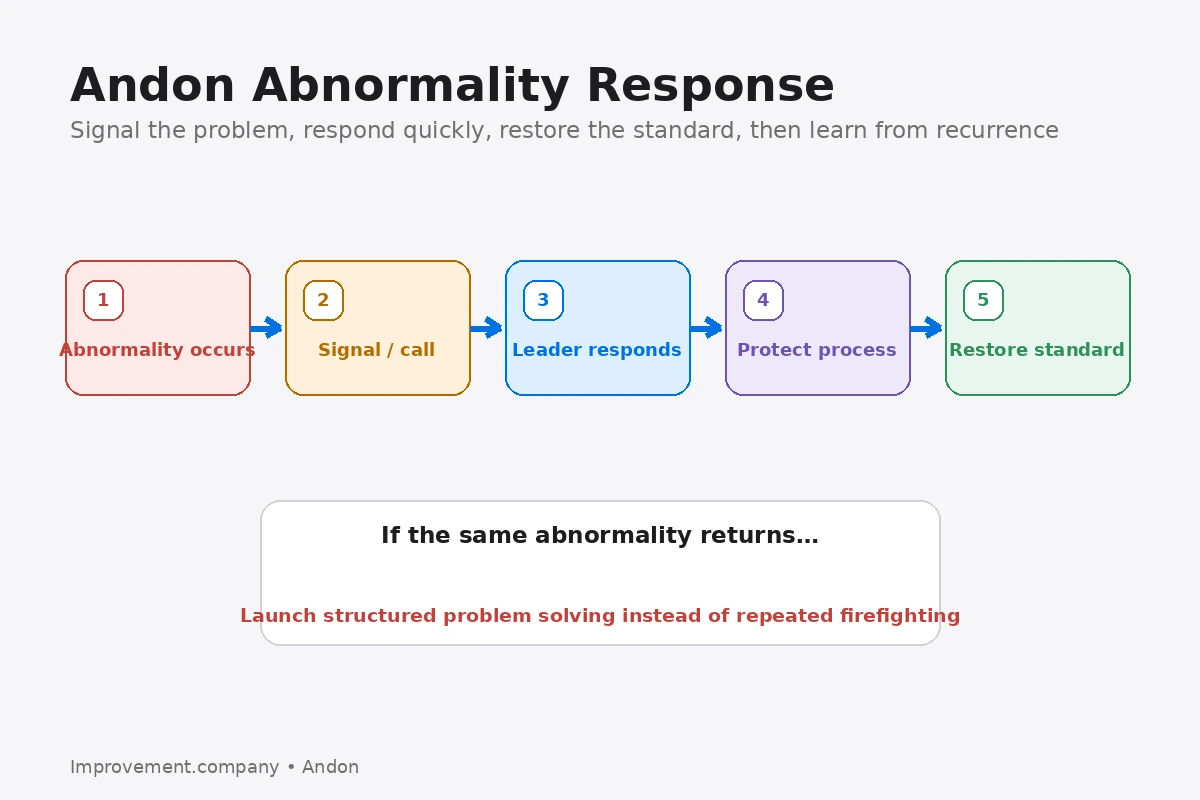
Andon is a visual or audible signaling system used to make an abnormal condition visible and trigger support.
The signal may come from a light, display, sound, button, pull cord or digital system. The technology can vary widely.
The important principle is that people should be able to identify a problem quickly and know what response is expected.
Andon supports abnormality management
A process needs an expected condition before an abnormality can be recognized.
An Andon signal may indicate a quality issue, equipment problem, missing material, safety concern or other condition that prevents normal work.
The signal should make the gap visible at the place and time where support can still protect the process.
The signal needs a response
An Andon system has little value if employees activate it and nobody comes.
The organization needs a defined response time, ownership and escalation path.
Frontline leaders, maintenance, quality or other support functions may respond depending on the signal type.
The reaction should be practiced enough that people trust the system.
Stop versus call for help
Not every Andon activation must stop production immediately.
Some systems provide an early warning that allows a leader to respond before the end of the work cycle. Other conditions require an immediate stop because safety or quality is at risk.
The rule should be explicit.
Employees should not have to guess whether they are allowed to stop the process.
Andon and Jidoka
Andon is closely associated with Jidoka, the Lean principle of building quality into the process and stopping when an abnormal condition occurs.
The objective is to prevent defects or problems from continuing downstream.
Stopping can appear inefficient in the short term, but repeatedly producing through abnormalities usually creates larger losses.
Avoid using Andon as surveillance
If Andon data is used primarily to blame individuals, people may avoid signaling problems.
That destroys the purpose of the system.
The data should help identify recurring process conditions and support improvement.
Repeated signals at the same station may indicate a training need, poor material supply, weak Standard Work, equipment instability or another system problem.
Use the history for improvement
Andon records can provide valuable problem data.
Frequency, location, duration and reason codes can reveal where support is repeatedly needed.
Pareto analysis and root cause methods can then target the chronic conditions.
Common mistakes
One mistake is installing lights without defining response roles.
Another is creating too many signal categories.
A third is measuring success only by reducing the number of Andon calls. Fewer calls may mean improvement, or it may mean people have stopped using the system.
A strong Andon system makes abnormalities safe to expose, brings support quickly and turns repeated signals into structured improvement.
Connect this concept to the wider system
For deeper application, connect this concept with Daily Management System, Visual Management, and Leader Standard Work. These methods help move from understanding the topic to managing it as part of a wider improvement system.