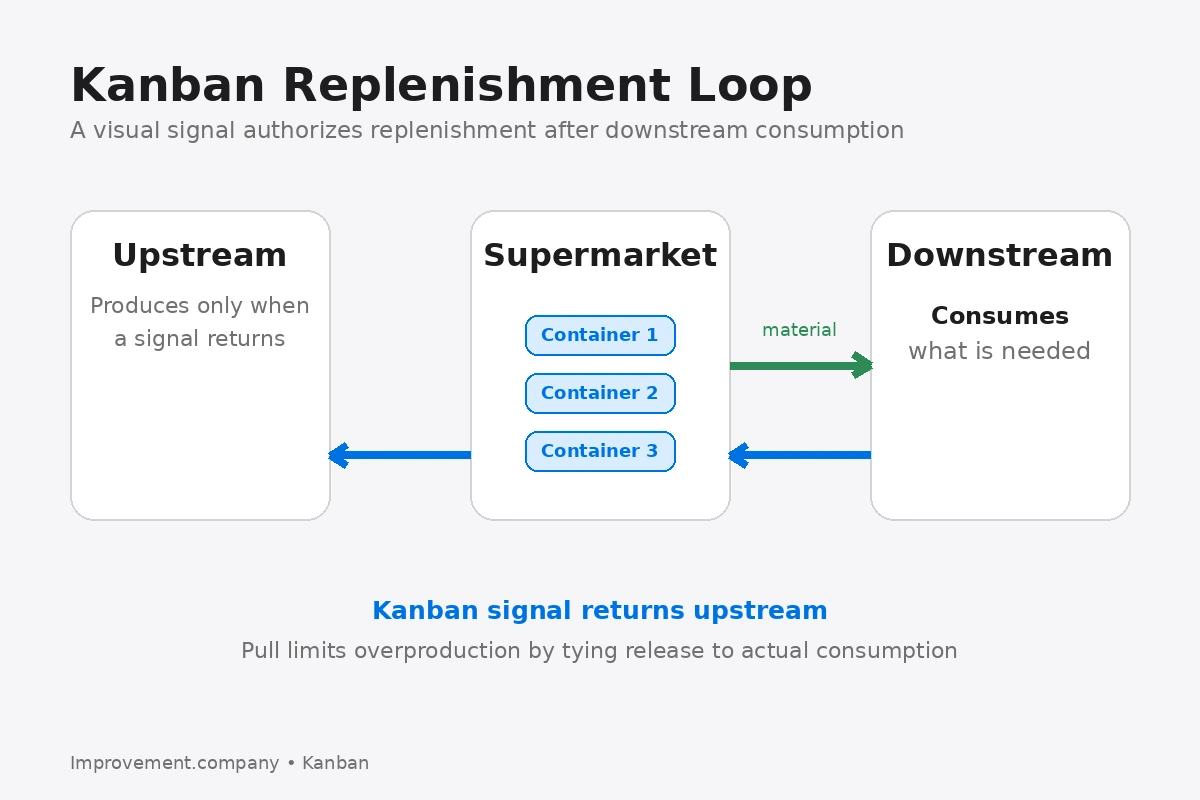
Kanban is a signaling method used to control production or replenishment based on actual consumption. In a pull system, downstream use creates the signal for upstream replenishment.
The signal may be a physical card, an empty container, a marked location or an electronic message. The format matters less than the rule: production should respond to authorized demand rather than uncontrolled forecast-driven output.
How Kanban creates pull
Imagine a downstream process that consumes a container of parts.
When that container reaches the defined replenishment point, a Kanban signal authorizes the upstream process or supplier to replace the consumed quantity.
The number of signals in circulation limits the amount of authorized inventory.
This is what makes Kanban a control system rather than simply a visual label.
Kanban needs defined rules
A stable Kanban system should make the replenishment quantity, source, destination and authorization logic clear.
Teams also need a rule for handling abnormalities.
If demand suddenly changes, a container is lost or replenishment is late, employees should know what action to take.
Without clear rules, Kanban can degrade into informal expediting.
Container quantity matters
Large containers can create excess inventory and slow feedback.
Very small containers may create excessive handling or replenishment frequency.
The appropriate quantity depends on consumption, replenishment time, variability, logistics and practical handling constraints.
Reducing container size may require improvements in changeover time, material movement or supplier response.
Kanban does not fix an unstable process
A pull signal cannot compensate for unreliable equipment, poor quality or unpredictable replenishment forever.
Those conditions may require additional protection at first, but they should also become improvement priorities.
Kanban tends to make instability more visible because excess inventory is no longer masking every problem.
Do not confuse Kanban with a task board
The word Kanban is also widely used for visual workflow boards in knowledge work.
Those boards can be useful for managing work in process, but they are not identical to a production replenishment Kanban.
The shared idea is visual control of work and limits, but the operating rules and purpose differ.
When to use Kanban
Kanban is particularly useful for repetitive items with reasonably predictable consumption and replenishment.
It can support supermarkets, internal logistics, component supply and production authorization.
It may be less suitable for highly unique work with no repeatable replenishment pattern.
A well-designed Kanban system connects consumption to replenishment, limits work in process and makes shortages or instability visible sooner.
Connect this concept to the wider system
For deeper application, connect this concept with What Is Lean, 8 Wastes of Lean, and Value Stream Mapping. These methods help move from understanding the topic to managing it as part of a wider improvement system.
Related application
This topic also connects with Kanban Sizing. Use that method when the improvement requires the related operating or management discipline.