
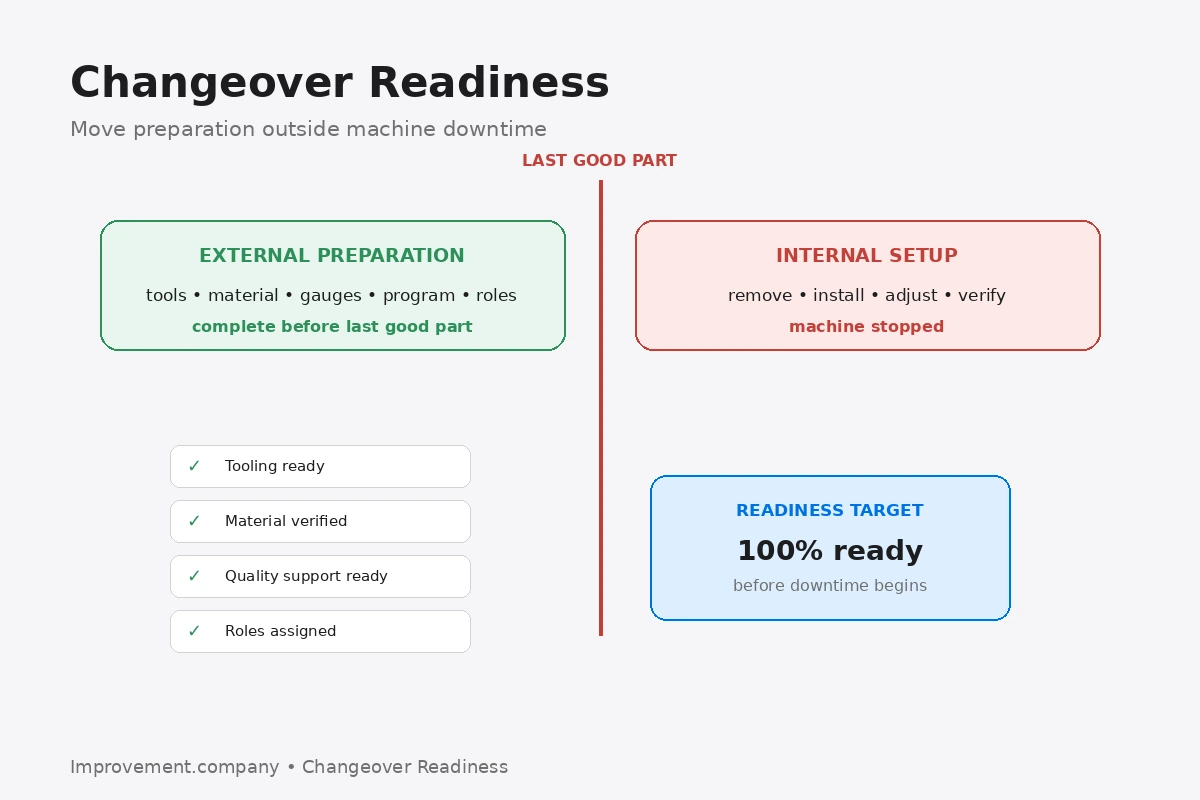
Changeover Readiness is the preparation required before a machine or process stops for a product change.
The objective is simple:
When the last good part is produced, everything needed for the changeover should already be ready.
This reduces internal setup time and prevents avoidable waiting during downtime.
Separate preparation from machine-stop work
SMED distinguishes:
- internal setup work that requires the equipment to be stopped;
- external setup work that can be completed while the equipment is running.
Changeover readiness focuses heavily on converting preparation into external work.
Define the readiness checklist
Typical readiness items include:
- tooling;
- fixtures;
- materials;
- gauges;
- documents;
- program;
- first-piece requirements.
The list should reflect the actual changeover, not a generic checklist copied across unrelated equipment.
Prepare tools at the point of use
Searching for:
- wrench;
- fastener;
- fixture;
- lifting device;
during the changeover extends downtime without adding value.
Kitting and staging should occur before the last good part whenever practical.
Confirm material and specification
The next product should be ready with:
- correct material;
- correct revision;
- correct label;
- correct tooling.
A fast mechanical setup still fails if production then waits for material or engineering clarification.
Clarify first-piece approval
If the next run requires:
- first-piece inspection;
- quality approval;
- process parameter confirmation;
the responsible people and gauges should be ready.
First Article Inspection provides relevant principles when the first produced item must be verified before normal production continues.
Assign ownership before the stop
The team should know:
- who performs each step;
- who brings materials;
- who confirms quality;
- who records completion.
Standard Work can define the best-known sequence and role split for repeatable changeovers.
Measure readiness separately
Changeover time alone does not reveal why a setup started late.
A simple readiness measure may ask:
Were all required external-preparation items complete before the last good part?
This makes preparation quality visible.
Learn from every delay
After the changeover, record delays caused by:
- missing tool;
- missing material;
- unclear instruction;
- approval wait;
- equipment condition.
The next readiness standard should remove recurring causes.
Common mistakes
Calling all setup activity internal work, starting preparation after the machine stops, using generic checklists, staging the wrong material, failing to arrange first-piece support, assigning no roles, and measuring only total changeover time without measuring preparation quality are common mistakes.
Practical sequence
- review the next scheduled product.
- identify external preparation.
- stage tooling and fixtures.
- confirm material and specification.
- confirm gauges and approval support.
- assign roles.
- verify readiness before the last good part.
- execute the internal setup.
- record readiness-related delays.
- improve the preparation standard.
The practical lesson
Changeover Readiness removes waiting before the clock starts.
The fastest changeover is easier to achieve when the team arrives at the last good part already prepared.