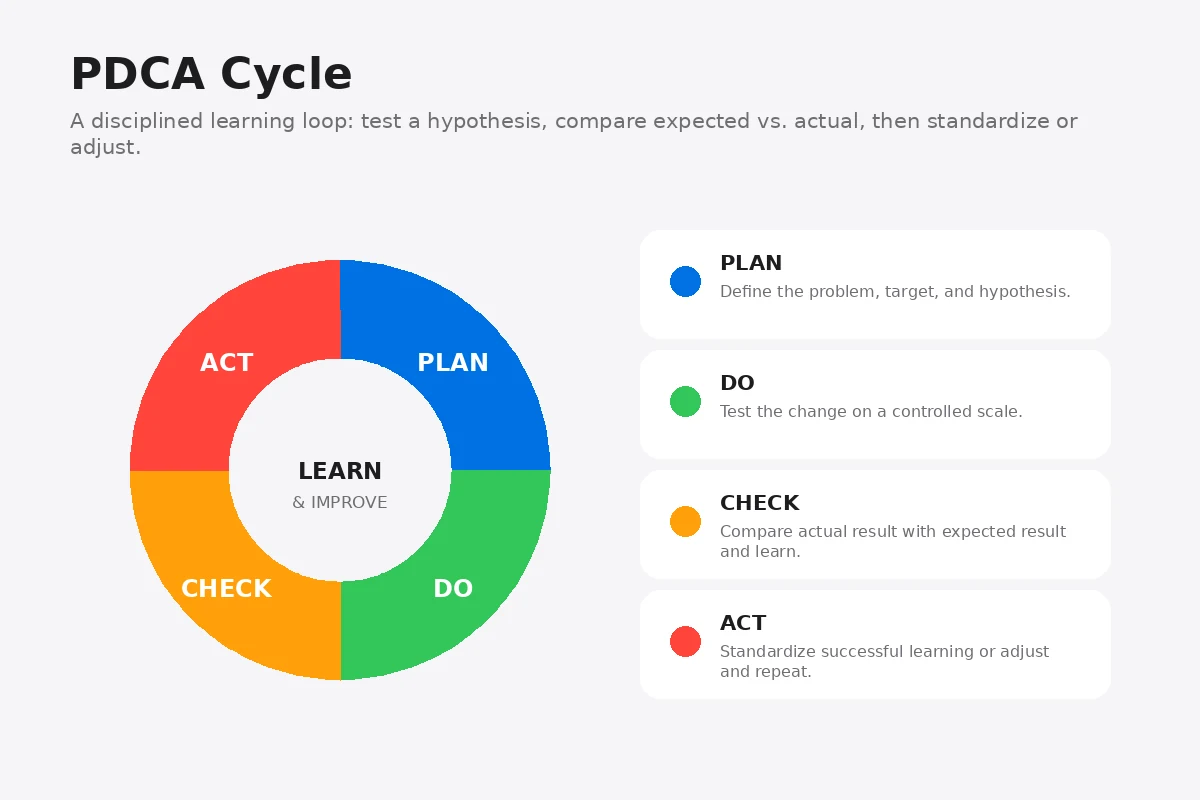
PDCA stands for Plan, Do, Check and Act.
It is a structured cycle for learning from changes rather than assuming that a proposed solution will work.
PDCA is central to Continuous Improvement because it treats improvement as an experiment.
Plan
Clarify the problem and current condition.
Define what you expect to happen, identify the change you want to test and determine how success will be measured.
A strong Plan step prevents teams from jumping directly from problem recognition to solution implementation.
Do
Run the test.
Where possible, begin on a controlled scale so that the organization can learn without creating unnecessary risk.
Record what actually happens, including unexpected effects.
Check
Compare the result with the prediction.
Did performance improve? Did something else get worse? Was the original understanding of the problem correct?
The Check step is about evidence.
Act
If the change works, standardize and sustain it.
If it does not work as expected, use the learning to adjust the next cycle.
Act does not mean every experiment becomes the new standard.
PDCA is a learning system
The power of PDCA comes from repetition.
Each cycle improves understanding of the process.
A failed test can still create useful learning when the team compares what happened with what it expected to happen.
Make the prediction explicit
PDCA becomes stronger when the Plan step includes a prediction. Before running the test, state what result is expected and why.
The comparison between prediction and actual result creates learning. If the result differs, the team has evidence that its understanding was incomplete. If the result matches, the team gains confidence in the cause-and-effect relationship it was testing. Without a prediction, teams can too easily interpret almost any outcome as success.
PDCA and problem solving
PDCA is often shown as four equal boxes, but real problem solving does not always spend equal time in each phase.
Complex problems may require significant effort in Plan because the current condition and causes are not yet understood. A simple local test may move through the cycle quickly.
The cycle should therefore be driven by learning needs rather than by a fixed schedule.
Check is more than checking completion
One common mistake is treating Check as confirmation that the action was completed.
The stronger question is whether the action produced the predicted effect.
A team may complete every planned task and still fail to improve the process. PDCA requires comparing the actual result with the expected result and understanding the difference.
That distinction separates activity management from experimental learning.
Standardize successful learning
When a change works, the learning should become part of the operating system.
That may require updating Standard Work, training, visual controls, maintenance routines, process parameters or management checks.
Without this step, the improvement depends on memory and can disappear when people, shifts or priorities change.
Use smaller cycles when uncertainty is high
Large changes create more variables and make cause-and-effect relationships harder to understand.
When practical, smaller experiments allow teams to learn faster and with less risk.
A small test does not mean the ambition is small. It means the organization is reducing uncertainty before wider implementation.
PDCA creates organizational memory
Repeated cycles create knowledge about how the process behaves.
Documenting the problem, prediction, test and result helps prevent teams from repeatedly rediscovering the same lessons.
Over time, this learning can improve standards, training and future problem solving.
PDCA therefore supports both process improvement and capability development.
Connect this concept to the wider system
For deeper application, connect this concept with Kaizen and Process Mapping. These methods help move from understanding the topic to managing it as part of a wider improvement system.
Related application
This topic also connects with SDCA. Use that method when the improvement requires the related operating or management discipline.
Related application
This topic also connects with Small Tests of Change. Use that method when the improvement requires the related operating or management discipline.