
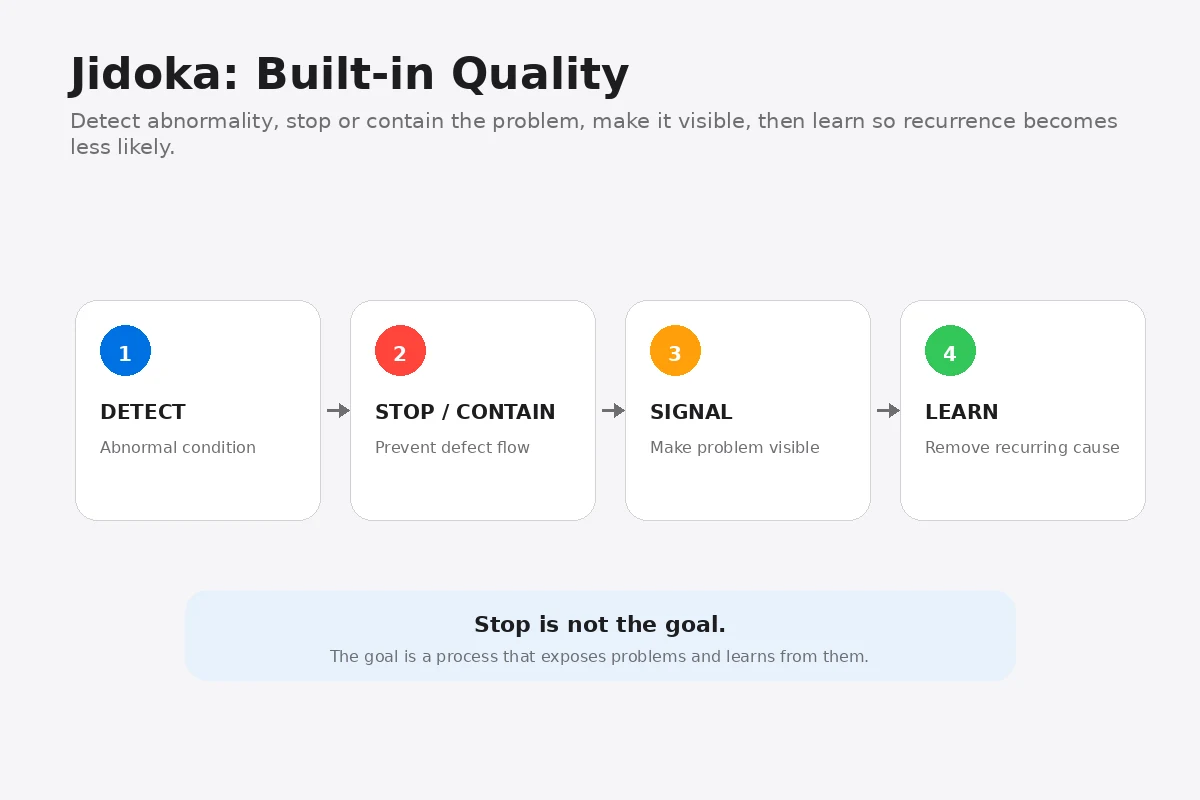
Jidoka is often translated as “automation with a human touch,” but the practical idea is broader: when an abnormal condition appears, the process should detect it, stop or contain it, make the problem visible, and prevent the defect from moving downstream.
That makes Jidoka a quality-at-the-source principle. Instead of relying on final inspection to catch problems after value has already been lost, Jidoka pushes detection and response closer to the point where the abnormality begins.
What Jidoka is trying to achieve
A stable process should distinguish normal from abnormal conditions quickly. Jidoka creates a deliberate response when that boundary is crossed.
The basic logic is:
- detect the abnormal condition;
- stop the process or contain the affected work;
- signal that help is needed;
- correct the immediate condition;
- investigate why it happened;
- improve the process so the same condition is less likely to recur.
The stop is not the goal. The learning is the goal.
Why stopping can improve productivity
Stopping a process can appear inefficient because production pauses. But allowing a defect to continue can be far more expensive. One bad condition can create rework, scrap, sorting, customer complaints, schedule disruption, or damage to downstream equipment.
Jidoka trades a controlled interruption now for a lower probability of uncontrolled loss later.
The strongest implementations also reduce the need for people to watch machines continuously. If equipment can detect abnormal conditions and stop safely, operators can support more than one process instead of acting as permanent inspectors.
Four practical elements of Jidoka
A useful Jidoka system normally includes four elements.
1. Detect
The process needs a clear method to identify abnormality. Detection can come from a sensor, limit switch, torque monitor, vision system, error-proofing device, operator check, or standardized work condition.
2. Stop or contain
Once the abnormality is detected, the process should prevent additional suspect output. Depending on risk, this might mean stopping one station, blocking transfer, holding material, or stopping the entire line.
3. Make the problem visible
The abnormality must be easy to see and respond to. Andon lights, alarms, digital alerts, escalation boards, or visual status indicators can make the condition visible.
4. Learn and prevent recurrence
If the same abnormality happens repeatedly, simply restarting the process is not enough. The organization should investigate the cause, implement a countermeasure, and update the standard when appropriate.
Jidoka and Andon are related, but not identical
Andon is a visual or audible signaling system that communicates process status and abnormal conditions. Jidoka is the broader principle of detecting abnormality and preventing defective work from continuing.
An Andon signal can support Jidoka, but a flashing light by itself does not create Jidoka. The response system matters: who reacts, how quickly, what authority exists to stop, and whether recurring problems are actually solved.
When Jidoka is especially useful
Jidoka is valuable when defects can multiply quickly, when automated equipment can continue producing bad output without obvious warning, when downstream detection is expensive, or when safety and quality depend on immediate containment.
It is also useful when teams are trying to move from inspection-based quality toward built-in quality.
Common mistakes
One mistake is treating every stop as operator error. That discourages people from exposing problems and drives abnormalities underground.
Another is resetting equipment repeatedly without investigating recurring causes. That turns Jidoka into a restart routine instead of an improvement mechanism.
A third is stopping without a defined escalation path. If nobody responds, the signal becomes noise.
Finally, organizations sometimes measure only uptime and pressure teams to avoid stops. That can unintentionally reward defect flow. Reliability and quality should be improved by eliminating causes, not by hiding interruptions.
A simple example
Suppose a fastening station monitors torque. The expected torque window is defined in the standard. If a fastener falls outside that window, the station stops and prevents the part from moving forward.
The operator confirms the condition, calls support if required, and contains affected parts. If the problem repeats, the team investigates causes such as tool wear, incorrect setup, component variation, or workholding.
That is Jidoka in practice: abnormality becomes visible, defects are contained, and the process creates a trigger for learning.
The management principle behind Jidoka
Jidoka depends on a culture that treats exposed problems as useful information. A process that stops for abnormalities may initially appear worse because more problems become visible.
That visibility is valuable.
The long-term objective is not a process that never stops because people ignore problems. It is a process that stops when necessary, learns quickly, removes recurring causes, and becomes progressively more stable.
Related application
This topic also connects with Quality at the Source. Use that method when the improvement requires the related management or operating discipline.