Knowledge hub

Continuous Improvement

Kaizen, PDCA, improvement culture, organizational learning and the management systems that make improvement part of everyday work.

KaizenPDCACI cultureLearning systems

Guides in this hub.

Start with the fundamentals, then follow the related methods as the knowledge base grows.

Continuous Improvement

After Action Review: Turn Experience into Better Next Steps

Learn how an After Action Review compares expected and actual results, identifies lessons, and converts experience into practical changes for future work.

After Action ReviewContinuous ImprovementLearningReflection
Read guide →
Continuous Improvement

Benefits Realization: Verify That Improvement Creates Value

Learn how Benefits Realization connects improvement actions with measurable operational, financial, customer, and risk outcomes after implementation.

Benefits RealizationContinuous ImprovementImprovement PortfolioPerformance
Read guide →
Continuous Improvement

Continuous Improvement Culture: Build Daily Learning

Learn the leadership behaviors, routines, and management systems that help people surface problems, test improvements, and sustain daily learning.

Continuous Improvement CultureLeadershipRespect for PeopleProblem Solving
Read guide →
Continuous Improvement

Countermeasure Management: Turn Problems into Owned Actions

Learn how Countermeasure Management connects verified problems to specific actions, owners, due dates, follow-up, and evidence of effectiveness.

CountermeasuresAction ManagementContinuous ImprovementProblem Solving
Read guide →
Continuous Improvement

Employee Suggestion Systems: Turn Frontline Ideas into Improvement

Learn how an employee suggestion system can capture, evaluate, test, and recognize practical improvement ideas without creating a slow approval bureaucracy.

Suggestion SystemEmployee IdeasContinuous ImprovementKaizen
Read guide →
Continuous Improvement

Hansei: Reflection as a Continuous Improvement Habit

Learn how Hansei uses disciplined reflection to identify gaps, learn from results, and improve future work even when performance was successful.

HanseiReflectionContinuous ImprovementLearning
Read guide →
Continuous Improvement

Improvement Backlog: Control the Queue Before Starting More Work

Learn how an Improvement Backlog makes accepted opportunities visible, limits active work, clarifies ownership, and prevents useful ideas from becoming unmanaged work in progress.

Improvement BacklogContinuous ImprovementPrioritizationWork in Progress
Read guide →
Continuous Improvement

Improvement Benefit Owner: Assign Accountability for Realized Value

Learn how an Improvement Benefit Owner stays accountable for validating, realizing, and sustaining the operational or financial benefit expected from an improvement.

Improvement Benefit OwnerContinuous ImprovementBenefitsOwnership
Read guide →
Continuous Improvement

Improvement Benefit Verification: Confirm the Expected Value Was Real

Learn how Improvement Benefit Verification checks whether an improvement produced the expected operational or financial benefit without double-counting or unsupported assumptions.

Improvement Benefit VerificationContinuous ImprovementBenefitsVerification
Read guide →
Continuous Improvement

Improvement Capacity Allocation: Decide Where CI Effort Goes

Learn how Improvement Capacity Allocation assigns limited improvement time and specialist support using value, risk, urgency, readiness, and execution constraints.

Improvement Capacity AllocationContinuous ImprovementCapacityPortfolio
Read guide →
Continuous Improvement

Improvement Capacity Planning: Match Work to Available Capacity

Learn how Improvement Capacity Planning limits active improvement work, protects operating priorities, and matches project demand with realistic people and leadership capacity.

Improvement Capacity PlanningContinuous ImprovementPortfolio ManagementWork in Progress
Read guide →
Continuous Improvement

Improvement Decision Log: Preserve Why Important Choices Were Made

Learn how an Improvement Decision Log records important project decisions, evidence, alternatives, owners, and dates so teams do not repeatedly revisit settled choices.

Improvement Decision LogContinuous ImprovementGovernanceDecision Making
Read guide →
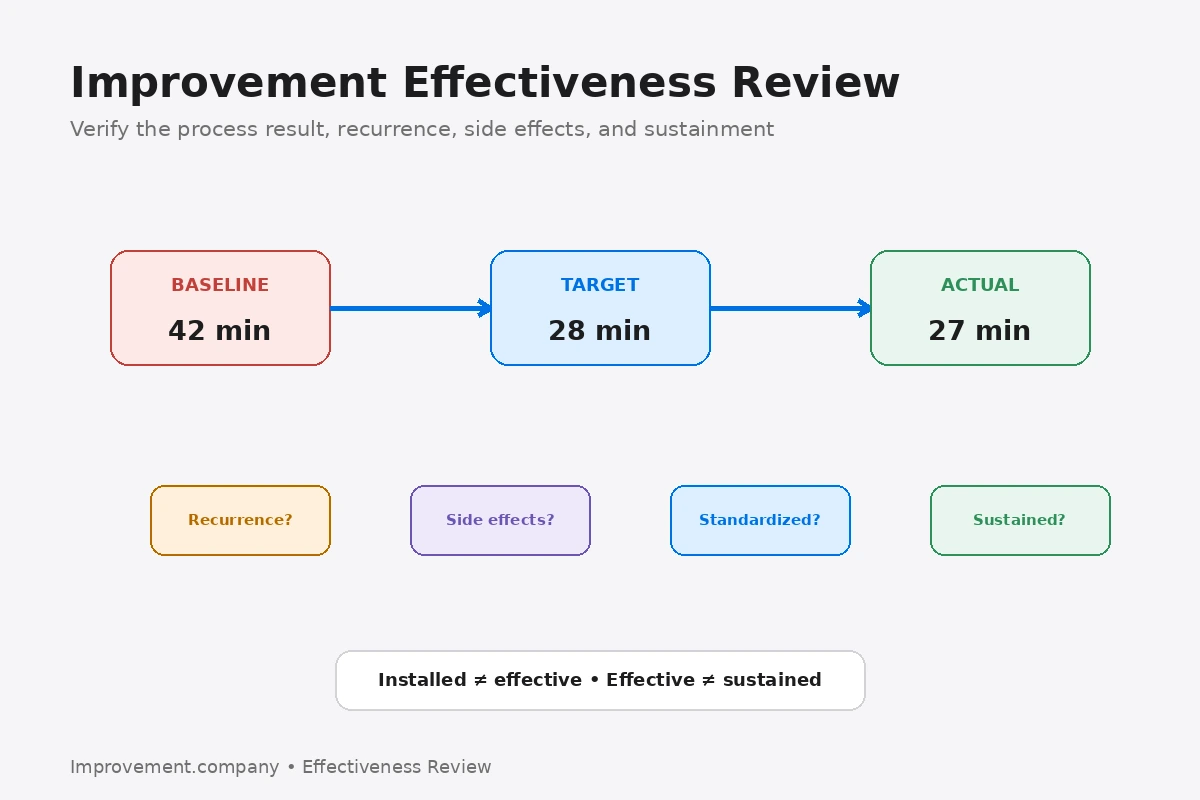
Improvement Effectiveness Review diagram comparing baseline, target, and actual performance and checking recurrence, side effects, standardization, and sustainment.
Continuous Improvement

Improvement Effectiveness Review: Verify the Change Actually Worked

Learn how an Improvement Effectiveness Review checks performance, recurrence, side effects, standardization, and sustainment after an improvement has been implemented.

Improvement Effectiveness ReviewContinuous ImprovementVerificationSustainment
Read guide →
Continuous Improvement

Improvement Funnel: Turn Many Ideas into Focused Action

Learn how an Improvement Funnel captures ideas, screens them consistently, prioritizes the strongest opportunities, and moves selected work into execution.

Improvement FunnelContinuous ImprovementPrioritizationImprovement Portfolio
Read guide →
Continuous Improvement

Improvement Intake Review: Decide What Should Enter the CI System

Learn how an Improvement Intake Review screens new ideas and requests for problem clarity, value, risk, ownership, readiness, duplication, and the right improvement pathway.

Improvement Intake ReviewContinuous ImprovementPrioritizationPortfolio
Read guide →
Continuous Improvement

Improvement Opportunity Assessment: Decide Whether an Idea Deserves It

Learn how an Improvement Opportunity Assessment evaluates problem size, strategic fit, evidence, value, risk, scope, and effort before improvement capacity is committed.

Improvement Opportunity AssessmentContinuous ImprovementPrioritizationImprovement Portfolio
Read guide →
Continuous Improvement

Improvement Pipeline Conversion Rate: Track Ideas Moving Into Action

Learn how Improvement Pipeline Conversion Rate shows whether qualified opportunities progress into active work while balancing readiness, capacity, and completion.

Improvement Pipeline Conversion RateContinuous ImprovementPipelinePortfolio
Read guide →
Continuous Improvement

Improvement Pipeline Review: Keep the Right Work Moving

Learn how an Improvement Pipeline Review manages ideas, active projects, blocked work, completed improvements, and available capacity without overloading the organization.

Improvement Pipeline ReviewContinuous ImprovementImprovement PortfolioCapacity
Read guide →
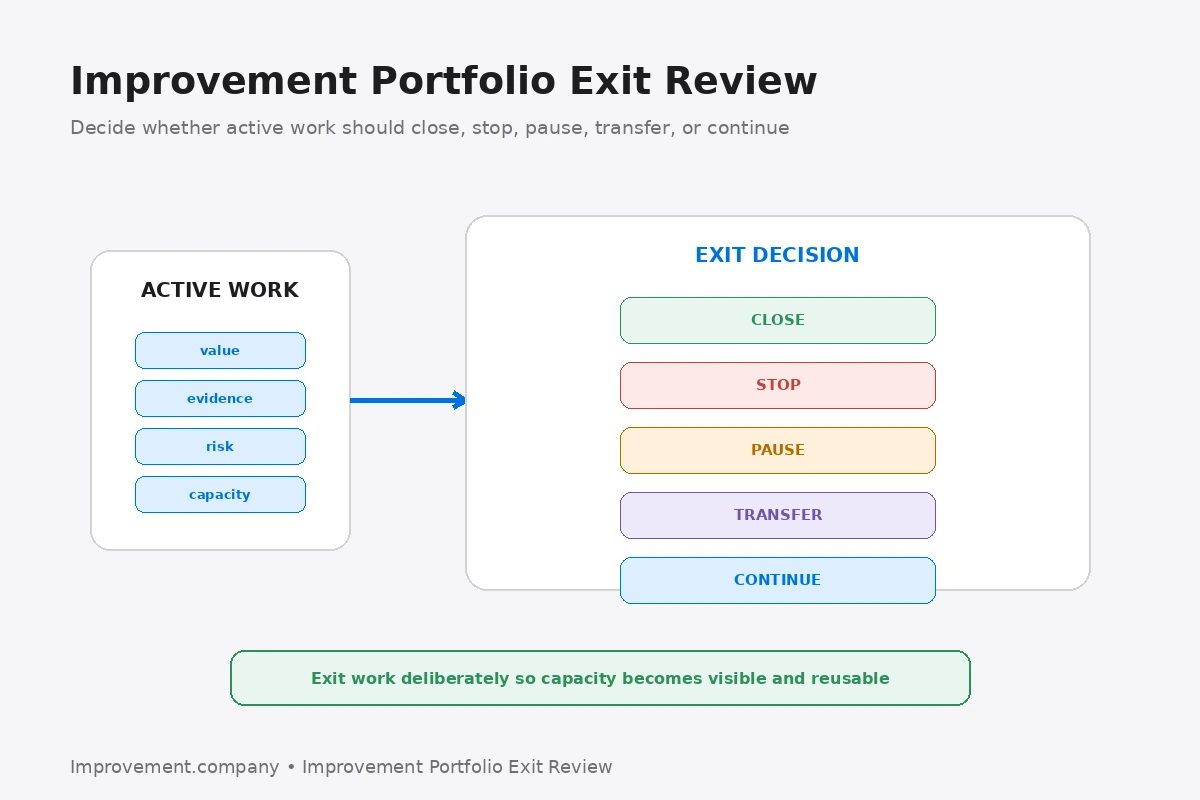
Improvement Portfolio Exit Review diagram showing active work evaluated for close, stop, pause, transfer, or continue decisions before improvement capacity is released.
Continuous Improvement

Improvement Portfolio Exit Review: Release Capacity Deliberately

Learn how an Improvement Portfolio Exit Review decides when completed, stopped, paused, or transferred work should leave the active portfolio and release capacity.

Improvement Portfolio Exit ReviewContinuous ImprovementPortfolioCapacity
Read guide →
Continuous Improvement

Improvement Project Charter: Define Scope, Goal, and Ownership

Learn how an Improvement Project Charter clarifies the problem, scope, goal, measures, ownership, constraints, and expected value before project work expands.

Project CharterContinuous ImprovementScopeProblem Solving
Read guide →
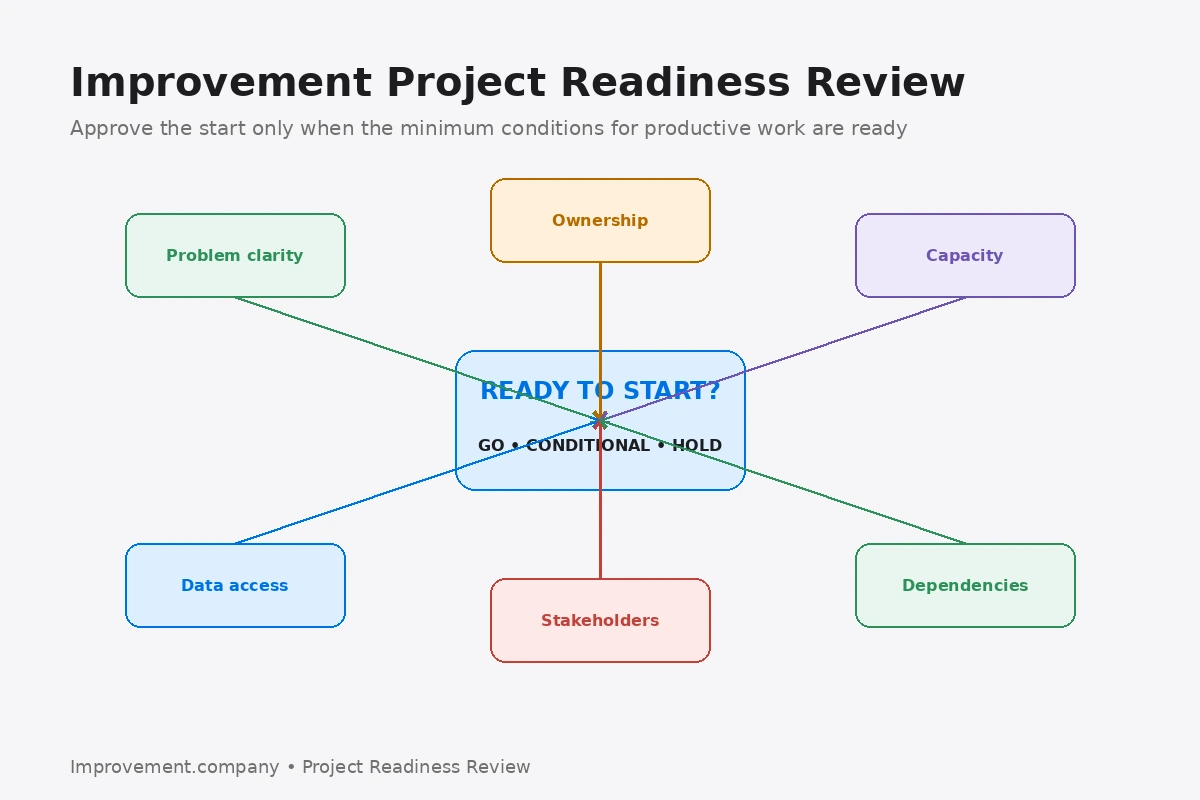
Improvement Project Readiness Review diagram showing problem clarity, ownership, capacity, data access, stakeholders, and dependencies feeding a start decision.
Continuous Improvement

Improvement Project Readiness Review: Confirm Work Is Ready

Learn how an Improvement Project Readiness Review checks problem clarity, ownership, data, capacity, stakeholder support, and dependencies before a project is launched.

Improvement Project ReadinessContinuous ImprovementProject SelectionCapacity
Read guide →
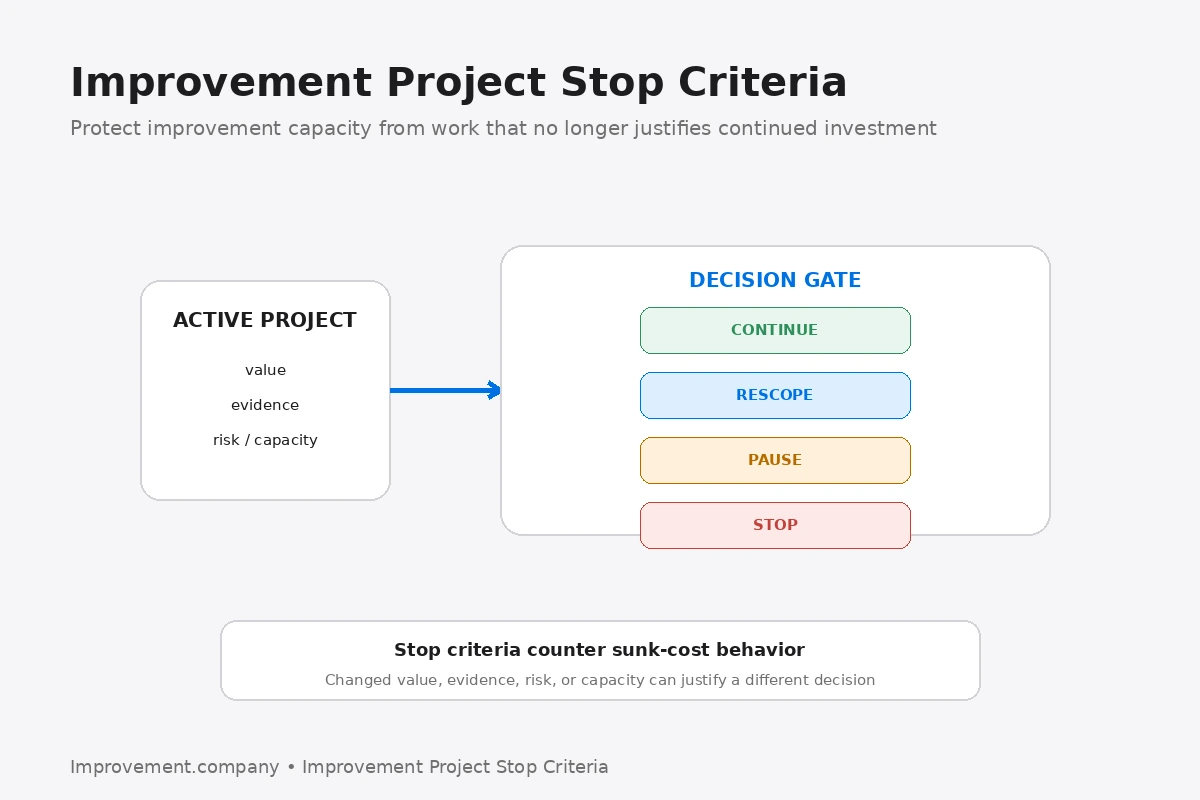
Improvement Project Stop Criteria diagram showing active project evidence feeding a decision gate with continue, rescope, pause, or stop outcomes.
Continuous Improvement

Improvement Project Stop Criteria: Know When to Stop

Learn how Improvement Project Stop Criteria define when an initiative should stop, pause, or be rescoped because value, evidence, risk, or capacity has changed.

Improvement Project Stop CriteriaContinuous ImprovementPortfolioPrioritization
Read guide →
Continuous Improvement

Improvement Resource Commitment Review: Confirm Capacity

Learn how an Improvement Resource Commitment Review verifies that people, specialist support, sponsor time, data access, and operating capacity are available before work starts.

Improvement Resource Commitment ReviewContinuous ImprovementResourcesCapacity
Read guide →
Continuous Improvement

Improvement Sponsor Effectiveness Review: Is Sponsorship Working?

Learn how an Improvement Sponsor Effectiveness Review checks decisions, barrier removal, priorities, resources, follow-up, and ownership without taking over the work.

Improvement Sponsor Effectiveness ReviewContinuous ImprovementSponsorshipLeadership
Read guide →
Continuous Improvement

Improvement Sustainment Plan: Keep Gains from Sliding Back

Learn how an Improvement Sustainment Plan defines ownership, standards, measures, audits, reaction rules, and follow-up so completed improvements remain in place.

Improvement Sustainment PlanContinuous ImprovementStandardizationControl
Read guide →
Continuous Improvement

Improvement Tollgate Review: Make Evidence-Based Project Decisions

Learn how an Improvement Tollgate Review checks evidence, risk, scope, ownership, and readiness before a project moves to its next phase.

Tollgate ReviewContinuous ImprovementProject GovernanceDMAIC
Read guide →
Continuous Improvement

Improvement Value Hypothesis: State Why the Work Should Matter

Learn how an Improvement Value Hypothesis links a defined performance gap with expected operational or financial value before substantial improvement effort is committed.

Improvement Value HypothesisContinuous ImprovementBenefitsPrioritization
Read guide →
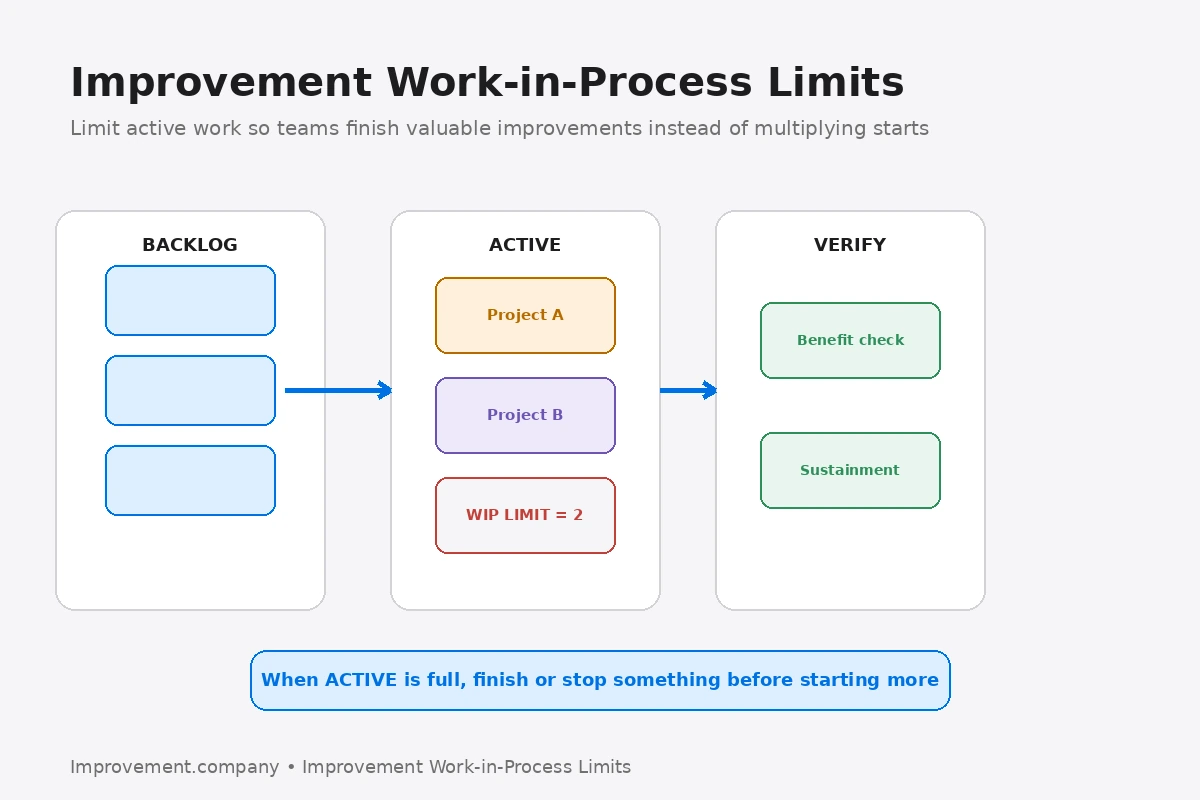
Improvement work-in-process limit diagram showing backlog, a capped active-work column, and verification to encourage finishing before starting more.
Continuous Improvement

Improvement Work-in-Process Limits: Stop Starting and Start Finishing

Learn how Improvement Work-in-Process Limits cap active improvement work so teams protect focus, expose blocked projects, and complete valuable changes faster.

Improvement WIP LimitsContinuous ImprovementFlowCapacity
Read guide →
Continuous Improvement

Kaizen: Continuous Improvement Through Practical Change

Learn what Kaizen means, how daily improvement works, when to use it, and how leaders create the conditions for disciplined small-scale learning.

KaizenContinuous ImprovementPDCAEmployee Engagement
Read guide →
Continuous Improvement

Kaizen Event: Focused Improvement in a Short Timeframe

Learn how a Kaizen Event uses a focused cross-functional team to analyze a defined problem, test changes quickly, and establish a better standard.

Kaizen EventRapid ImprovementContinuous ImprovementPDCA
Read guide →
Continuous Improvement

Kaizen Newspaper: Keep Improvement Actions Visible After the Event

Learn how a Kaizen Newspaper keeps unfinished improvement actions visible with owners, due dates, status, and follow-up after focused improvement work.

Kaizen NewspaperContinuous ImprovementKaizen EventAction Management
Read guide →
Continuous Improvement

Lessons Learned System: Turn Experience into Reusable Knowledge

Learn how a Lessons Learned System captures verified experience, assigns ownership, and makes useful learning easy to reuse in future work.

Lessons LearnedContinuous ImprovementOrganizational LearningYokoten
Read guide →
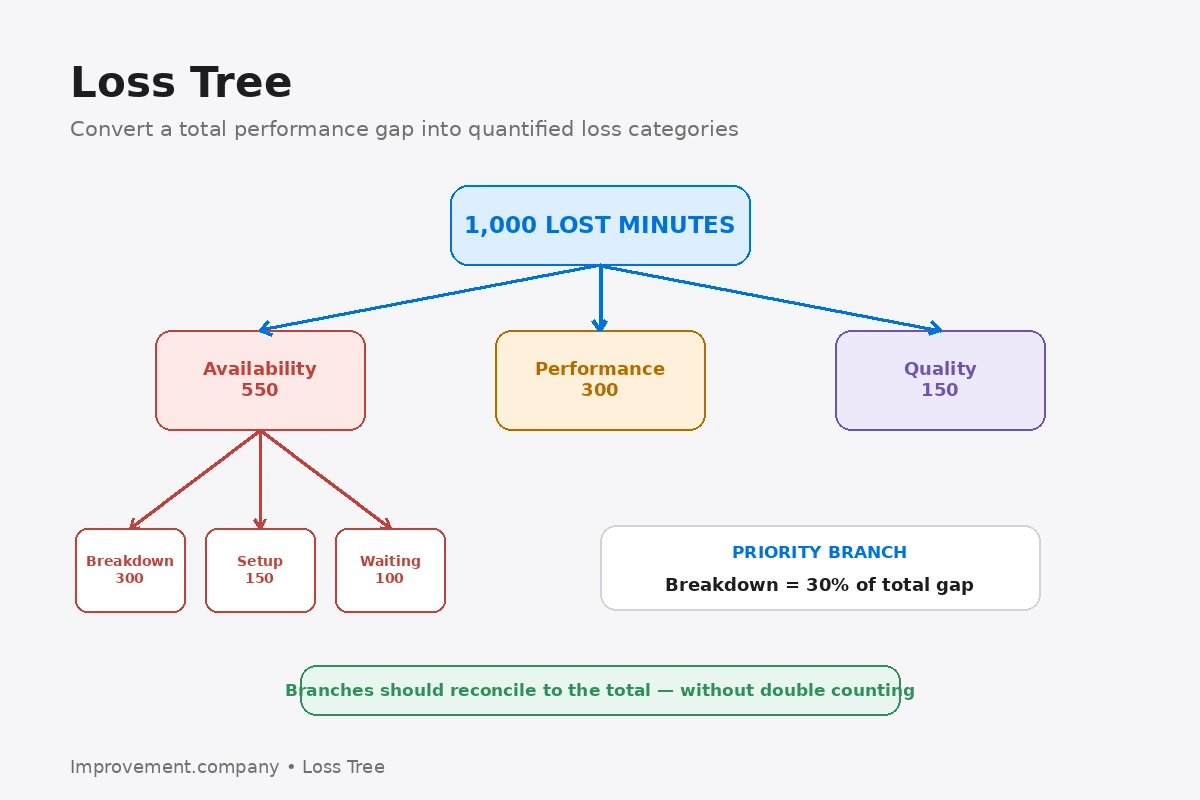
Loss Tree diagram showing a total performance gap decomposed into availability, performance, and quality losses with a prioritized sub-branch.
Continuous Improvement

Loss Tree: Connect High-Level Performance Gaps to Specific Losses

Learn how a Loss Tree decomposes a high-level performance gap into quantified loss categories so teams can prioritize where improvement effort will create the most value.

Loss TreeContinuous ImprovementLoss AnalysisOEE
Read guide →
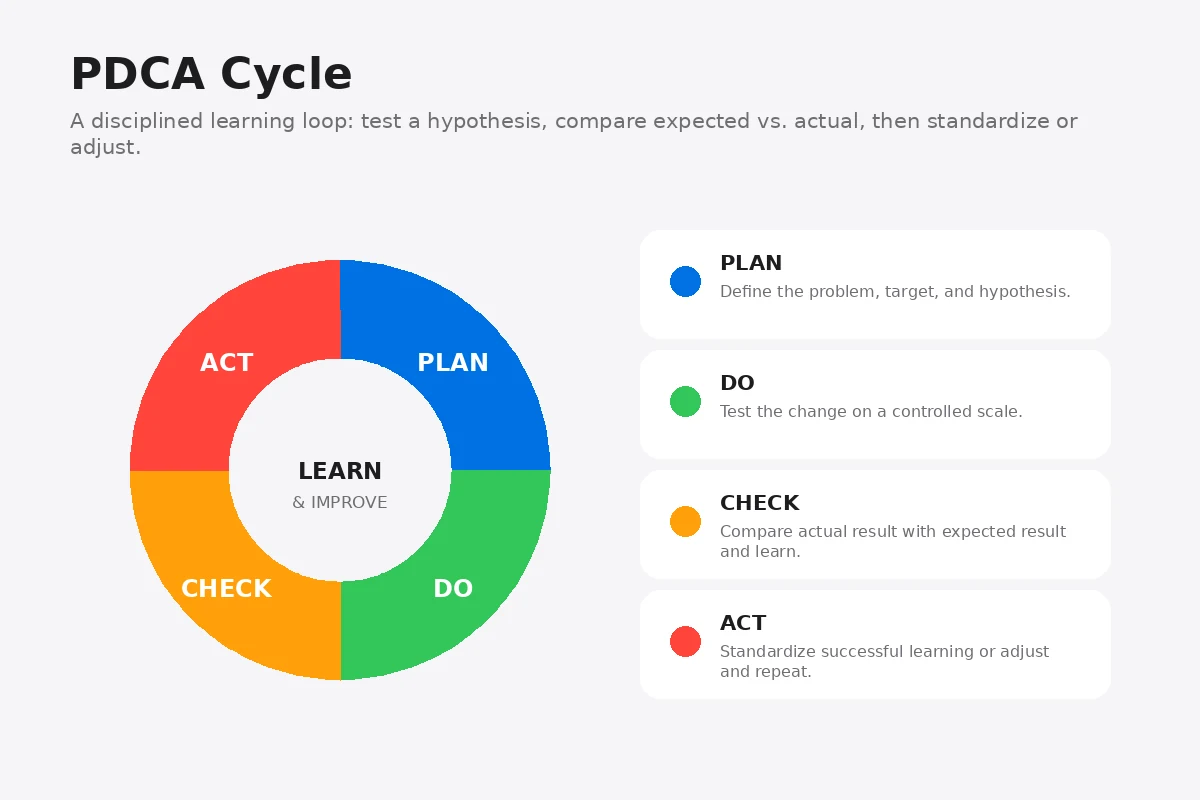
PDCA cycle showing Plan, Do, Check, and Act as a continuous learning loop
Continuous Improvement

PDCA Cycle

PDCA is a structured learning cycle for testing changes, comparing results with expectations and improving processes through repeated experimentation.

PDCAKaizenExperimentation
Read guide →
Continuous Improvement

Process Baseline: Establish the Starting Point Before Improvement

Learn how a Process Baseline defines current performance, variation, conditions, and measurement rules so improvement can be compared with credible before-and-after evidence.

Process BaselineContinuous ImprovementMeasurementPerformance
Read guide →
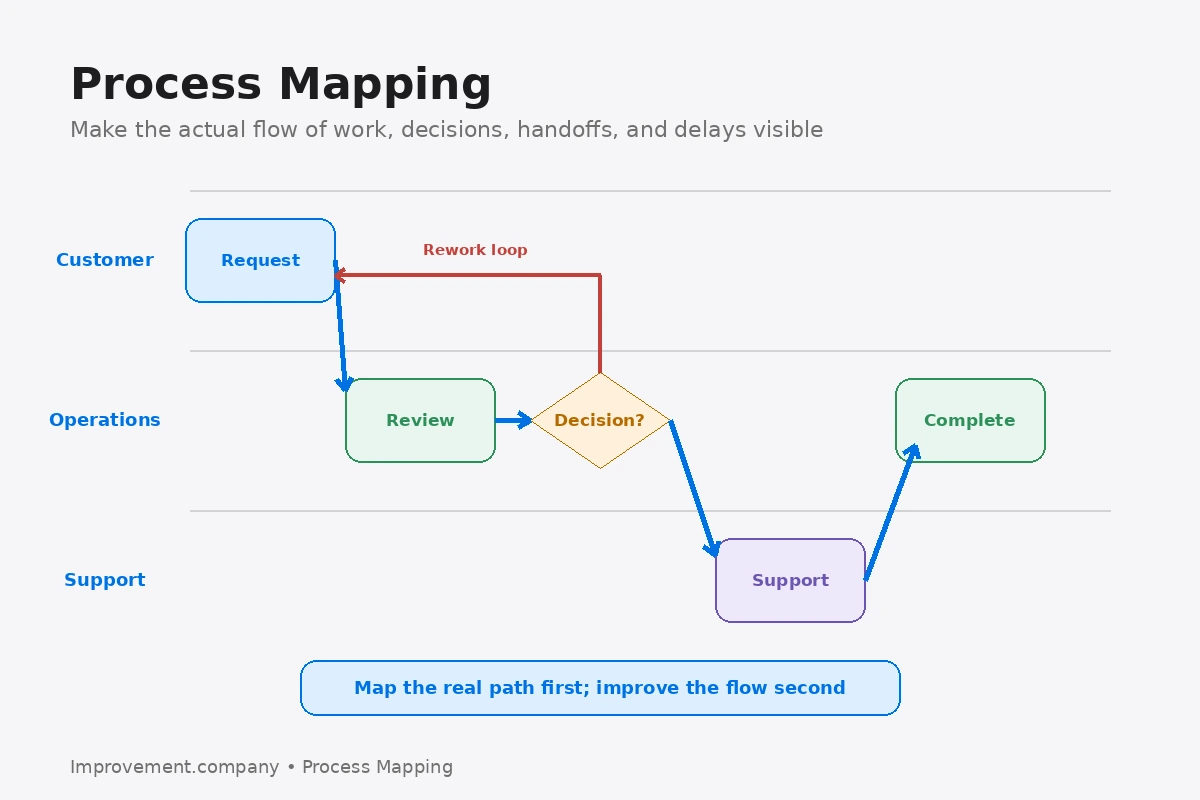
Process mapping diagram showing work moving across customer, operations, and support lanes with a decision point, support handoff, and rework loop.
Continuous Improvement

Process Mapping: How to See Work Before You Improve It

Learn how process mapping makes workflow, decisions, handoffs, delays, and rework visible before teams redesign a process.

Process MappingContinuous ImprovementWorkflowWaste
Read guide →
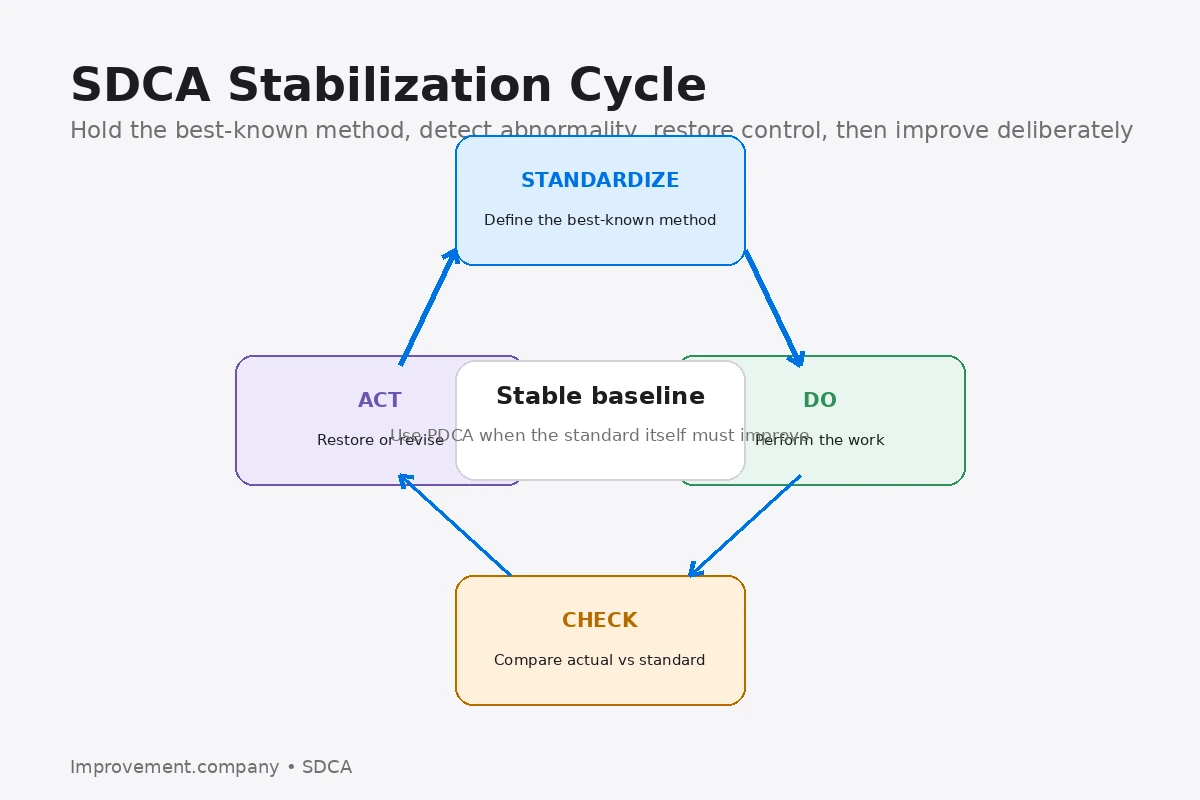
SDCA cycle showing Standardize, Do, Check, and Act around a stable baseline with PDCA used when the standard itself must improve.
Continuous Improvement

SDCA: Stabilize the Standard Before the Next Improvement

Learn how SDCA uses Standardize, Do, Check, and Act to hold a proven method, expose abnormality, and create a stable baseline for PDCA.

SDCAContinuous ImprovementStandardizationPDCA
Read guide →
Continuous Improvement

Small Tests of Change: Learn Fast Before Scaling an Improvement

Learn how small tests of change reduce implementation risk by testing one idea, observing the result, learning quickly, and expanding only after evidence improves.

Small Tests of ChangeContinuous ImprovementExperimentationPDCA
Read guide →
Continuous Improvement

Standardization After Improvement: Make the Better Method Standard

Learn how to standardize a verified improvement through updated work methods, training, controls, ownership, and follow-up without freezing future learning.

StandardizationContinuous ImprovementStandard WorkSustainment
Read guide →
Continuous Improvement

What Is Continuous Improvement?

A practical explanation of Continuous Improvement: what it means, how it works, which methods support it, and how organizations turn improvement into everyday work.

KaizenPDCALeanProblem Solving
Read guide →
Continuous Improvement

Yokoten: Share Improvement Horizontally Across the Organization

Learn how Yokoten spreads proven learning across teams and locations without forcing blind copying of a solution that may not fit local conditions.

YokotenContinuous ImprovementKnowledge SharingKaizen
Read guide →