The Theory of Constraints, or TOC, is a management approach built around a simple idea:
Every system has a limiting factor that constrains its overall performance.
Improving non-constraints can make individual departments look better without improving the total system.
TOC focuses attention on the point that currently limits throughput.
Constraint vs bottleneck
The terms are often used interchangeably, but they are not always identical.
A bottleneck is a process step whose capacity limits flow.
A constraint is the factor that currently limits the system from achieving more of its goal.
The constraint might be:
- machine capacity;
- labor availability;
- engineering capacity;
- market demand;
- a policy;
- a long approval process;
- supplier capacity;
- a material shortage.
In manufacturing, the constraint is often a physical resource, but it does not have to be.
Why local efficiency can be misleading
Suppose a factory can produce:
- 100 units/hour at Process A;
- 60 units/hour at Process B;
- 90 units/hour at Process C.
If Process B is the true constraint, increasing Process A from 100 to 120 units/hour does not increase system output.
It may only create more work-in-process in front of Process B.
The correct improvement question is:
What increases useful output through the entire system?
This is why TOC aligns strongly with Lean thinking about flow and avoiding overproduction.
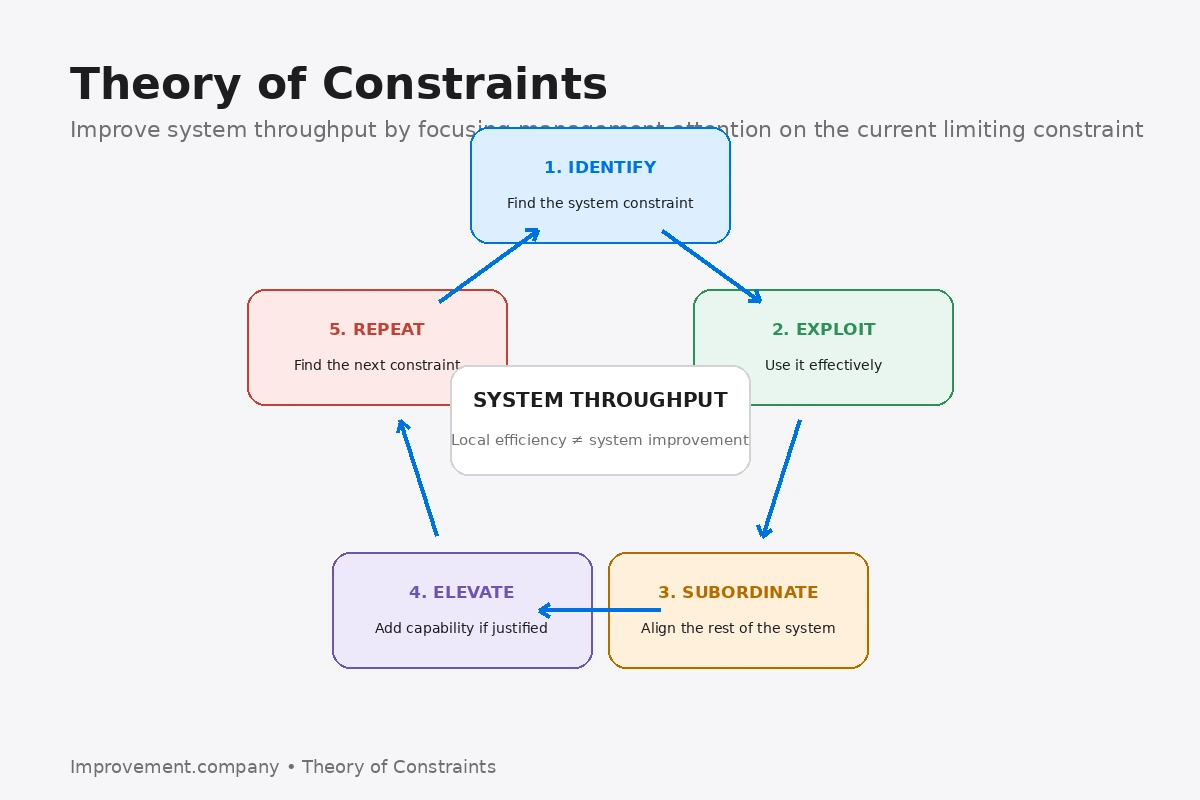
The Five Focusing Steps
A common TOC sequence is:
1. Identify the constraint
Determine what currently limits system performance.
Use actual data rather than assumptions.
2. Exploit the constraint
Get the best possible output from the constraint using existing resources.
Examples:
- reduce avoidable downtime;
- ensure material is always available;
- keep qualified labor available;
- remove non-value-adding work from the constraint;
- prevent defects from consuming constraint time.
3. Subordinate everything else
Align upstream and downstream activity to support the constraint.
Non-constraints should not produce simply because they have available capacity.
4. Elevate the constraint
If the constraint still limits required performance, add capability.
Examples include equipment, labor, automation, outsourcing, process redesign, or technology.
5. Repeat
Once the constraint moves, find the new limiting factor.
Improvement is continuous because the constraint can shift.
Protect constraint time
A minute lost at the constraint can become a minute lost for the entire system.
That makes reliability and quality especially important at the constraint.
TPM can reduce equipment losses.
SMED can reduce changeover loss.
Poka-Yoke can prevent defects from consuming scarce constraint capacity.
The improvement priority should reflect the system impact.
Buffers can be useful
TOC does not assume all inventory is bad.
A carefully designed buffer before the constraint can protect it from upstream variability.
The key is intentional control.
Inventory should exist for a reason, not because uncontrolled overproduction created it.
This is consistent with Just-in-Time, which aims to reduce unnecessary buffers while improving the instability that makes them necessary.
Constraint management and capacity planning
Capacity Planning asks whether realistic process capacity can meet expected demand.
TOC adds another perspective:
Which resource actually governs system throughput right now?
A capacity model may show several potential risks, while TOC directs immediate improvement attention toward the active constraint.
Common mistakes
Improving every process equally
Resources should be focused where system performance is limited.
Running non-constraints at maximum utilization
This often creates excess inventory and longer lead time.
Confusing a busy resource with the constraint
A resource can look busy because of poor scheduling or batching.
Ignoring quality at the constraint
Defects produced at or before the constraint consume scarce capacity.
Assuming the constraint is permanent
Constraints move as the system changes.
Practical application
A practical TOC approach is:
- Define the system goal.
- Measure end-to-end throughput.
- Identify the current constraint.
- Quantify lost constraint time.
- Remove avoidable losses.
- Protect the constraint from starvation, defects, and disruption.
- Align non-constraints with constraint needs.
- Elevate capacity only when justified.
- Reassess after improvement.
The practical lesson
TOC prevents teams from confusing activity with improvement.
A system improves when its limiting condition improves.
Focus on the constraint, protect it, improve it, and then look for the next one.
Related application
This topic also connects with Current Reality Tree. Use that method when the improvement requires the related operating or management discipline.
Related application
This topic also connects with Drum-Buffer-Rope. Use that method when the improvement requires the related operating or management discipline.
Related application
This topic also connects with Throughput. Use that method when the improvement requires the related operating or management discipline.
Related application
This topic also connects with Production Constraint Protection Review. Use that method when the improvement requires the related operating or management discipline.