
Throughput is the rate at which a system produces completed output over time.
Depending on the process, it may be expressed as units per hour, orders per day, cases per week, or tonnes per shift.
The key word is completed. Activity inside the process is not the same as throughput.
Define the completion point
The measure should specify when output counts as completed.
Examples include finished product, shipped order, approved case, or completed service.
Operational Definition helps make the completion rule consistent. If one report counts material entering final inspection and another counts shipped units, the two throughput measures are not comparable.
Separate throughput from utilization
A machine can be busy without increasing system throughput.
If upstream equipment produces faster than the constraint can process, the result may be more WIP, longer lead time, and more handling.
Theory of Constraints emphasizes improving the performance of the system constraint rather than maximizing local utilization everywhere.
Identify the limiting resource
Bottleneck Analysis helps identify where effective capacity is limiting flow.
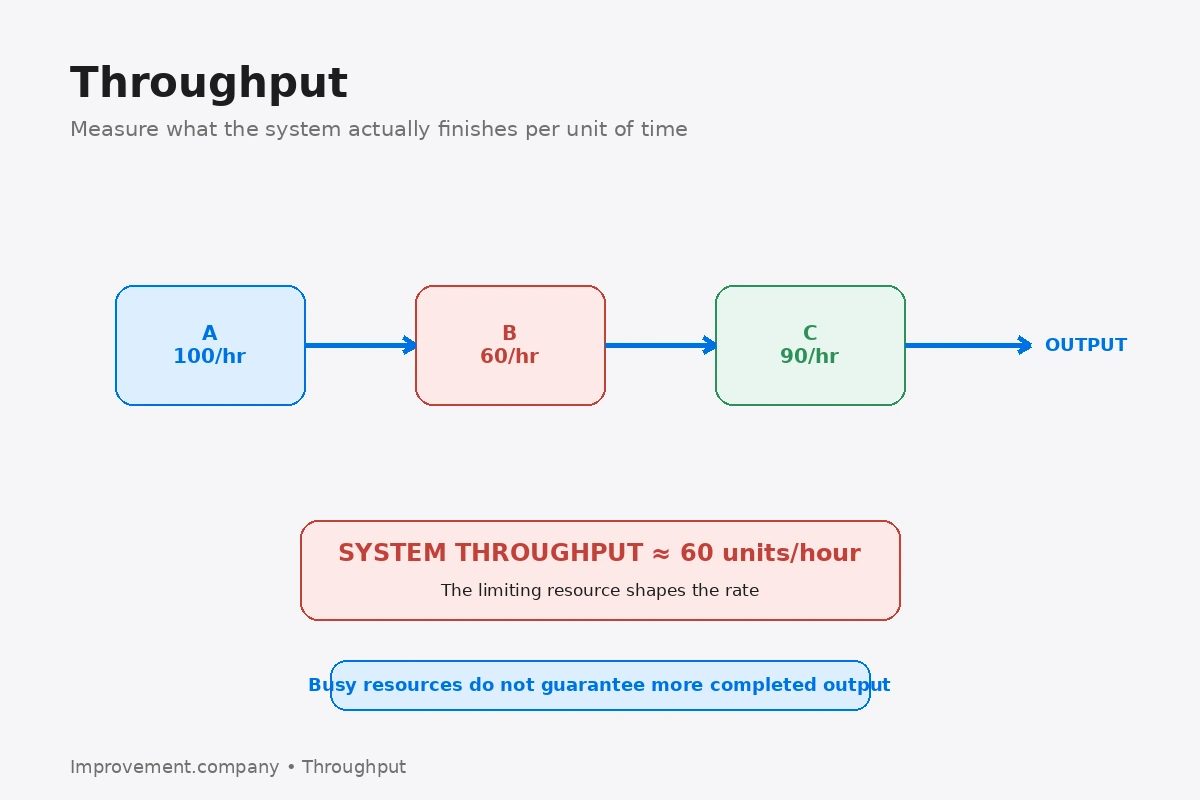
If Step A can produce 100 units per hour, Step B 60, and Step C 90, the system cannot sustain 100 units per hour merely because Step A can.
The limiting resource shapes system throughput.
Connect throughput with WIP and lead time
Little’s Law connects:
WIP = Throughput × Lead Time
Increasing WIP does not automatically increase throughput. Once the limiting resource is saturated, extra WIP often increases lead time instead.
Distinguish gross production from good output
If the process creates defects and rework, the gross production rate may overstate useful throughput.
First Pass Yield helps show how much output completes a process correctly the first time.
The organization should decide whether throughput counts all completions, good completions, or shipped units. Use the definition that supports the decision.
Measure over an appropriate interval
Very short intervals can be noisy. Very long intervals can hide operational problems.
Useful time buckets may include hour, shift, day, or week.
Short Interval Control can make throughput loss visible early enough for recovery.
Improve throughput at the system level
Useful actions may include protecting constraint uptime, reducing constraint changeover, improving constraint quality, subordinating upstream release, and preventing starvation.
Improving a non-constraint may still be useful, but it does not necessarily increase total system output.
Common mistakes
Counting starts instead of completions, confusing utilization with throughput, improving non-constraints while the true constraint remains unchanged, allowing defects to inflate the apparent rate, adding WIP after the constraint is already saturated, and changing the completion definition between reports are common mistakes.
Practical sequence
- define completed output.
- choose the time interval.
- measure actual throughput.
- identify the constraint.
- understand losses at the constraint.
- protect constraint availability.
- control upstream release.
- improve quality at the constraint.
- monitor WIP and lead time.
- verify system throughput after changes.
The practical lesson
Throughput measures what the system actually finishes.
The best throughput improvements come from managing the whole flow around the limiting resource, not from making every resource look busy.