
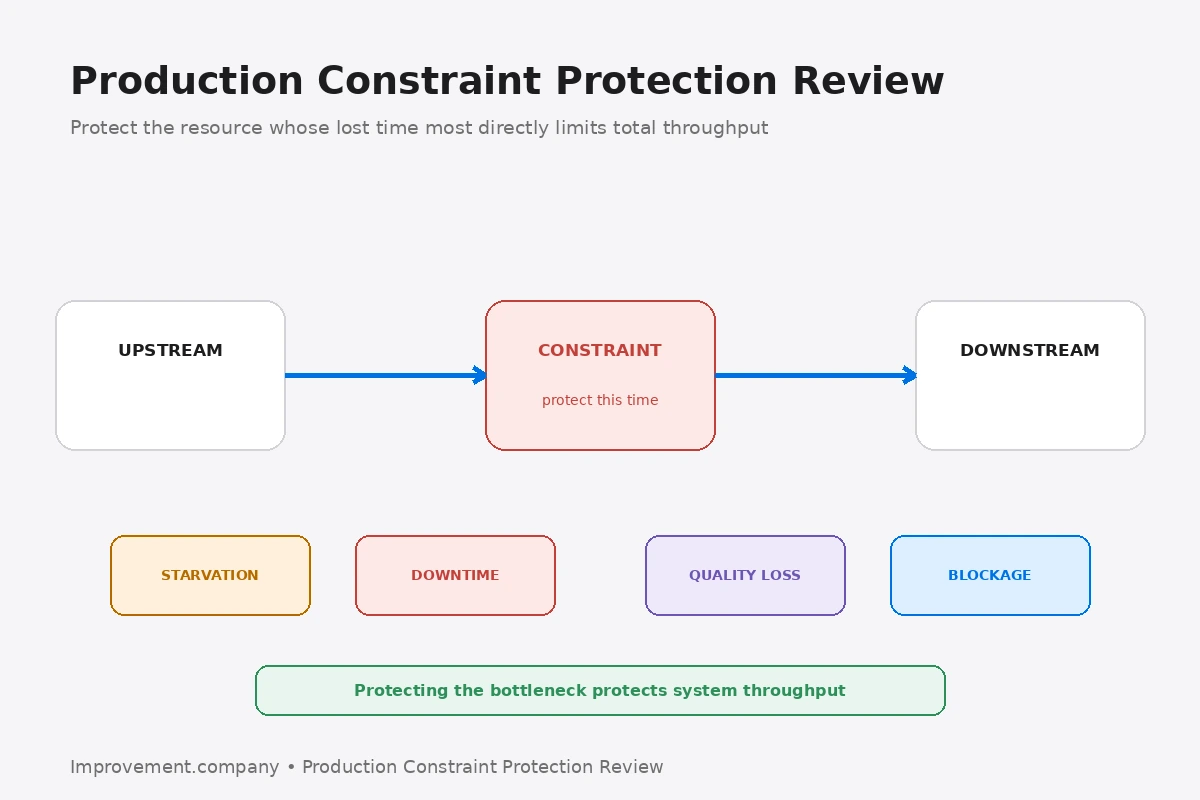
A Production Constraint Protection Review checks whether the resource that limits system output is being protected from avoidable loss.
The purpose is not to maximize utilization everywhere.
The purpose is to protect the resource whose lost time most directly limits total throughput.
Confirm the current constraint
Theory of Constraints helps identify the resource that limits total system performance.
The constraint can move after:
- demand change;
- equipment improvement;
- product-mix change;
- staffing change.
Do not protect yesterday’s bottleneck automatically.
Review starvation
Ask whether the constraint waited because of:
- missing material;
- upstream downtime;
- poor sequencing;
- quality holds.
Plan for Every Part helps define material quantity, container, location, handling, and replenishment information.
Constraint starvation should be treated as a system loss.
Also review how much protective time or material buffer exists ahead of the constraint. A buffer should not hide chronic instability, but it can create enough protection for upstream variation to be absorbed without immediately starving the bottleneck. Repeated buffer depletion is a signal that upstream reliability or replenishment needs attention.
Review blockage
The constraint may also stop because downstream flow cannot accept output.
Check:
- full buffers;
- downstream downtime;
- packaging limits;
- storage restrictions.
Review equipment losses
OEE Overall Equipment Effectiveness helps separate availability, performance, and quality losses.
At the constraint, even small losses can have disproportionate throughput impact.
Review quality at the constraint
Bad output consumes scarce constraint time without creating usable throughput.
Quality at the Source helps prevent and detect defects where they occur.
Prioritize controls that protect good output through the bottleneck.
Review staffing and support
Ask whether the constraint has:
- qualified operators;
- rapid maintenance response;
- required technical support.
Daily Support Capacity Review helps align scarce specialist support with operating consequence.
Review schedule decisions
Production Priority Rules helps align customer commitment, risk, material readiness, constraint impact, stability, and recovery.
Sequence changes should not create avoidable setups or starvation at the constraint.
Common mistakes
Assuming the bottleneck never moves, measuring only machine utilization, ignoring quality loss, allowing the constraint to wait for material, protecting local efficiency instead of system throughput, scheduling excessive changeovers at the constraint, and assigning weak support response to the most critical resource are common mistakes.
Practical sequence
- confirm the current constraint.
- review starvation losses.
- review blockage losses.
- review equipment downtime.
- review performance loss.
- review quality loss.
- review staffing and support.
- review schedule and sequence decisions.
- assign actions to the largest avoidable constraint losses.
- recheck whether the constraint has moved.
The practical lesson
A Production Constraint Protection Review focuses attention where lost time matters most.
Protecting the bottleneck protects system throughput.