
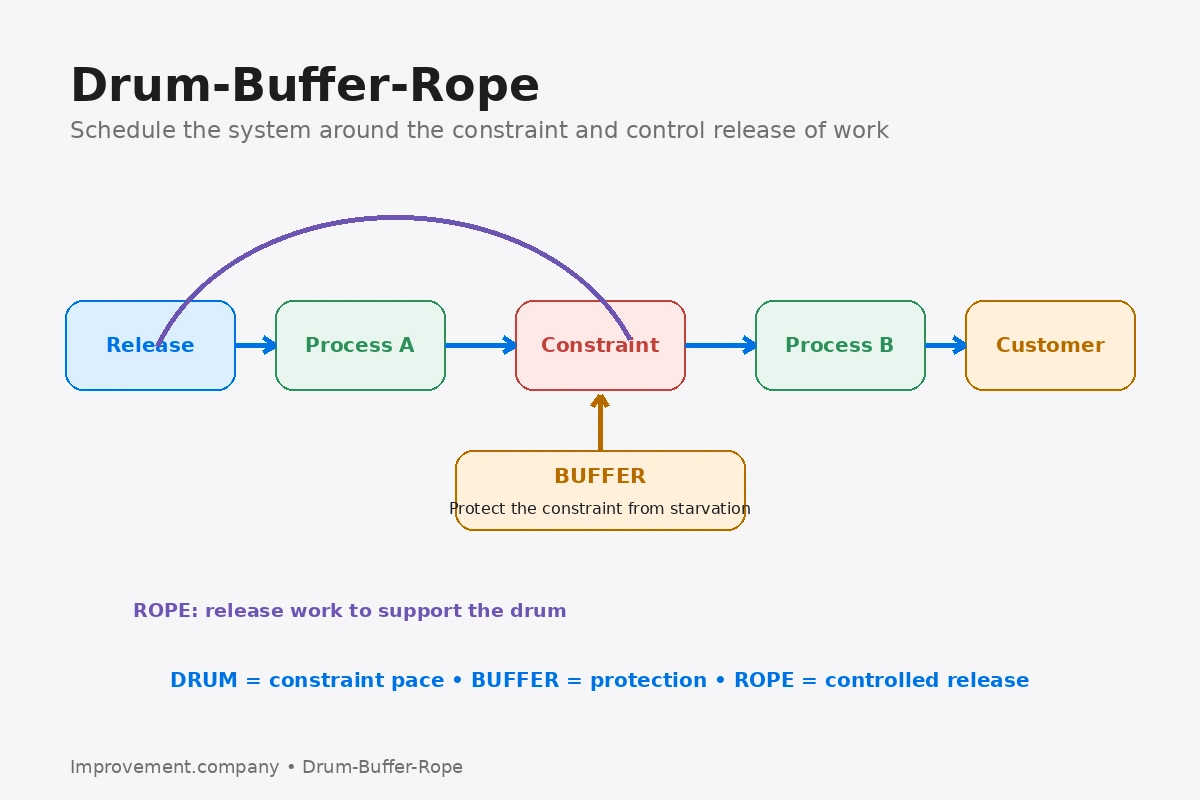
Drum-Buffer-Rope, often abbreviated DBR, is a production scheduling concept from the Theory of Constraints.
It coordinates the system around the limiting resource.
The three elements are:
- Drum: the pace set by the constraint;
- Buffer: protection against disruption;
- Rope: the release signal that prevents too much work from entering the system.
Identify the constraint
The system should first understand which resource currently limits throughput.
That may be:
- machine;
- labor skill;
- inspection step;
- furnace;
- supplier;
- approval process.
Theory of Constraints provides the broader method for identifying and managing the system constraint.
The constraint should be based on actual system behavior, not assumption.
Use the constraint as the drum
The constraint establishes the pace that the rest of the system must support.
If the constraint can produce 80 units per shift, releasing enough work for 140 units does not create 140 units of throughput.
It creates:
- WIP;
- waiting;
- expediting;
- longer lead time.
The drum schedule should focus on what the constraint can realistically process.
Protect the constraint with a buffer
The constraint should not be starved because an upstream process was temporarily delayed.
A time or material buffer can protect the constraint from normal variation.
The buffer is not simply “more inventory.”
Its purpose is controlled protection of throughput.
[Buffer Management] concepts can be applied by observing how much of the protection is being consumed and where recurring disruption originates.
Use the rope to control release
The rope links release of new work to the needs of the drum.
Instead of pushing work into production as soon as it is available, the organization releases work at a rate that supports the constraint schedule.
This reduces unnecessary WIP.
Little’s Law helps explain why excessive WIP tends to increase lead time when throughput does not rise proportionally.
Keep nonconstraints synchronized
Nonconstraint resources should support the constraint rather than maximize local utilization.
A nonconstraint machine may sometimes wait.
That can be appropriate.
Producing extra inventory only to keep every resource busy can reduce system performance.
Bottleneck Analysis helps distinguish the true system bottleneck from local congestion.
Watch the buffer
Buffer status can provide an early warning.
If the constraint buffer is repeatedly consumed, ask:
- Which upstream process is causing the shortage?
- Is the constraint schedule unstable?
- Are changeovers too long?
- Are quality losses consuming capacity?
The pattern should guide improvement.
Reassess when the constraint moves
After improvement, the constraint may shift.
The scheduling logic should be reviewed.
A system that continues protecting yesterday’s constraint may create new waste.
Apply the idea beyond manufacturing
The same logic can apply to:
- engineering;
- healthcare;
- service operations;
- project work;
- approval processes.
The terminology may change, but the principle remains:
Protect the scarce capacity and control release into the system.
Common mistakes
Choosing the constraint based on opinion, building excessive buffers, releasing work without connection to the drum, maximizing utilization at every resource, ignoring quality losses at the constraint, and failing to reassess after the constraint moves are common mistakes.
Practical sequence
- identify the system constraint.
- define the constraint schedule.
- establish appropriate protection.
- link release to the drum.
- synchronize nonconstraints.
- monitor buffer consumption.
- investigate recurring buffer penetration.
- improve the constraint and supporting processes.
- reduce excess WIP.
- reassess where the constraint moves.
The practical lesson
Drum-Buffer-Rope coordinates flow around the system’s real limiting resource.
The objective is not to keep every resource busy. It is to protect throughput and control WIP.
Related application
This topic also connects with Buffer Management. Use that method when the improvement requires the related operating or management discipline.