
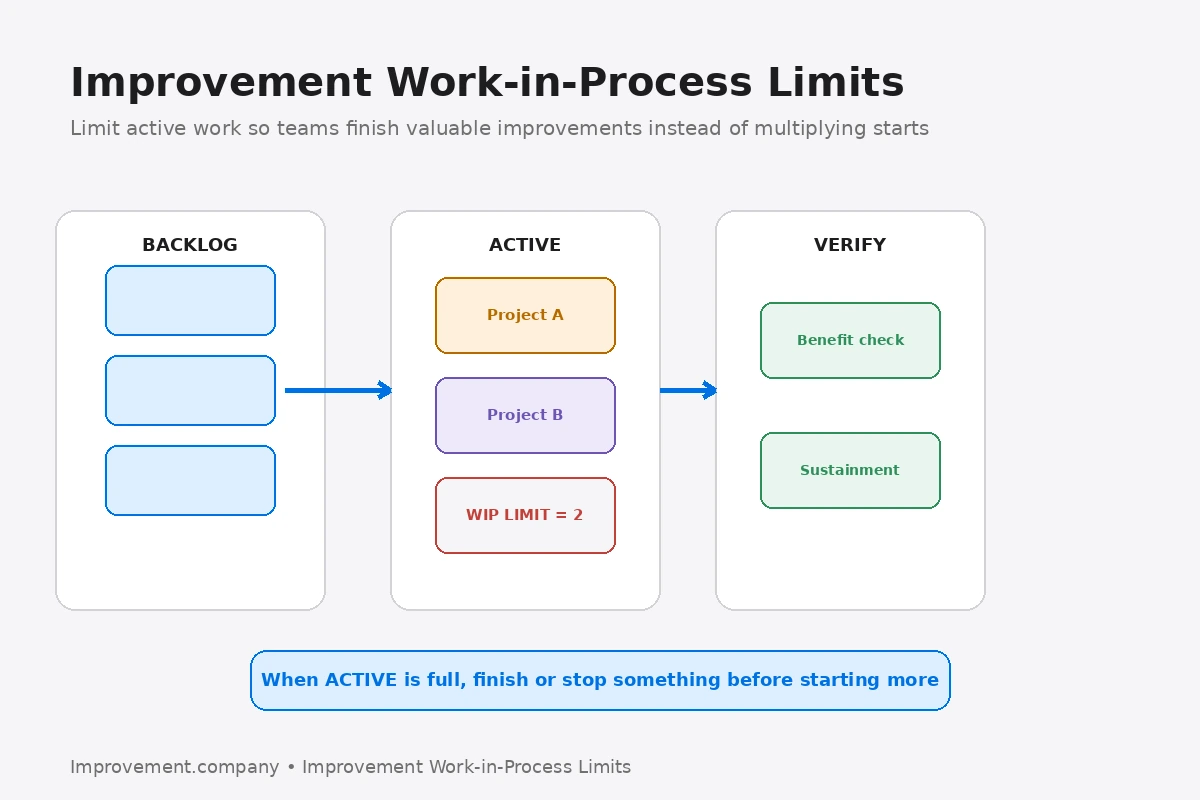
Improvement Work-in-Process Limits define how many improvement initiatives a team, function, or support resource may actively work on at one time.
The logic is similar to operational flow: too much work in process increases waiting, multitasking, and lead time.
The objective is not to suppress good ideas. The objective is to stop more work from entering the active system than the organization can finish effectively.
Make active work visible
Start by defining what counts as active.
Possible stages include approved, analysis, testing, implementation, and verification.
Improvement Pipeline Review helps make ideas, active work, blocked work, and completions visible.
Do not count backlog ideas as active WIP.
Match limits to real capacity
Improvement Capacity Planning helps compare improvement demand with available people, specialist time, and management attention.
A team with one qualified analyst should not launch ten analysis-heavy projects simply because ten ideas are important.
The WIP limit should reflect execution capacity.
Limit at the right level
Possible limits include active projects per team, active projects per improvement leader, concurrent engineering trials, or concurrent projects using the same specialist.
The most useful limit is often placed where work accumulates.
Use the limit to force priority decisions
When the active limit is full, the next opportunity must wait unless something else finishes, stops, or is deferred.
Improvement Portfolio Management helps decide which work deserves scarce improvement capacity.
A WIP limit makes those tradeoffs visible.
Treat blocked work explicitly
A blocked project still consumes attention.
The review should decide whether to remove the blocker, pause the project, return it to backlog, or stop it.
Improvement Backlog provides a controlled place for work that is important but not yet active.
Measure flow, not only project count
Useful measures include active WIP, average project age, blocked time, completion rate, and lead time from approval to verified result.
Work in Process explains why excess inventory in a flow system increases waiting and obscures problems.
The same principle applies to improvement work.
Protect urgent exceptions carefully
Some issues genuinely require immediate priority.
Define who can authorize an exception to the WIP limit and what active work will be displaced.
Do not allow every urgent request to become extra WIP.
Common mistakes
Counting every idea as active, setting limits without understanding capacity, allowing blocked work to remain active forever, overriding the limit whenever a senior person asks, measuring only how many projects were started, and treating a WIP limit as a reason to ignore serious risk are common mistakes.
Practical sequence
- define active improvement stages.
- count current WIP.
- identify constrained improvement resources.
- set an initial WIP limit.
- prioritize active work.
- stop launching work beyond the limit.
- resolve or pause blocked projects.
- measure completion and aging.
- adjust the limit using evidence.
- protect flow by finishing before starting more.
The practical lesson
Improvement Work-in-Process Limits protect execution focus.
A smaller number of completed improvements creates more value than a large inventory of partially active projects.