
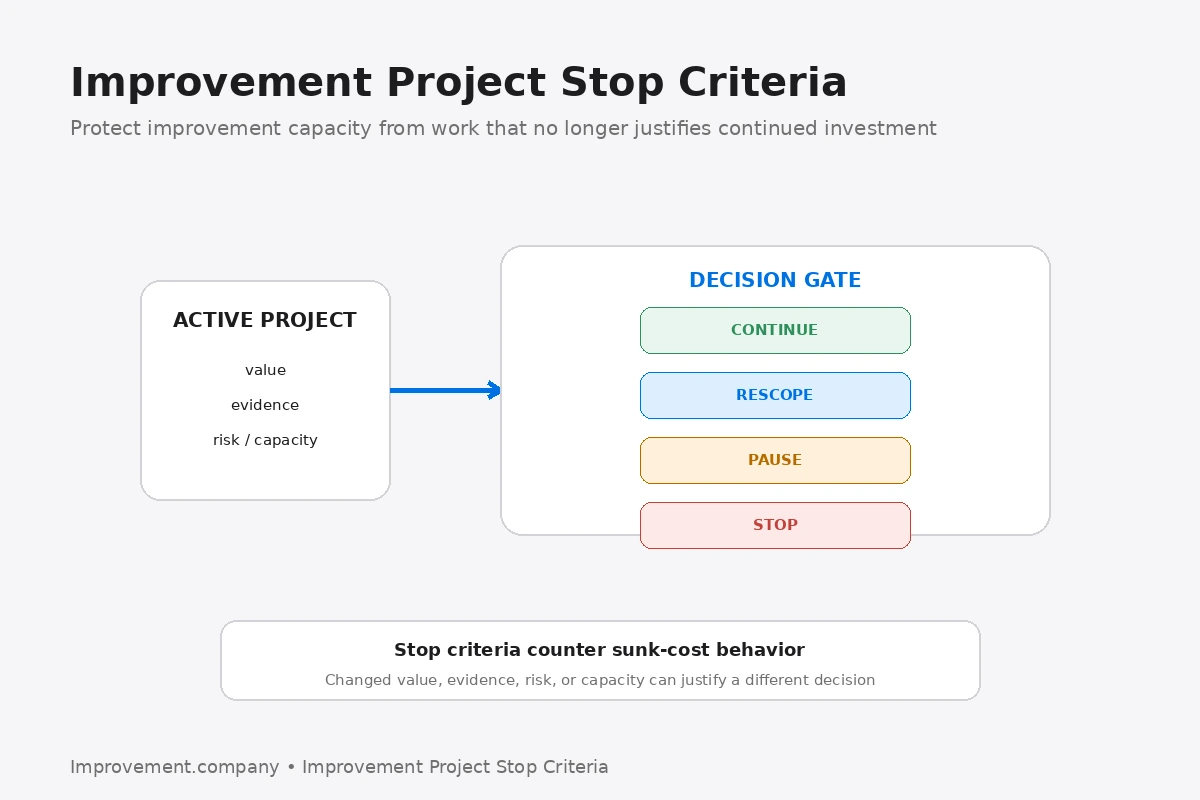
Improvement Project Stop Criteria define the conditions under which an active improvement initiative should be stopped, paused, or rescoped.
Starting projects is easy.
Stopping weak work is often much harder because teams have already invested:
- time;
- reputation;
- management attention.
The objective is not to abandon difficult work too quickly.
The objective is to protect improvement capacity from work that no longer justifies continued investment.
Define stop criteria before trouble appears
Possible stop triggers include:
- problem no longer material;
- expected value collapses;
- required evidence unavailable;
- technical approach infeasible;
- risk becomes unacceptable;
- higher-priority work displaces capacity.
Improvement Opportunity Assessment helps evaluate value, evidence, strategic fit, scope, risk, dependencies, and effort before work starts.
Those same dimensions can be revisited during execution.
Review the value hypothesis
Improvement Value Hypothesis makes the expected value mechanism explicit.
Ask whether the original benefit still exists.
A project may become less valuable because:
- demand changed;
- another process became the constraint;
- product is ending;
- temporary workaround became permanent.
Continuing automatically because work already started is sunk-cost thinking.
Review evidence quality
A project may have been approved with uncertain assumptions.
If investigation shows that the original problem or cause is not supported, the project may need to stop or rescope.
Improvement Decision Log helps preserve the evidence and reasoning behind important project choices.
Review capacity pressure
Improvement Work-in-Process Limits helps prevent more active improvement work than the organization can finish effectively.
Stopping weak work releases capacity for stronger opportunities.
Distinguish stop from pause
A pause may be appropriate when:
- required shutdown is months away;
- supplier evidence is pending;
- capital decision is temporarily blocked.
A stop means the project is no longer justified in its current form.
Use the right decision.
Define authority
Not every project leader should stop a strategic initiative alone.
Improvement Portfolio Management helps balance value, risk, strategic fit, and capacity across multiple initiatives.
Stop authority should match project significance.
Capture the learning
A stopped project can still create value through learning.
Record:
- what was discovered;
- why the project stopped;
- what would justify reopening.
This prevents another team from restarting the same weak path later.
Common mistakes
Continuing because too much effort has already been spent, stopping difficult work without evidence, using stop criteria as a reason to avoid accountability, pausing projects indefinitely, leaving no record of why the work ended, and allowing project leaders to make high-impact stop decisions without the required authority are common mistakes.
Practical sequence
- define stop criteria.
- review them during project cadence.
- reassess value.
- reassess evidence.
- reassess risk.
- reassess capacity.
- decide continue, rescope, pause, or stop.
- obtain required authority.
- capture learning.
- release capacity deliberately.
The practical lesson
Improvement Project Stop Criteria protect the portfolio from sunk-cost behavior.
Stopping the wrong work is often a necessary part of making room for the right work.