
An Improvement Portfolio Exit Review is the structured decision point used to remove work from the active improvement portfolio.
The purpose is not simply to mark projects complete.
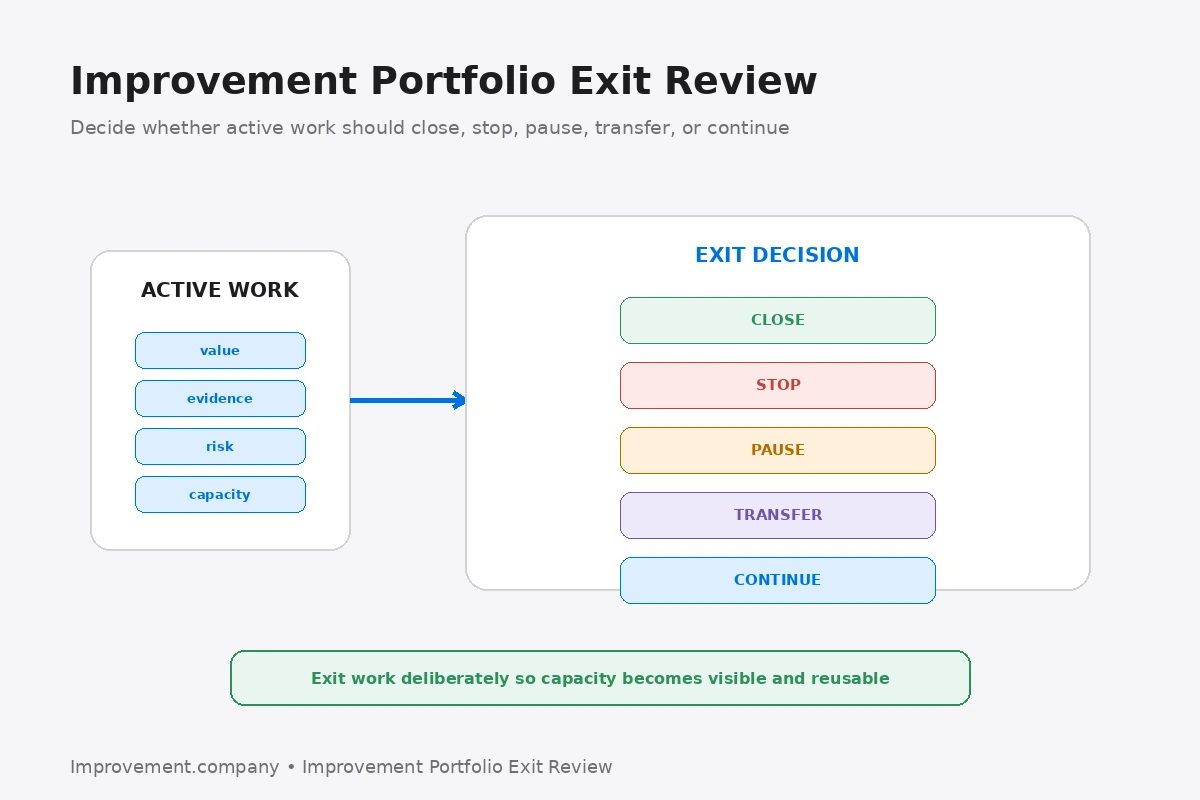
The purpose is to decide whether each item should:
- close;
- stop;
- pause;
- transfer to normal process ownership;
- remain active.
Start with the current status
Review what the work originally intended to achieve.
Improvement Project Charter helps define the problem, scope, ownership, expected value, and boundaries of an improvement effort.
Compare the current condition with that original intent.
A project should not stay active merely because people have already invested time in it.
Verify value and effectiveness
For completed work, confirm whether the expected effect is visible.
Improvement Benefit Verification helps test whether claimed benefits are supported by operational evidence.
If the work delivered the intended result, it may be ready to leave the active portfolio.
Review stop or pause logic
Some projects should exit without being completed.
Improvement Project Stop Criteria helps determine whether changing value, evidence, risk, or capacity justifies continue, rescope, pause, or stop.
Stopping weak work is a valid capacity decision.
Confirm ownership transfer
When improvement work becomes normal operating practice, responsibility should move to the process owner.
Process Ownership Handover helps transfer accountability, controls, review cadence, and unresolved risks without losing continuity.
Do not leave completed projects dependent on the improvement team for routine sustainment.
Release resources explicitly
Improvement Capacity Allocation helps assign limited improvement capability across competing priorities.
When work exits, identify what becomes available:
- CI facilitator time;
- engineering support;
- sponsor attention;
- team participation.
Released capacity should be reassigned deliberately rather than disappearing into unplanned demand.
Preserve useful learning
Capture:
- what worked;
- what failed;
- assumptions that changed;
- methods worth reusing.
Lessons Learned System helps retain knowledge so later teams do not repeat avoidable mistakes.
Common mistakes
Keeping completed projects active because no formal exit exists, allowing paused work to consume invisible capacity, treating stopped projects as failure, transferring ownership without controls, claiming benefits without evidence, and closing the project without preserving useful learning are common mistakes.
Practical sequence
- review the original charter.
- review current status.
- verify expected benefits.
- apply stop or pause criteria.
- confirm sustainment requirements.
- transfer ownership where appropriate.
- record lessons learned.
- release committed resources.
- update the active portfolio.
- reallocate capacity deliberately.
The practical lesson
An Improvement Portfolio Exit Review keeps the active portfolio honest.
Work should remain active only while it still requires improvement capacity and has a justified reason to stay there.