
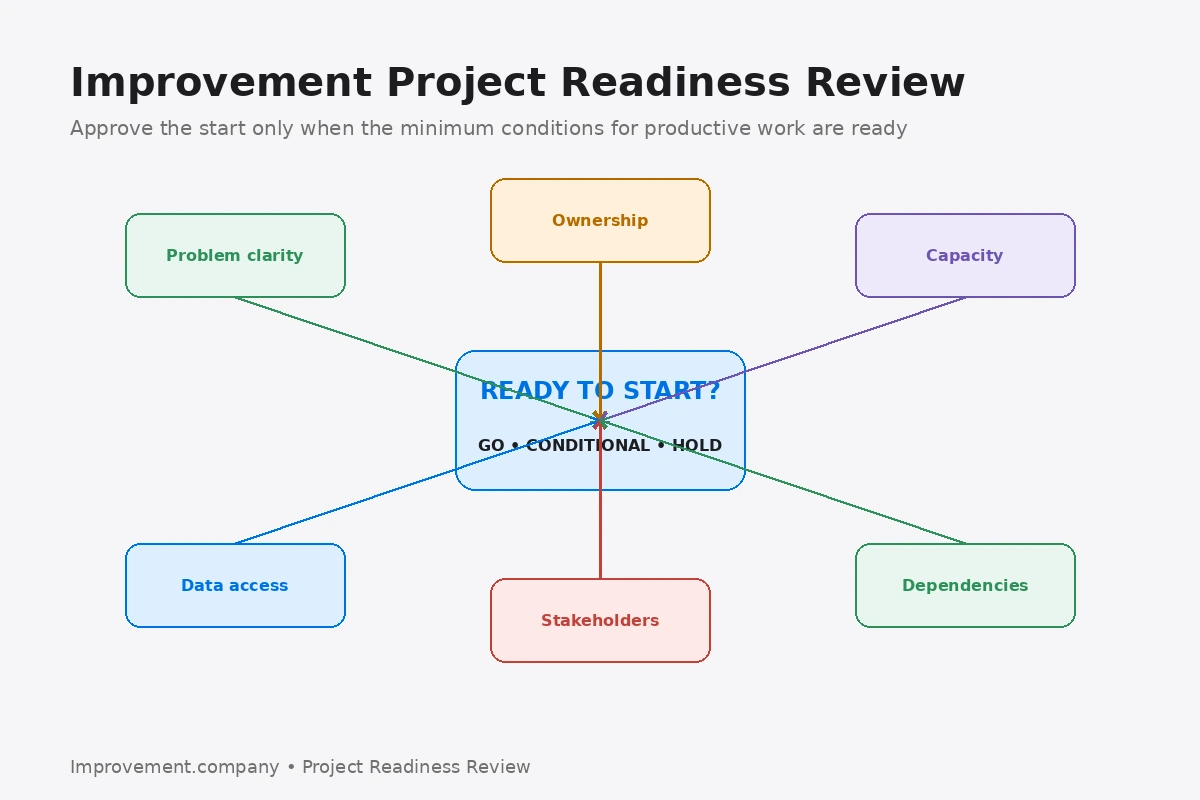
An Improvement Project Readiness Review is a pre-start check used to confirm that an approved improvement opportunity has the minimum conditions needed for productive work.
It answers a different question from project selection.
Selection asks whether the organization should do the work. Readiness asks whether the organization is actually ready to start it now.
Confirm the problem is clear enough
The team should have an evidence-based starting point.
Problem Statement helps define the expected condition, actual condition, scope, timing, and impact.
The problem does not need to be fully understood before launch, but it should be specific enough to investigate.
Confirm ownership
Identify the process owner, project lead, sponsor, and key support roles.
Improvement Project Charter helps formalize purpose, scope, goals, roles, and boundaries.
A project without an accountable owner is not ready.
Confirm capacity
Ask whether the people required to do the work are realistically available.
Improvement Capacity Planning helps compare active improvement demand with execution capacity.
Starting work without time creates immediate delay and weakens commitment.
Confirm access to evidence
The team may need process data, production access, customer information, maintenance history, or subject-matter expertise.
If critical evidence cannot be obtained, identify the dependency before launch.
Confirm stakeholder support
Stakeholder Analysis helps identify people who influence, support, use, or may be affected by the improvement.
Readiness may require sponsor alignment, operator participation, engineering support, or supplier access.
Do not discover after launch that an essential stakeholder cannot participate.
Review major dependencies
Dependencies may include a capital decision, system change, shutdown window, external test, or regulatory approval.
A project can still launch with dependencies, but they should be visible and owned.
Check whether the opportunity still makes sense
Improvement Opportunity Assessment evaluates value, strategic fit, evidence, risk, scope, and effort before capacity is committed.
If circumstances changed significantly after approval, reassess rather than launch automatically.
Make a readiness decision
Possible outcomes include ready, ready with conditions, hold, or return for clarification.
A hold is better than starting a project that cannot move.
Common mistakes
Treating approval as automatic readiness, launching before ownership is clear, assuming people will find time later, discovering missing data after the project starts, ignoring stakeholder availability, creating a readiness checklist with no decision authority, and holding projects for minor issues that could be resolved during normal investigation are common mistakes.
Practical sequence
- confirm the problem statement.
- confirm process ownership.
- confirm project leadership.
- confirm improvement capacity.
- confirm access to required evidence.
- confirm key stakeholder availability.
- identify major dependencies.
- verify the opportunity still matters.
- decide ready, conditional, or hold.
- start only when the minimum conditions for productive work exist.
The practical lesson
An Improvement Project Readiness Review protects scarce improvement capacity.
A valuable project started too early can create more delay than a project deliberately held until the essential conditions are ready.
Related application
This topic also connects with Improvement Resource Commitment Review. Use that method when the improvement requires the related operating or management discipline.