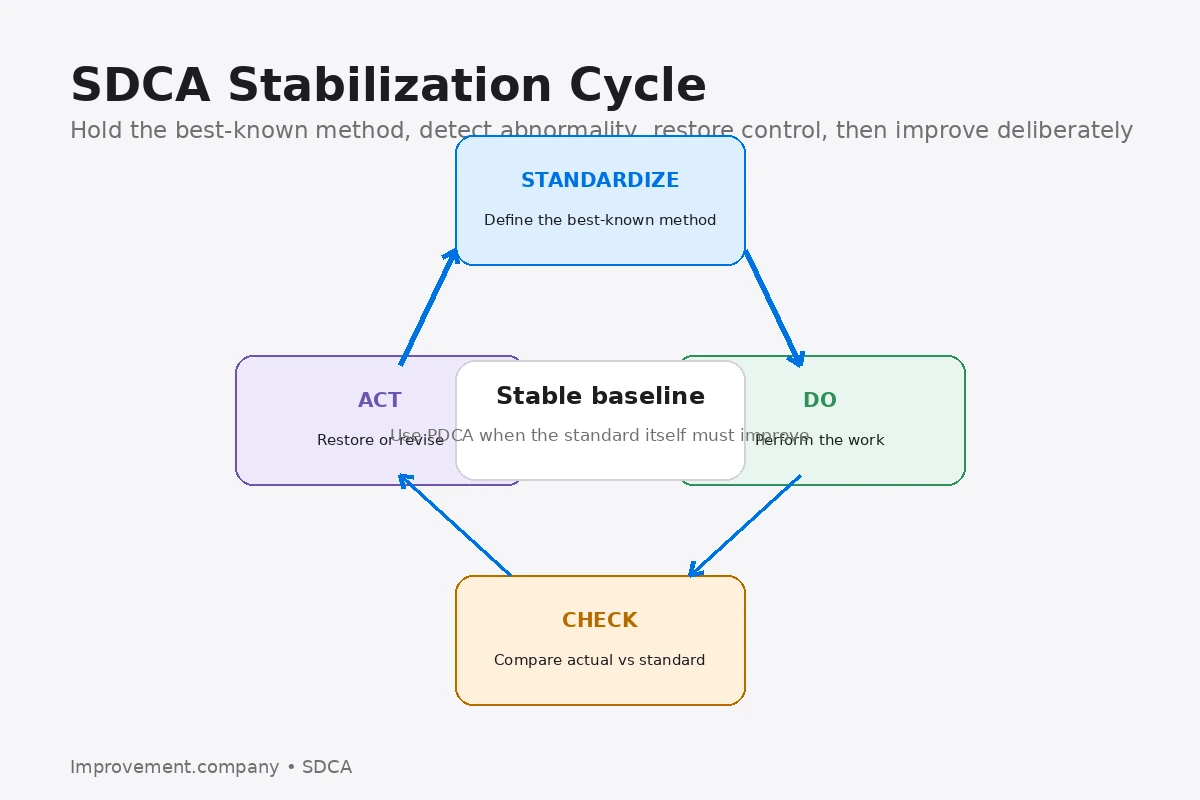
SDCA stands for Standardize, Do, Check, and Act.
It is a management cycle used to maintain a known good method and keep a process stable before the organization attempts the next improvement.
PDCA and SDCA support different needs.
PDCA is primarily a learning and improvement cycle. SDCA is primarily a stabilization and sustainment cycle.
Standardize the best-known method
The cycle begins with a defined standard.
That standard may include:
- work sequence;
- process parameters;
- quality checks;
- visual controls;
- maintenance tasks;
- reaction plans.
Standard Work provides a clear baseline for repetitive operational work.
The standard should represent the best-known practical method, not an outdated document that no longer matches the Gemba.
Do the work according to the standard
The team performs the process using the agreed method.
The purpose is not blind compliance.
The purpose is to create a stable reference condition so variation becomes easier to recognize.
If every person uses a different sequence or setting, the process has no reliable baseline for learning.
Check actual versus standard
The Check step compares actual performance with the intended condition.
Questions include:
- Was the method followed?
- Was the required result achieved?
- Were abnormal conditions visible?
- Did the standard remain practical?
- Did the process drift?
Process Confirmation can support direct verification at the workplace.
The check should examine both adherence and whether the standard itself is still capable of producing the expected result.
Act on gaps
When a gap appears, the team should decide what kind of response is required.
Possible responses include:
- restore the standard;
- correct a missing condition;
- retrain;
- repair equipment;
- remove a barrier;
- revise the standard if the current one is no longer appropriate.
The objective is to return the process to a known controlled condition.
Know when to switch from SDCA to PDCA
If the current standard is consistently followed but still cannot meet the required target, repeated SDCA is not enough.
That is an improvement problem.
The team should move into PDCA, A3, DMAIC, or another structured improvement method.
After the new method is verified, Standardization After Improvement turns the learning into a revised standard.
Then SDCA begins again around the new baseline.
Use SDCA in daily management
SDCA is especially useful in environments where the operating system must hold many standards simultaneously.
Examples include:
- production;
- maintenance;
- quality inspection;
- service operations;
- transactional processes.
Daily Management System helps reveal when performance deviates from the expected standard and when restoration or improvement is required.
Avoid using standards as blame tools
A deviation does not automatically mean the employee is the problem.
Ask:
- Is the standard clear?
- Is it physically practical?
- Are tools and materials available?
- Is demand forcing shortcuts?
- Has the process changed?
A stable system requires standards that people can actually follow.
Common mistakes
Writing standards without verifying them at the Gemba, treating SDCA as rigid compliance, blaming people for systemic barriers, repeatedly restoring a process that is incapable of meeting the target, and failing to update the standard after a proven improvement are common mistakes.
Practical sequence
- define the best-known method.
- make the standard visible.
- perform the work according to the method.
- compare actual versus standard.
- identify abnormalities.
- restore missing conditions.
- revise the standard when justified.
- use PDCA when the standard itself must improve.
- standardize the verified new method.
- repeat SDCA around the new baseline.
The practical lesson
SDCA protects stability while PDCA creates learning.
Strong continuous improvement needs both: hold the current best-known method, then improve it deliberately.