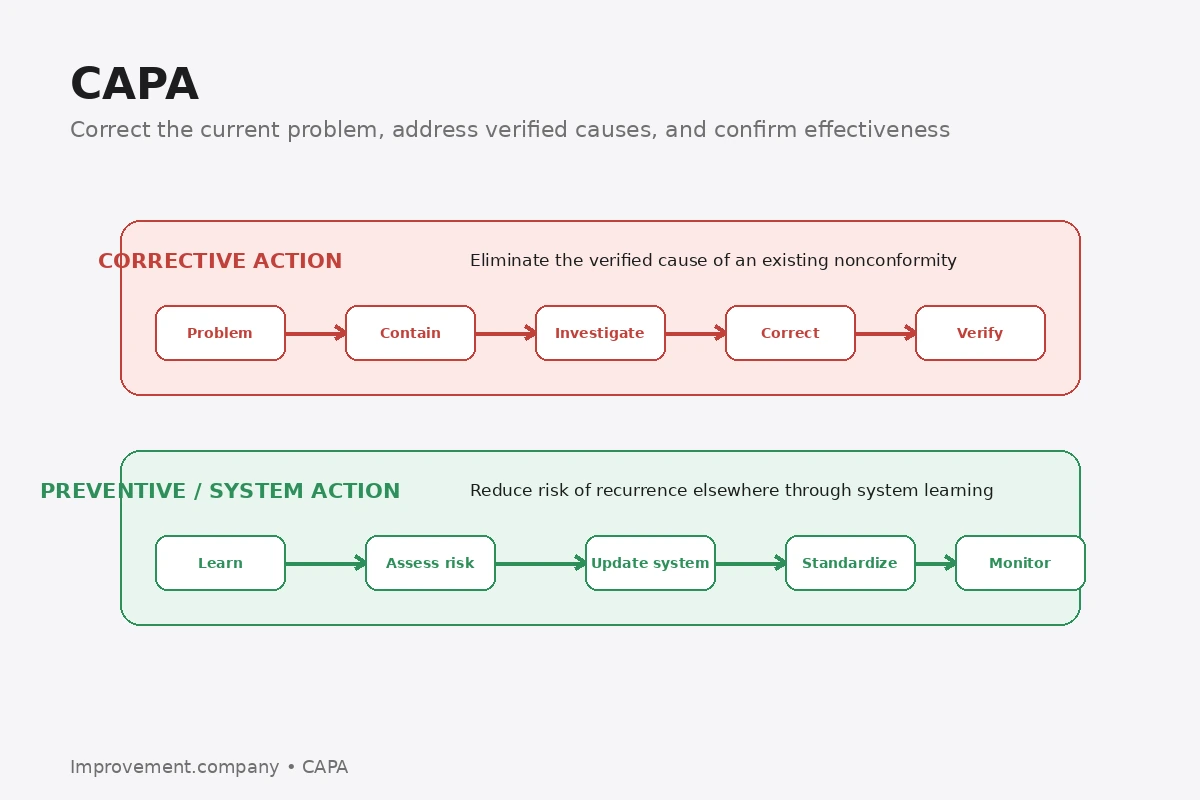
CAPA stands for Corrective and Preventive Action.
It is a structured way to respond to significant problems, determine why they happened, correct the causes, and strengthen the system so similar problems are less likely to occur.
CAPA is common in regulated industries, but the logic is useful in any organization that needs disciplined problem resolution.
Corrective action is not correction
A correction fixes the immediate problem.
Examples include:
- replacing a defective part;
- reworking a product;
- correcting a document;
- restoring a failed machine;
- shipping a replacement order.
Corrective action goes further.
It addresses the cause of the problem so recurrence becomes less likely.
If a mislabeled container is relabeled, that is correction.
If the labeling process is changed so the wrong label cannot be selected, that is corrective action.
What preventive action means
Preventive action addresses a potential problem before it occurs.
It may come from:
- risk analysis;
- audit findings;
- trend data;
- near misses;
- lessons learned;
- failure-mode analysis;
- similar problems in another process.
Modern quality systems often integrate preventive thinking into risk management rather than treating it as a completely separate activity.
The important idea is prevention, not the label used on the form.
Start with containment
When a significant problem is discovered, the first responsibility is usually to control the immediate risk.
Containment may include:
- stopping shipment;
- identifying affected material;
- segregating inventory;
- adding temporary inspection;
- notifying customers;
- stopping the process.
Containment protects the customer while the deeper investigation continues.
This is different from permanent corrective action.
Investigate the cause
Root Cause Analysis provides the core thinking for a CAPA investigation.
Methods such as 5 Whys, Fishbone Analysis, and 4M Analysis can help organize possible causes.
The team should verify evidence rather than select the most convenient explanation.
“Operator error” is rarely enough.
Ask what conditions in the system made the error possible or likely.
Define actions that match the cause
Corrective actions should logically address the verified cause.
If the cause is an incorrect fixture design, retraining alone will not solve the problem.
If the cause is an unclear specification, adding inspection may only detect the same problem later.
Possible actions include:
- design changes;
- process controls;
- software changes;
- revised Standard Work;
- maintenance changes;
- mistake-proofing;
- supplier controls;
- training when a real skill gap exists.
Poka-Yoke is especially valuable when the action can prevent the error rather than rely on detection.
Verify effectiveness
A CAPA is not complete when the action is installed.
The team should verify that the action actually worked.
Useful questions include:
- Has the problem recurred?
- Did the failure rate decrease?
- Is the new control being followed?
- Did the change create another risk?
- Is the process stable?
A Control Plan can help sustain the new controls after the CAPA is closed.
Common mistakes
Closing the CAPA after containment, selecting causes without evidence, assigning actions unrelated to the cause, using training as the default response, and failing to verify effectiveness all weaken the process.
Practical sequence
- Define the problem clearly.
- Contain immediate risk.
- Gather evidence.
- Identify and verify causes.
- Define corrective actions.
- Review related processes for similar risk.
- Implement preventive controls where appropriate.
- Update standards and control plans.
- Verify effectiveness.
- Close only when evidence supports closure.
The practical lesson
CAPA is not paperwork for recording that a problem was fixed.
It is a disciplined method for turning a problem into system learning and stronger prevention.