
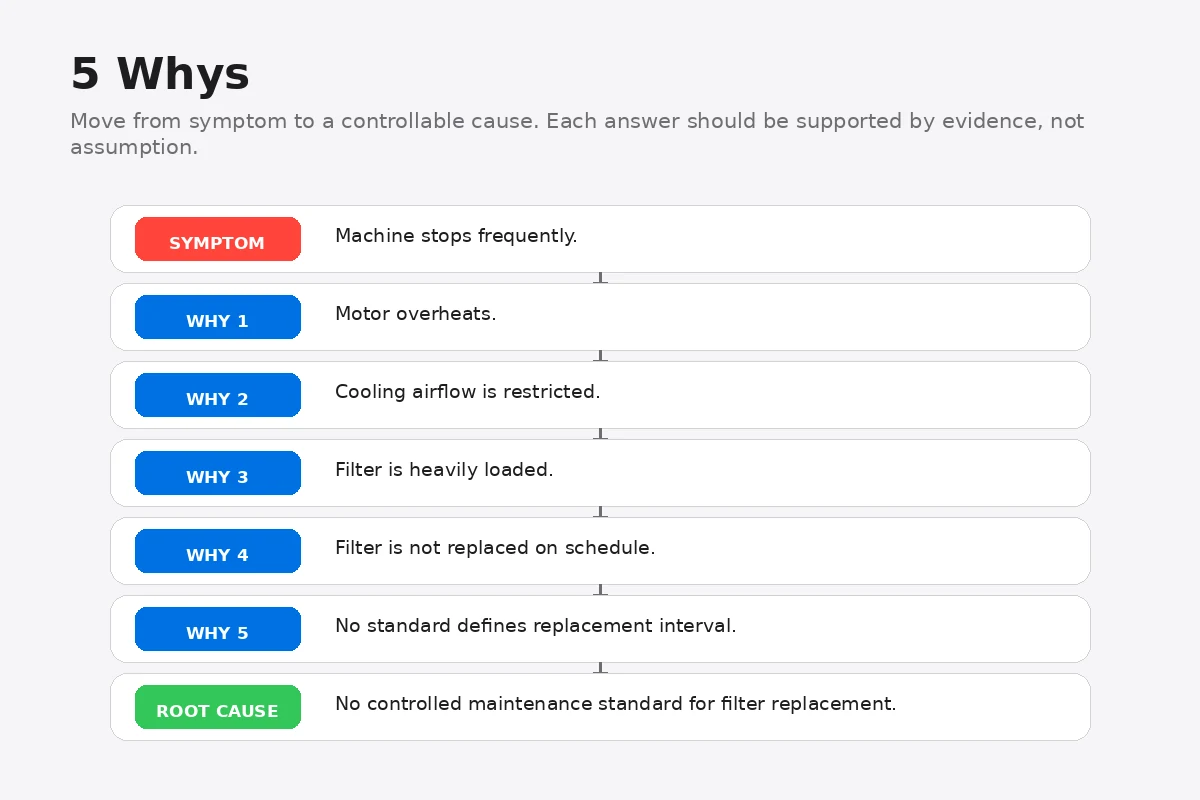
5 Whys is a problem-solving technique that explores cause-and-effect relationships by repeatedly asking why a problem occurred.
The name does not mean every investigation must contain exactly five questions.
The objective is to move beyond the immediate symptom and understand the process conditions that allowed the problem to happen.
Start with a specific problem
Weak problem statements create weak analysis.
Instead of starting with a broad statement such as “quality is poor,” define what happened, where it happened and what condition was expected.
Follow the causal chain
Each answer should lead logically to the next why.
For example:
A machine stopped.
Why? A drive fault occurred.
Why? The motor overheated.
Why? Cooling airflow was restricted.
Why? The filter was heavily contaminated.
Why? The filter inspection was not included in the maintenance standard.
The analysis has moved from the event toward a system condition that can be addressed.
Verify the answers
5 Whys should not become a storytelling exercise.
Whenever possible, confirm each cause with evidence from the process, equipment, records or people involved.
If the chain depends on assumptions, investigate before continuing.
More than one cause may exist
Complex problems rarely have a single neat chain.
Teams may need multiple branches or a fishbone diagram to explore different categories of causes.
5 Whys is useful because it is simple, but simplicity should not replace careful analysis.
Avoid blaming people
Stopping at “the operator made a mistake” usually provides little improvement value.
Ask what conditions made the error possible.
Consider training, standards, equipment design, information, workload, visual controls and mistake-proofing.
The aim is to strengthen the process.
When 5 Whys works well
5 Whys is most useful when the cause-and-effect chain is reasonably direct and the team can verify the steps.
It can work well for equipment abnormalities, process errors, missed standards and recurring operational problems where the investigation remains close to observable facts.
The method is attractive because it is simple enough to use at Gemba without specialized software.
When 5 Whys is not enough
Some problems involve several interacting causes.
A quality defect may depend on material, equipment, method, measurement and environmental conditions at the same time. In those situations, a single linear chain can oversimplify the system.
A fishbone diagram, fault tree, FMEA, statistical analysis or other method may be more appropriate.
The investigator should choose the method based on the problem, not force every problem into five questions.
Test whether the cause is actionable
A useful cause points toward a condition the organization can change or control.
Statements such as “human error,” “lack of attention” or “bad luck” usually end the investigation too early.
Continue asking what process conditions made the event possible.
Was the standard unclear? Was the task difficult to perform correctly? Was the error detectable? Was the equipment condition unstable? Was the training adequate?
Confirm the countermeasure
Finding a plausible root cause is not the end of the investigation.
The countermeasure should reduce or remove the causal mechanism, and the team should verify that the problem no longer occurs under the relevant conditions.
If the problem returns, the original analysis may have been incomplete.
The value of 5 Whys comes from improving the process, not from completing five lines on a form.
Connect this concept to the wider system
For deeper application, connect this concept with Root Cause Analysis and A3 Problem Solving. These methods help move from understanding the topic to managing it as part of a wider improvement system.