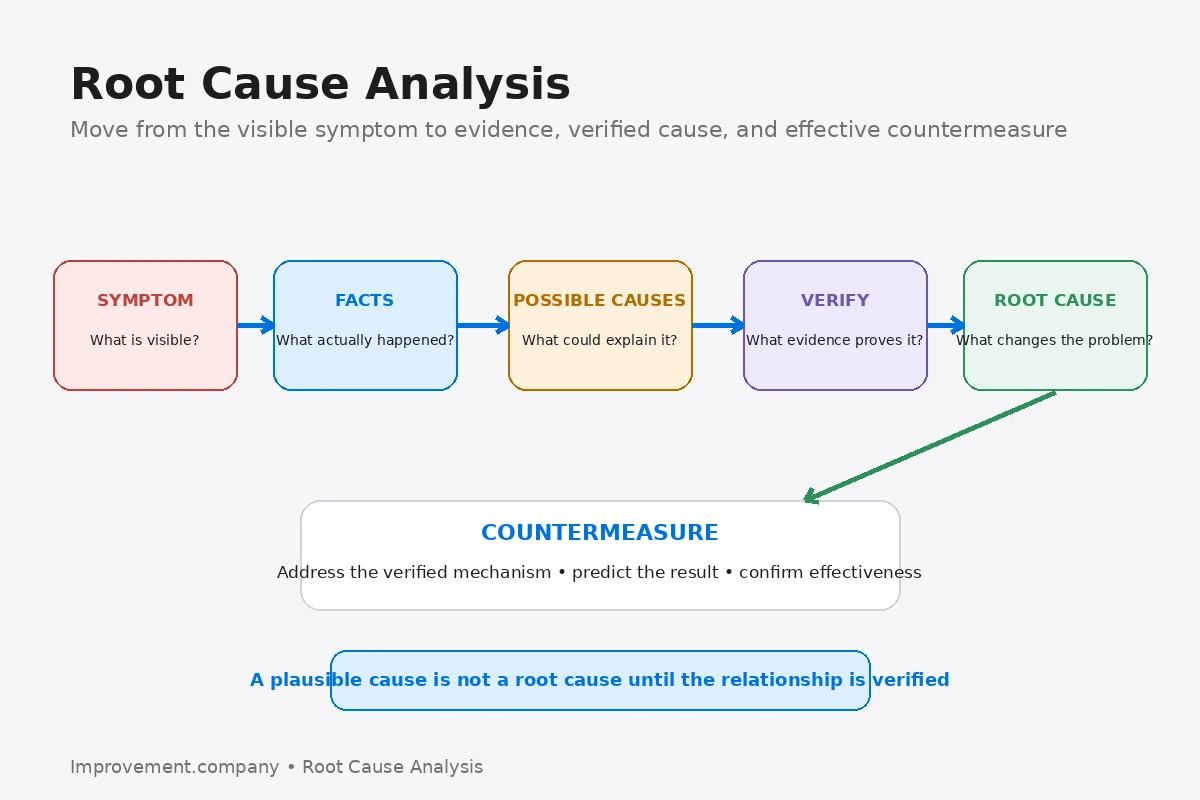
Root Cause Analysis, often abbreviated RCA, is the structured process of understanding why a problem occurred and identifying the conditions that must change to prevent recurrence.
The objective is not to find a person to blame or to select the first plausible explanation. The objective is to establish a cause-and-effect relationship that is supported by evidence.
Start with a clear problem statement
Cause analysis becomes weak when the problem itself is vague.
The team should define what happened, where it happened, when it happened, how often it occurs and what the expected condition should have been.
Specific problem definition narrows the investigation and helps distinguish relevant evidence from unrelated information.
Symptoms are not root causes
A symptom describes what was observed.
For example, a machine stop, a customer complaint or a defect is evidence of a problem, but it is not automatically the underlying cause.
The analysis needs to move deeper into the process conditions that allowed the event to occur.
Statements such as “operator error” or “lack of attention” are rarely sufficient because they do not explain why the system allowed the error to create the outcome.
Choose the method based on complexity
There is no single RCA tool that fits every problem.
5 Whys can work well when the causal chain is relatively direct.
A fishbone diagram can help organize multiple possible causes across categories.
Fault-tree analysis, FMEA, statistical methods, equipment diagnostics or designed experiments may be needed for more complex problems.
The method should match the risk, data and structure of the problem.
Verify causes before acting
A suspected cause should be tested against evidence.
If the condition is present, does the problem occur? If the condition is removed or controlled, does the problem disappear?
The exact verification method varies, but the team should avoid implementing expensive countermeasures based only on opinion.
Containment and corrective action are different
Immediate containment protects the customer or process now.
Corrective action changes the causal mechanism that produced the problem.
Both may be necessary.
A temporary inspection can contain a quality problem while the team investigates why the defect is being created.
Confusing containment with permanent correction is one reason recurring problems return.
Verify the countermeasure
After implementation, the team should confirm that the problem has been reduced or eliminated under the relevant operating conditions.
It should also check that the change did not introduce new safety, quality, delivery or maintenance risks.
If the problem returns, the original cause analysis may have been incomplete.
Build learning into the system
A successful RCA should update the operating system.
That may include Standard Work, maintenance plans, training, visual controls, process parameters, design standards or FMEA.
The value of RCA is not the completed report. It is the removal of a verified causal mechanism and the transfer of that learning into future work.
Additional connections
This topic also connects with CAPA, Fault Tree Analysis, and Is / Is Not Analysis. These relationships are useful when the team needs to extend the method into a wider improvement system.
Related application
This topic also connects with Countermeasure Management. Use that method when the improvement requires the related management or operating discipline.
Related application
This topic also connects with Barrier Analysis. Use that method when the improvement requires the related operating or management discipline.
Related application
This topic also connects with Event and Causal Factor Charting. Use that method when the improvement requires the related operating or management discipline.
Related application
This topic also connects with Change Point Analysis. Use that method when the improvement requires the related operating or management discipline.
Related application
This topic also connects with Cause Verification. Use that method when the improvement requires the related operating or management discipline.
Related application
This topic also connects with Fault Isolation. Use that method when the improvement requires the related operating or management discipline.