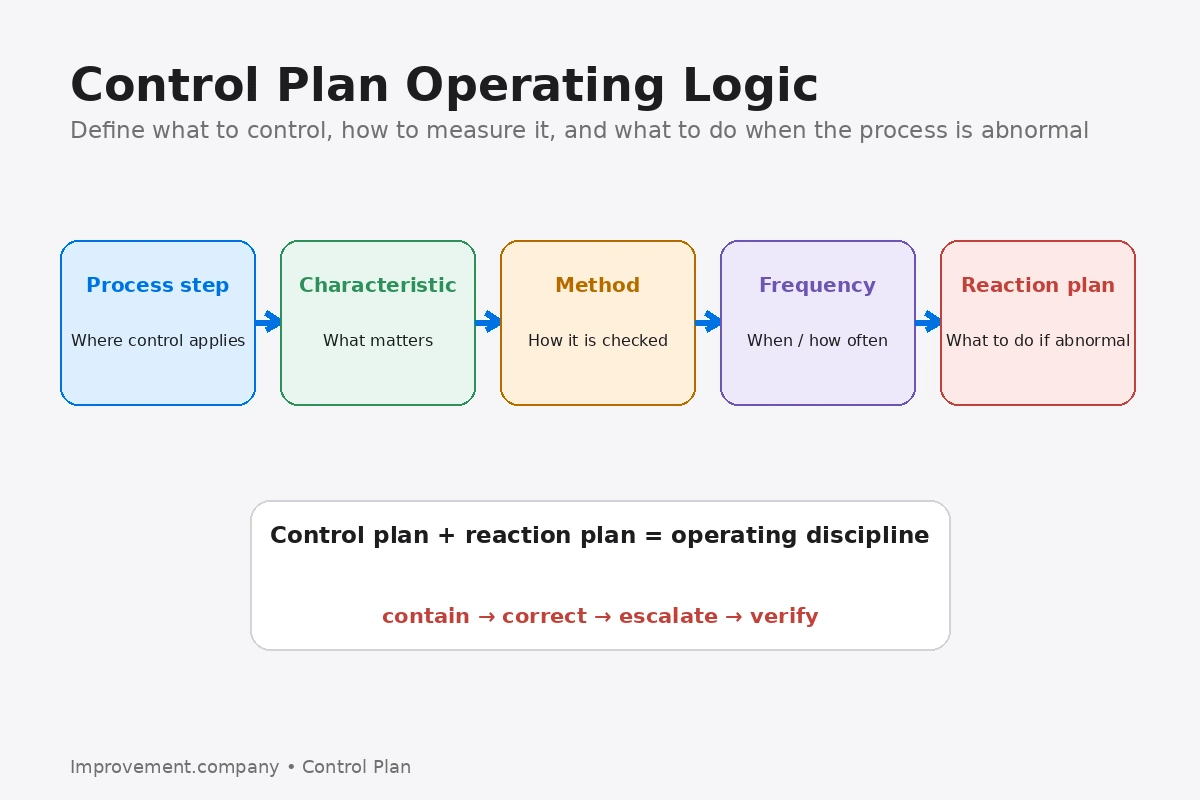
A Control Plan is a structured document that defines how important process and product characteristics will be monitored and controlled.
Its purpose is to make an improved process sustainable. A project may identify the right settings, inspection points, reaction rules, and responsibilities. The Control Plan turns those decisions into an operating method that can be followed every day.
What a Control Plan should answer
A useful Control Plan should make several questions clear:
- What characteristic matters?
- Where is it measured or checked?
- What specification or target applies?
- How is it measured?
- How often is it checked?
- Who performs the check?
- What happens if the result is abnormal?
- Where is the result recorded?
If the plan cannot answer these questions, it may not be strong enough to control the process.
Control Plans and DMAIC
The Control Plan is commonly associated with the Control phase of DMAIC.
During Define, Measure, Analyze, and Improve, the team learns which inputs and conditions affect the desired output. The Control phase protects those gains.
A Control Plan captures the critical conditions that must remain stable after the project team leaves.
Connect the plan to CTQs
The most important controls should connect to customer requirements.
Critical to Quality characteristics help identify the outputs that matter most. The Control Plan should then define the process controls that protect those requirements.
For example:
Customer need → accurate torque.
CTQ → torque must remain within a defined specification.
Process control → calibrated tool, programmed torque range, verification frequency, reaction plan.
Include both product and process controls
A weak Control Plan focuses only on final inspection.
A stronger plan also controls process conditions that influence the result, such as temperature, pressure, speed, torque, material lot, setup position, tool condition, fixture condition, measurement method, and operator qualification.
Preventive process controls are usually stronger than relying only on detection after the work is complete.
Define the reaction plan
One of the most important parts of a Control Plan is the reaction plan.
If a check fails, the plan may require the team to stop or contain the process, identify affected material, notify the responsible role, correct the immediate condition, investigate the cause, verify the process before restart, and document the event.
This connects closely with Jidoka, because both emphasize preventing an abnormal condition from continuing unchecked.
Measurement-system quality matters
A Control Plan can fail if the measurement system is unreliable.
If inspectors, gauges, or test systems produce inconsistent results, the process may appear stable when it is not. Measurement System Analysis helps verify that the measurement method is suitable for the decision.
Control Plan vs Standard Work
A Control Plan defines what must be controlled and how abnormal conditions are handled.
Standard Work defines the best-known method for performing the work consistently.
They complement each other.
Common mistakes
Creating the plan only for an audit, listing checks without reaction rules, monitoring too many characteristics, leaving ownership unclear, and failing to update the plan when the process changes all weaken control.
Practical sequence
- Identify CTQs and critical process characteristics.
- Define the required specification or target.
- Select a suitable measurement method.
- Set the checking frequency.
- Assign responsibility.
- Define the reaction plan.
- Connect the plan to Standard Work and visual controls.
- Train the affected roles.
- Audit whether the plan is being followed.
- Update it when the process or risk changes.
The practical lesson
A Control Plan is the bridge between improvement and sustainment.
It converts project learning into a daily control system that keeps the process from drifting back to the old condition.
Related application
This topic also connects with First Article Inspection. Use that method when the improvement requires the related operating or management discipline.
Related application
This topic also connects with Control Plan Reaction Verification. Use that method when the improvement requires the related operating or management discipline.