
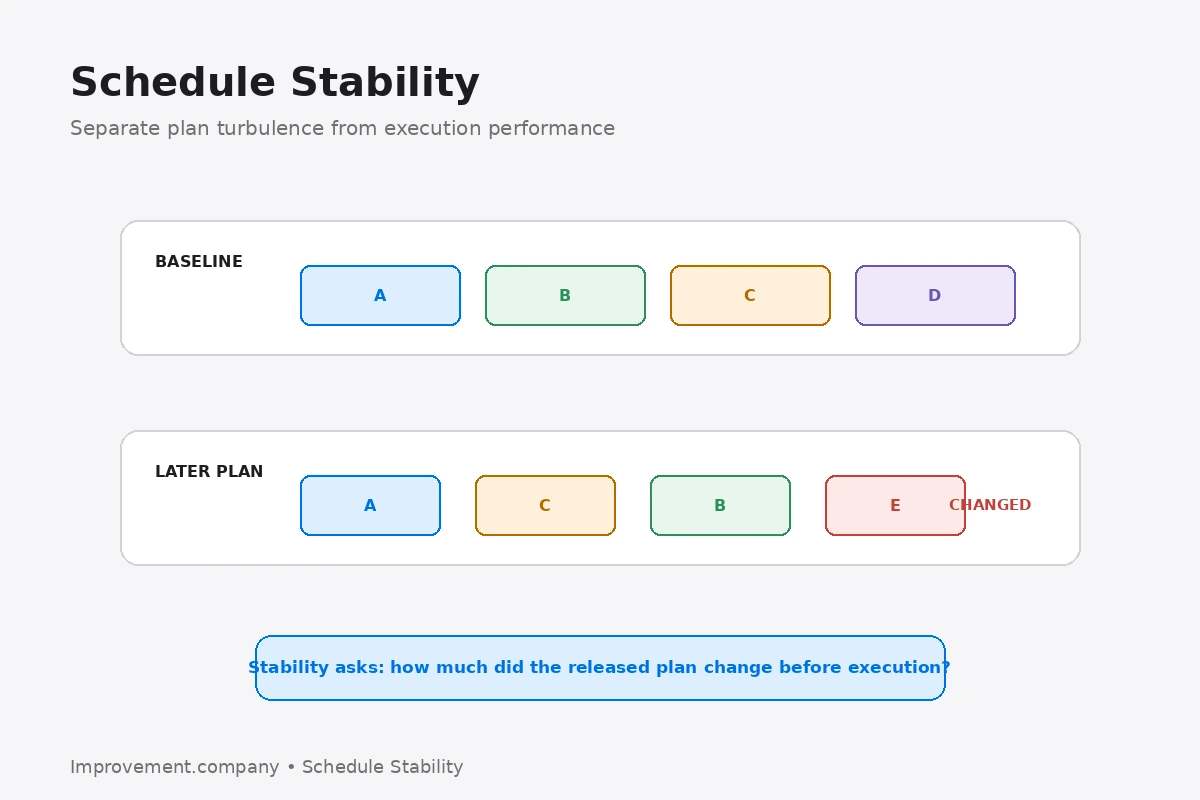
Schedule Stability measures how consistently the near-term production plan remains unchanged after it is released for execution.
The purpose is not to freeze every plan forever.
The purpose is to understand how much schedule change the operating system is being asked to absorb.
Frequent changes can create:
- material shortages;
- setup loss;
- sequence disruption;
- expediting;
- overtime.
Define the comparison point
Choose when the schedule becomes the baseline.
Examples include:
- start of shift;
- 24 hours before execution;
- freeze-window release.
Production Schedule Freeze Window helps define a protected near-term horizon in which changes require explicit authorization.
Schedule stability should use the same operating logic.
Define what counts as change
Changes may include:
- product;
- quantity;
- sequence;
- due time;
- cancellation.
Decide which changes matter enough to measure.
A minor administrative edit should not count the same as moving a major order.
Separate authorized and avoidable changes
Some changes are legitimate.
Examples include:
- equipment failure;
- quality hold;
- safety issue;
- major customer emergency.
Other changes may come from:
- weak planning;
- missing material;
- late priority decisions.
Finite Capacity Scheduling helps create a feasible schedule before execution.
A stable but impossible plan is not useful.
Use a practical metric
Possible measures include:
- percentage of orders unchanged;
- number of sequence changes;
- hours of work moved;
- changes inside the freeze window.
Production Sequence Adherence complements schedule stability by showing whether execution follows the intended order.
Stability measures the plan. Adherence measures execution against the plan.
Connect changes with consequences
Track whether frequent schedule changes drive:
- setup increases;
- material expedites;
- missed shipments;
- WIP growth.
This helps distinguish harmless flexibility from damaging instability.
Investigate recurring sources
Classify change reasons such as:
- customer;
- material;
- capacity;
- maintenance;
- planning.
Schedule Attainment helps compare completed production with the released schedule and identify whether instability is damaging performance.
Avoid optimizing stability alone
A perfectly stable schedule may still be wrong.
The objective is a feasible, useful plan that changes only when the business case for change exceeds the disruption created.
Common mistakes
Counting every edit equally, rewarding stability even when the plan is infeasible, mixing planning change with execution noncompliance, hiding authorized emergencies, failing to link changes with operational consequences, and blaming production for instability created by upstream planning are common mistakes.
Practical sequence
- define the schedule baseline.
- define meaningful change types.
- measure changes inside the chosen horizon.
- classify reasons.
- separate authorized from avoidable change.
- connect changes with operating consequences.
- review repeat sources.
- improve planning inputs.
- protect the near-term execution window.
- balance stability with legitimate responsiveness.
The practical lesson
Schedule Stability makes planning turbulence visible.
Operations can execute more reliably when the near-term plan is feasible, protected, and changed only for reasons worth the disruption.
Related application
This topic also connects with Production Schedule Change Review. Use that method when the improvement requires the related operating or management discipline.