
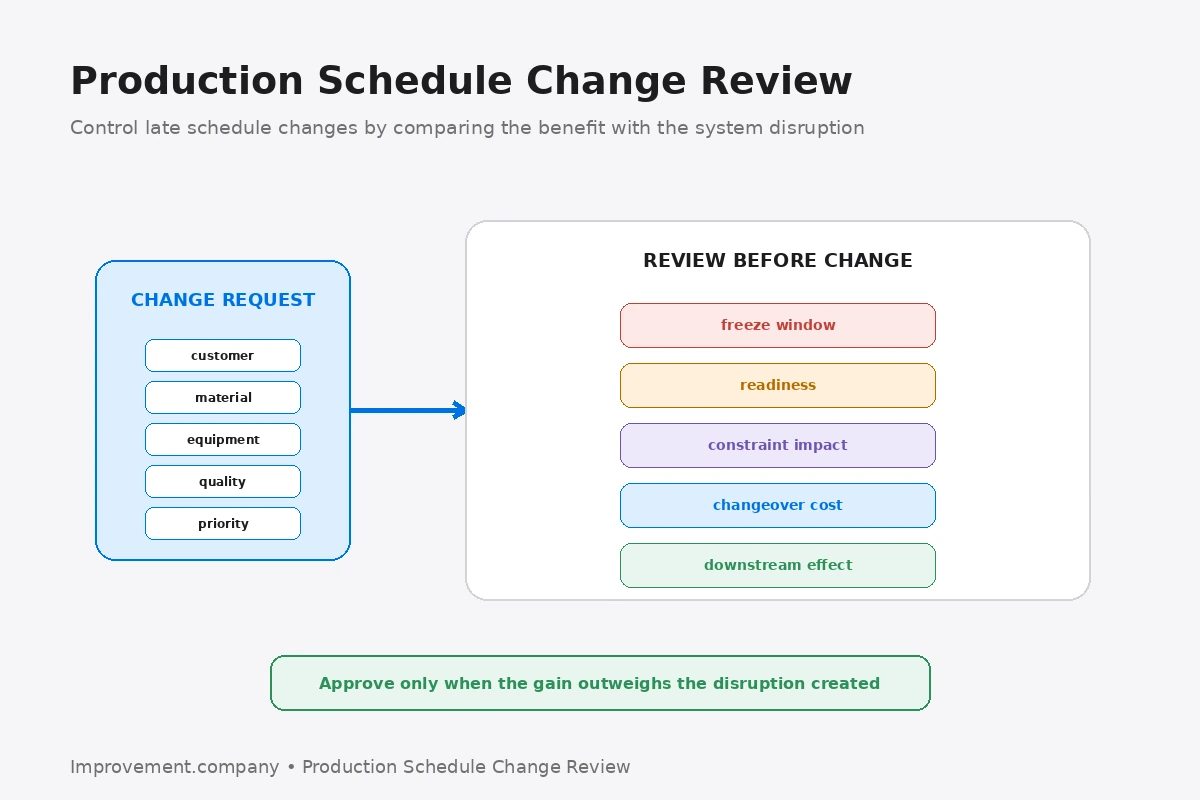
A Production Schedule Change Review evaluates requests to change a committed production sequence or schedule after the normal planning window.
The purpose is not to prevent every change.
The purpose is to distinguish justified changes from avoidable instability.
Start with the reason
Typical schedule-change requests include:
- urgent customer demand;
- material shortage;
- equipment failure;
- quality hold;
- priority override.
Schedule Stability helps measure how much the committed plan changes after release.
The review should make the reason visible before changing the schedule.
Check the freeze window
Production Schedule Freeze Window defines the period where changes require stronger justification because preparation and execution commitments are already underway.
A request inside the freeze window should receive more scrutiny than a normal planning update.
Review customer impact
Ask:
- What customer need changes if we keep the current schedule?
- What commitment improves if we change it?
- Which other customer may be affected?
Avoid treating every expedite request as automatically highest priority.
Review material readiness
Production Readiness Exception Review helps expose missing material, tooling, staffing, approvals, technical information, and equipment conditions.
Changing the schedule to an unready order may simply move the problem.
Review the system constraint
Production Constraint Protection Review helps protect the resource whose lost time most directly limits throughput.
Schedule changes that increase setups or starvation at the constraint deserve careful evaluation.
Review changeover and downstream effects
Consider:
- additional setup time;
- WIP;
- downstream congestion;
- packaging;
- labor assignment.
A local customer recovery can create larger system disruption.
Apply shared priority rules
Production Priority Rules helps align customer commitment, risk, readiness, constraint impact, schedule stability, and recovery.
Use agreed logic instead of relying on the loudest requester.
Record authority and consequence
If the change is approved, record:
- who approved it;
- why;
- displaced work;
- expected consequence.
Repeated overrides should become a planning-system signal.
Common mistakes
Changing the schedule without showing the reason, accepting every expedite, moving to unready work, ignoring constraint impact, overlooking changeover cost, allowing several functions to change priorities independently, and failing to review chronic schedule changes are common mistakes.
Practical sequence
- capture the change request.
- identify the reason.
- check freeze-window status.
- assess customer impact.
- assess readiness.
- assess constraint impact.
- assess setup and downstream effects.
- apply priority rules.
- approve or reject with clear authority.
- review recurring change patterns.
The practical lesson
A Production Schedule Change Review protects flow from unnecessary instability.
The right question is not whether the schedule can change, but whether the benefit of changing it exceeds the system disruption created.