
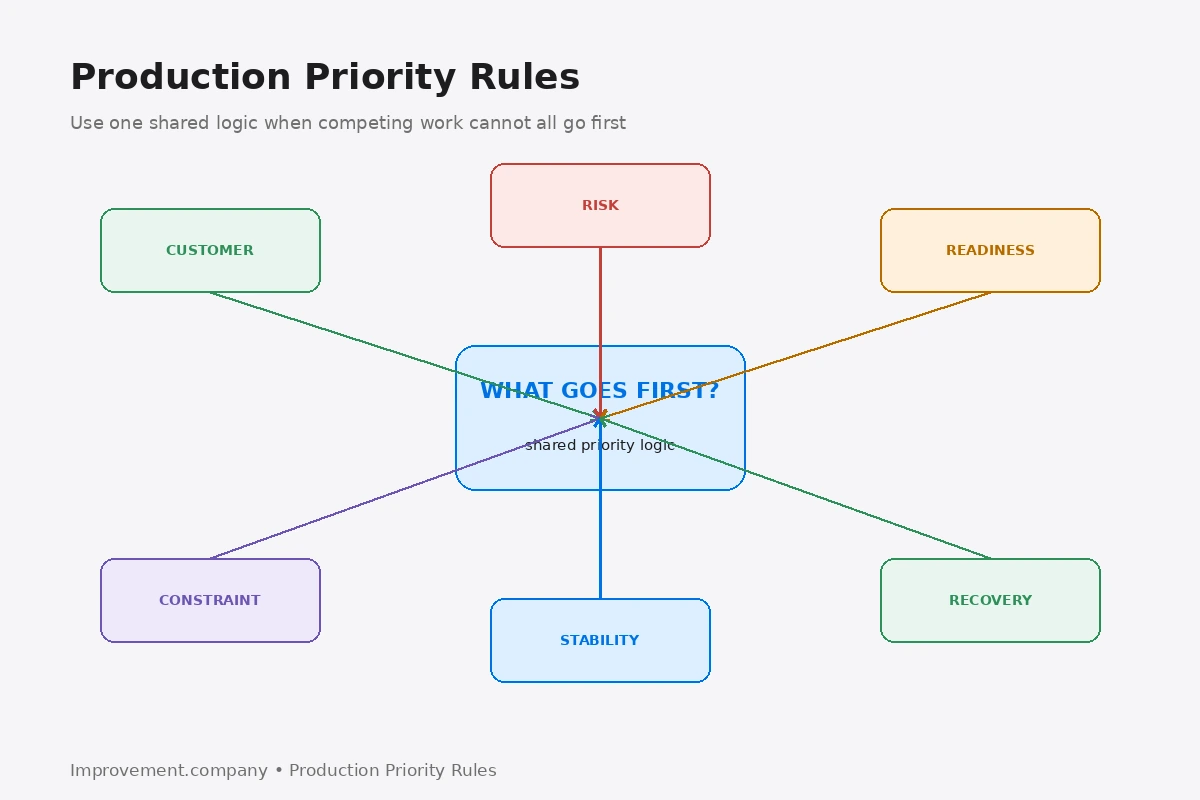
Production Priority Rules define how competing production work is ranked when everything cannot be processed at the same time.
The purpose is not to eliminate judgment. It is to make priority decisions consistent enough that operations, material handling, planning, and support functions work from the same logic.
Start with customer commitment
Priority may reflect confirmed due date, service risk, shortage recovery, or contractual requirement.
Schedule Attainment helps compare completed production with the released schedule and shows whether planned commitments are being met.
Avoid allowing the most recent request to automatically become the highest priority.
Protect safety and quality
Work that creates unresolved safety or quality risk may need to wait even when customer urgency is high. Priority rules should never override safety controls, quality holds, or regulatory requirements.
Consider material readiness
A high-priority order that cannot start may create more disruption than value.
Plan for Every Part helps define material quantity, container, location, handling, and replenishment information. Use readiness information before changing sequence.
Protect the constraint
Theory of Constraints helps identify the resource that limits total system output.
Priority decisions that starve or disrupt the constraint can reduce total throughput even when they help one order.
Protect near-term sequence stability
Production Schedule Freeze Window creates a protected execution zone where changes require explicit justification.
Late priority changes should be rare enough that the operating system can prepare materials, setups, and staffing.
Define recovery rules
After a disruption, the team may need to choose between the oldest order, highest customer risk, constraint recovery, or sequence restoration.
Daily Recovery Plan helps coordinate actions after an operating disruption. Priority rules should explain how recovery differs from normal execution.
Make overrides visible
Sometimes leadership will override the normal rule. Record the reason, decision owner, and expected impact.
Schedule Stability helps measure how much the released production plan changes before execution. Repeated overrides may indicate that the priority system is poorly designed.
Common mistakes
Using urgency without customer logic, allowing every function to create its own priority list, changing sequence without considering material readiness, ignoring the constraint, overriding the freeze window routinely, failing to define recovery priorities, and hiding leadership overrides are common mistakes.
Practical sequence
- define customer-priority logic.
- protect safety and quality rules.
- check material readiness.
- consider constraint impact.
- respect the near-term schedule.
- define recovery logic.
- assign override authority.
- record overrides.
- review disruption created by priority changes.
- refine the rules using operating evidence.
The practical lesson
Production Priority Rules make tradeoffs visible. A stable production system needs a shared answer to what goes first before the next conflict occurs.