
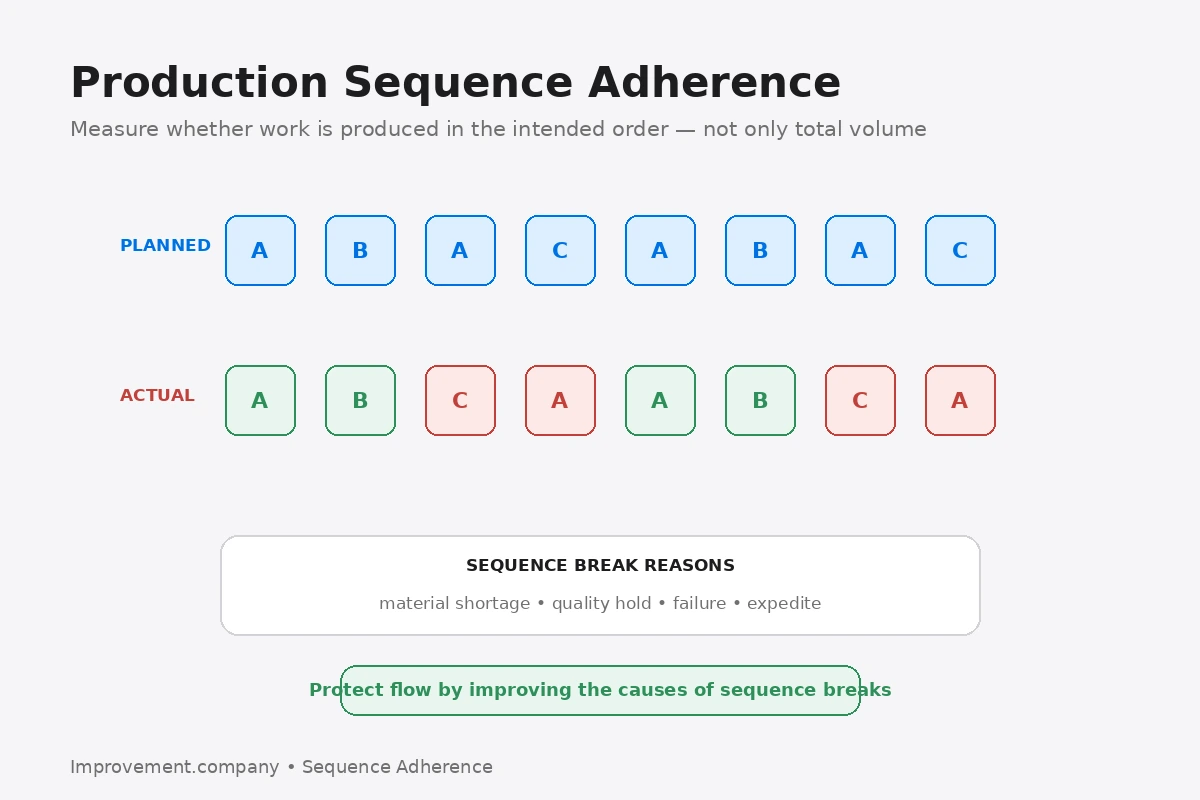
Production Sequence Adherence measures how consistently work is produced in the planned order.
The sequence may be designed to support:
- customer demand;
- leveled production;
- material availability;
- labor balance;
- shipping priority.
A plant can meet total daily output and still create significant disruption if the intended sequence is repeatedly broken.
Define the expected sequence
The sequence may come from:
- production schedule;
- heijunka pattern;
- customer build order;
- campaign logic.
Model-Mix Sequencing helps define how different products should be arranged to protect flow and resource balance.
The expected order must be visible before adherence can be measured.
Define what counts as a sequence break
Examples include:
- skipped job;
- wrong model;
- unauthorized priority change;
- excessive resequencing;
- batch inserted outside the plan.
Use an Operational Definition so teams count the same condition consistently.
Understand why sequence matters
Sequence changes can create:
- material shortages;
- labor imbalance;
- setup increase;
- shipping risk;
- WIP.
A locally convenient change may move disruption downstream.
Measure both output and sequence
Schedule Attainment answers whether the intended product and quantity were completed in the planned period.
Sequence adherence adds another question:
Was the work completed in the intended order?
Both measures can be useful when order matters operationally.
Record the reason for breaks
Useful reason codes may include:
- material unavailable;
- equipment failure;
- quality hold;
- urgent customer change;
- planning change.
Do not blame production for sequence changes caused by weak upstream planning.
Escalate repeated causes
If material shortages cause most sequence breaks, the improvement target is material readiness.
If changeovers are the issue, review setup strategy.
Heijunka relies on stable conditions to maintain leveled sequence.
Repeated deviation may show the system is not yet capable of following the designed pattern.
Avoid forcing the sequence blindly
There are legitimate reasons to break sequence.
Safety, quality, or major equipment constraints may require change.
The objective is controlled deviation, not rigid adherence at any cost.
Common mistakes
Measuring only daily volume, changing the sequence informally, defining no sequence-break rule, blaming operators for upstream shortages, using excessive expedite orders, forcing sequence when safety or quality requires deviation, and never analyzing the reasons for repeated breaks are common mistakes.
Practical sequence
- define the planned sequence.
- make it visible.
- define sequence-break criteria.
- record actual order.
- calculate adherence.
- classify break reasons.
- identify dominant causes.
- improve material, reliability, or planning conditions.
- control authorized deviations.
- verify whether sequence stability improves flow.
The practical lesson
Production Sequence Adherence protects more than scheduling discipline.
Stable sequence helps materials, labor, changeovers, and downstream processes operate with fewer surprises.