
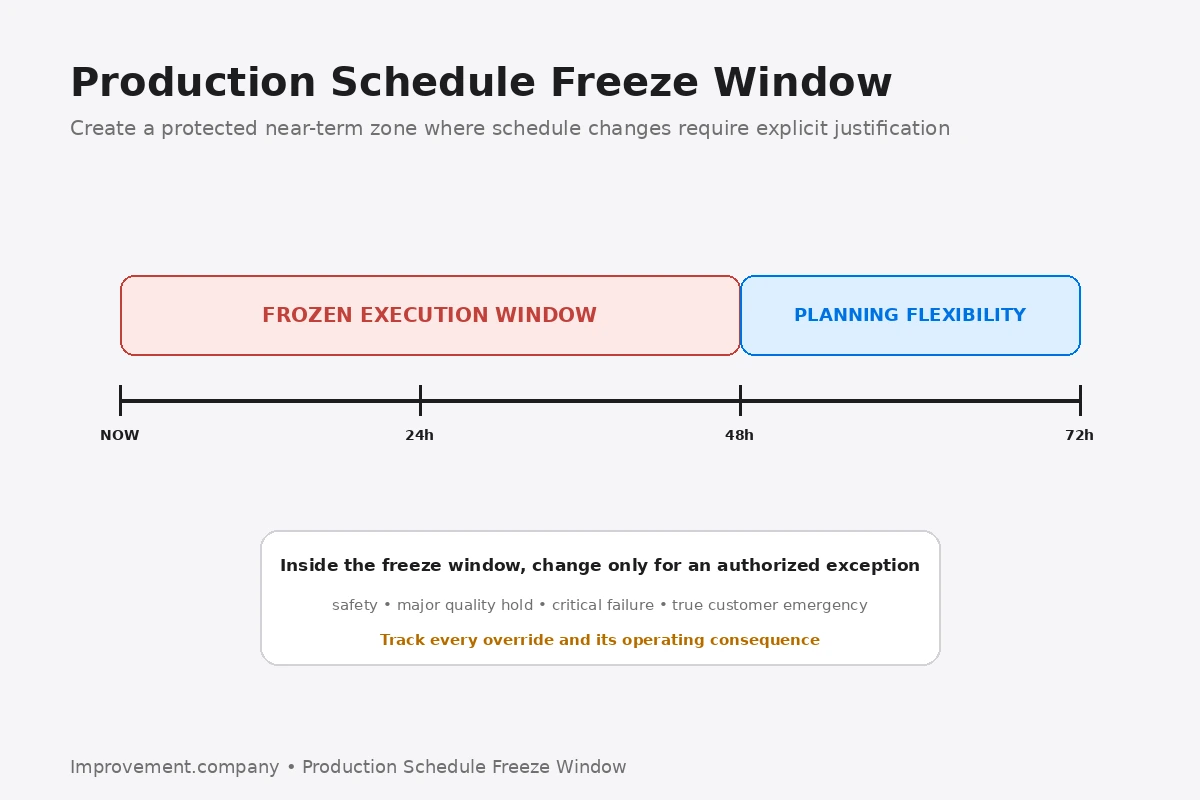
A Production Schedule Freeze Window is a defined near-term period during which the production schedule should not change without explicit authorization.
The objective is not to eliminate all customer responsiveness.
The objective is to protect the part of the schedule that operations, material handling, maintenance, and suppliers are already preparing to execute.
Define the frozen horizon
The freeze window may be:
- one shift;
- one day;
- several days.
The appropriate horizon depends on:
- material lead time;
- setup preparation;
- labor planning;
- process complexity.
Finite Capacity Scheduling helps ensure the schedule reflects the actual capacity of constrained resources.
A freeze window protects execution of that feasible plan.
Clarify what is frozen
The rule should state whether the freeze applies to:
- product;
- quantity;
- sequence;
- due time.
Different environments may need different levels of flexibility.
Define authorized exceptions
Some changes are legitimate.
Examples include:
- safety issue;
- major quality hold;
- critical equipment failure;
- high-priority customer emergency.
The process should define who can authorize an exception.
Production Sequence Adherence helps measure whether actual execution follows the intended order.
Frequent exceptions often explain poor adherence.
Make the cost of change visible
A late schedule change may create:
- missing material;
- extra setup;
- overtime;
- WIP;
- expediting.
The requestor should understand that changing one order can affect the entire operating system.
Coordinate with material readiness
Plan for Every Part helps define material quantity, container, location, handling, and replenishment information.
Near-term schedule stability allows material systems to prepare the correct parts at the correct time.
Protect the constraint
Theory of Constraints helps keep attention on the resource that limits total system output.
Schedule changes that disrupt the constraint should require particularly strong justification.
Review exception frequency
If the freeze window is broken constantly, investigate why.
Possible causes include:
- unrealistic planning;
- missing material;
- unstable demand;
- poor priority rules;
- weak capacity assumptions.
Schedule Attainment helps compare actual completion with the intended schedule and identify whether instability is damaging execution.
Adjust the horizon using evidence
A freeze window that is too long may reduce responsiveness.
A window that is too short may provide no operational stability.
Use:
- change frequency;
- adherence;
- expediting;
- service performance.
Adjust from evidence rather than preference.
Common mistakes
Freezing an unrealistic schedule, allowing anyone to override the window, making the frozen horizon so long that customer response suffers, measuring adherence without measuring authorized changes, ignoring material and setup preparation, and blaming operations for schedule instability created upstream are common mistakes.
Practical sequence
- define the freeze horizon.
- define what schedule elements are frozen.
- define authorized exception reasons.
- assign approval authority.
- publish the frozen schedule.
- prepare materials and resources.
- record late changes.
- measure sequence and schedule adherence.
- analyze repeated exceptions.
- adjust the window using operating evidence.
The practical lesson
A Production Schedule Freeze Window creates a protected zone for execution.
Near-term stability gives the operating system enough time to prepare and perform instead of continuously reacting to the latest schedule change.
Related application
This topic also connects with Schedule Stability. Use that method when the improvement requires the related operating or management discipline.
Related application
This topic also connects with Production Priority Rules. Use that method when the improvement requires the related operating or management discipline.