
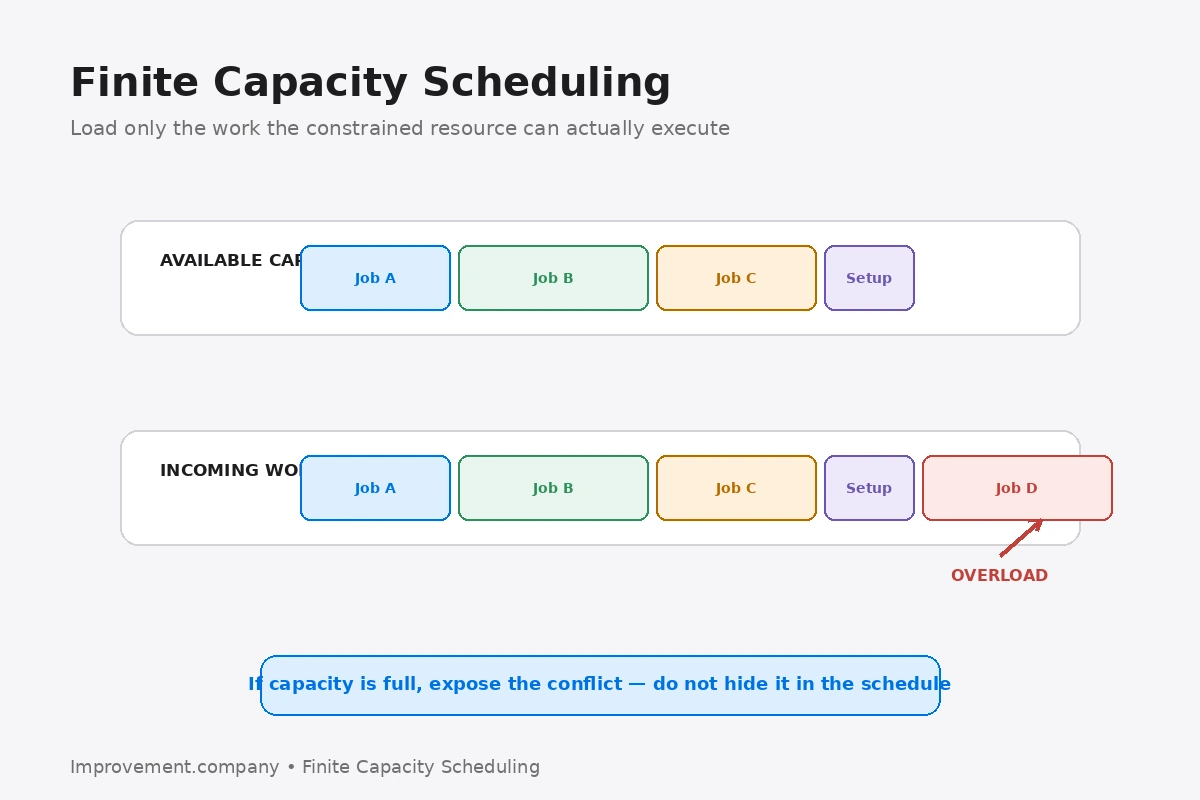
Finite Capacity Scheduling builds a production or work schedule while respecting the actual capacity of constrained resources.
Unlike an infinite-capacity plan, it does not assume that every order can be loaded into the same period regardless of machine hours, labor, tooling, sequence, or changeovers.
The objective is to create a schedule that can realistically be executed.
Start with available capacity
Capacity Planning helps compare workload with available resources.
For scheduling, capacity should reflect the actual planning period.
Consider scheduled hours, planned downtime, staffing, known losses, and calendar constraints.
Do not schedule against theoretical 24-hour availability if the resource cannot actually provide it.
Identify constrained resources
Some resources require finite loading more than others.
Examples include a bottleneck machine, heat-treatment furnace, specialized technician, or inspection laboratory.
Bottleneck Analysis helps identify where limited capacity controls flow.
The schedule should protect those resources from impossible overload.
Include sequence effects
Available hours alone may not be enough.
Sequence can change capacity because of setup time, cleaning, campaign rules, and tooling changes.
Model-Mix Sequencing helps arrange product mix to protect flow and resource balance.
Load work against the calendar
Each job should consume real capacity at the required resource.
When capacity is full, remaining work must move to another period, alternate resource, different sequence, or escalation.
The schedule should expose the conflict instead of hiding it.
Use priority rules carefully
Priority may be based on customer due date, material availability, constraint protection, product family, or risk.
Frequent manual expediting can destroy the stability that finite scheduling is intended to create.
Production Sequence Adherence helps measure whether the planned order is actually followed.
Replan when conditions change
Equipment failure, labor loss, or urgent customer changes may alter capacity.
The schedule should be updated when the underlying assumptions materially change.
Do not keep an impossible plan merely to preserve the appearance of stability.
Measure schedule quality
Useful measures include schedule attainment, sequence adherence, overload frequency, and reschedule frequency.
A schedule that changes constantly may indicate poor inputs or unrealistic planning logic.
Common mistakes
Scheduling against theoretical capacity, ignoring changeovers, loading every order into the same period, relying on expediting to resolve overload, failing to identify the true constraint, preserving an impossible schedule after capacity changes, and measuring only whether a schedule was published are common mistakes.
Practical sequence
- define the planning horizon.
- calculate available capacity.
- identify constrained resources.
- include setup and sequence effects.
- load work against the calendar.
- identify overload.
- resolve conflicts deliberately.
- publish the feasible schedule.
- control authorized changes.
- compare actual execution with the finite plan.
The practical lesson
Finite Capacity Scheduling makes overload visible before execution.
A realistic schedule is more useful than a perfect-looking plan that the resources could never run.
Related application
This topic also connects with Production Schedule Freeze Window. Use that method when the improvement requires the related operating or management discipline.