
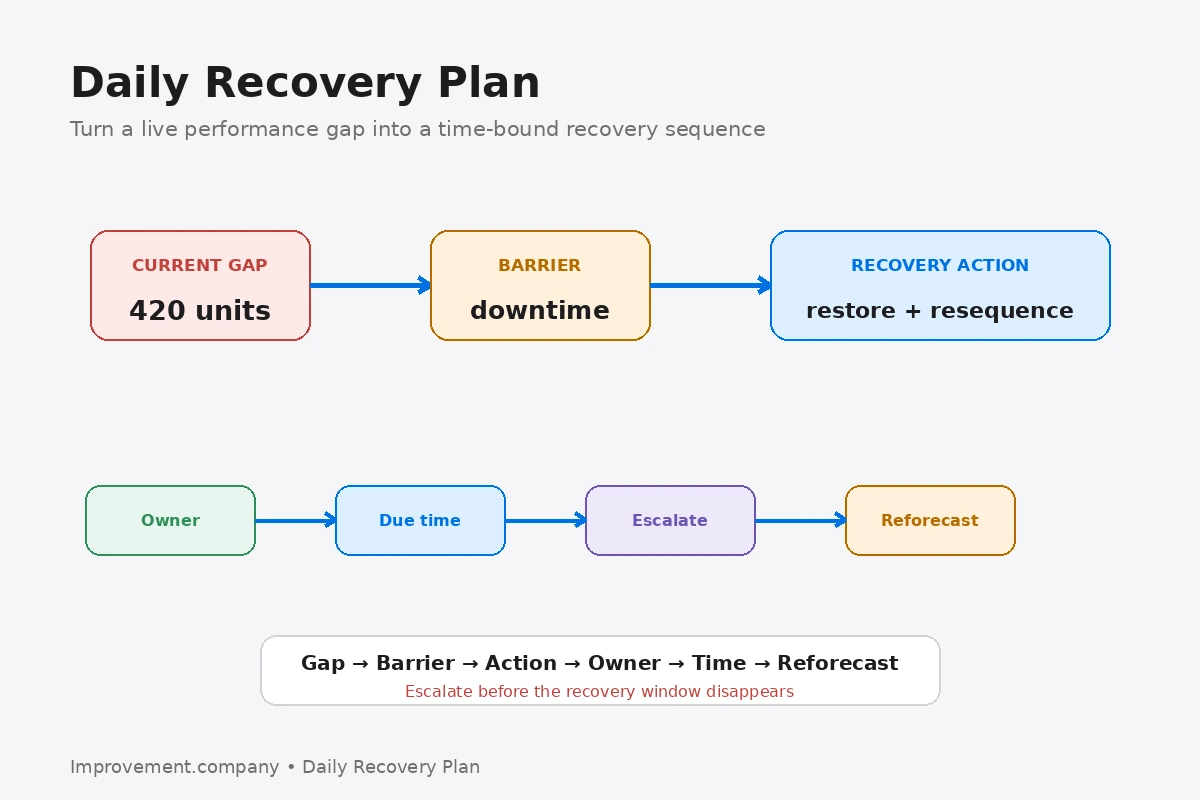
A Daily Recovery Plan is a short operating plan created when actual performance falls behind the expected condition and the team still has time to recover within the current shift or day.
The objective is not to explain yesterday’s loss.
The objective is to answer:
What must happen now to protect today’s commitment?
Start with the remaining gap
Define the gap in concrete terms.
Examples include:
- 420 units still required;
- two customer orders at risk;
- 90 minutes of capacity lost;
- 15 inspections behind plan.
Schedule Attainment helps compare actual completion with the intended schedule.
The recovery plan should be based on the real remaining requirement, not a vague statement that the team is “behind.”
Recalculate the available time
Ask:
- How much productive time remains?
- What constraints are active?
- What capacity is realistically available?
If the remaining requirement cannot be achieved safely with available capacity, the plan should escalate early rather than create an impossible target.
Capacity Planning provides useful thinking for comparing workload with available resources.
Identify the dominant barrier
The team should identify the condition currently preventing recovery.
Examples include:
- equipment downtime;
- material shortage;
- staffing gap;
- quality hold;
- slow cycle.
Daily Loss Review helps convert operating losses into prioritized actions.
Do not create ten recovery actions when one unresolved barrier controls the outcome.
Define immediate countermeasures
Recovery actions may include:
- restore the failed asset;
- resequence work;
- secure material;
- move qualified support;
- reduce changeover delay.
The action should address the barrier without creating unsafe work or uncontrolled quality risk.
Assign owner and timing
Each action should state:
- owner;
- completion time;
- expected effect.
Daily Accountability Process helps keep ownership visible until the action is closed.
A recovery action without a time expectation is unlikely to protect the remaining schedule.
Escalate early when local action is insufficient
Daily Management Escalation Ladder helps define when a problem needs higher-level authority or specialist support.
Do not wait until the end of the shift to report a gap that became unrecoverable hours earlier.
Recheck the forecast
After each major action, update:
- remaining gap;
- remaining time;
- expected completion.
This makes the recovery plan dynamic.
If the forecast still shows a miss, escalate the next barrier immediately.
Common mistakes
Creating a recovery plan without recalculating remaining capacity, adding overtime as the default response, assigning too many actions, waiting too long to escalate, using unsafe shortcuts to recover output, and failing to update the forecast after conditions change are common mistakes.
Practical sequence
- quantify the current gap.
- calculate remaining productive time.
- identify the controlling barrier.
- define the immediate countermeasure.
- assign owner and due time.
- escalate missing support.
- update the expected finish.
- repeat until the gap is closed or formally escalated.
- record unresolved causes for deeper work.
- review whether recurring recovery needs signal a systemic problem.
The practical lesson
A Daily Recovery Plan turns an operating miss into a time-bound response.
The earlier the gap becomes visible, the more options the team has to recover it safely.