
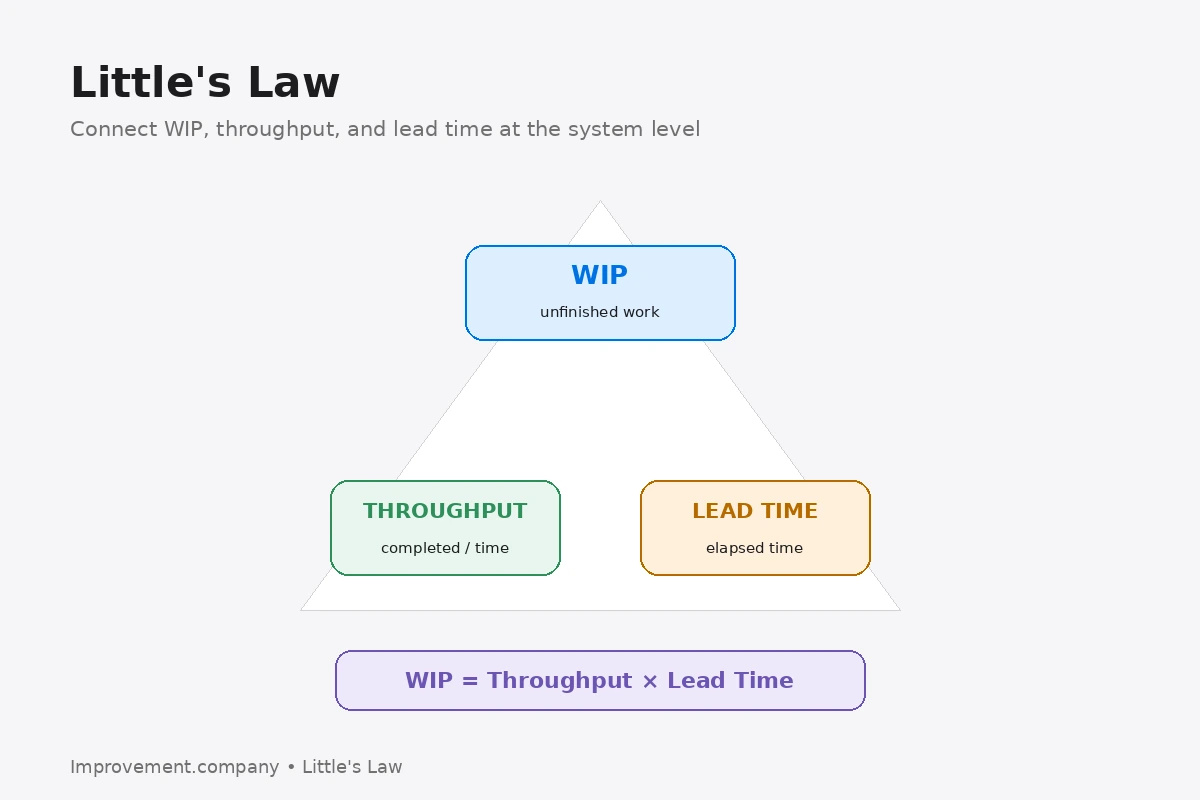
Little’s Law is a fundamental relationship between three measures of a stable system:
Work-in-Process = Throughput × Lead Time
In practical terms, if more work is allowed into a system than can flow out, work-in-process grows.
As WIP grows, lead time usually grows with it.
This makes Little’s Law highly relevant to Lean flow.
The three variables
Work-in-Process is the amount of work currently inside the system. It may be parts, orders, service requests, support tickets, engineering tasks, patients, or applications.
Throughput is the rate at which the system completes work.
Lead Time is the average time a unit spends in the system from entry to completion.
Simple example
Suppose a process contains an average of 100 units of WIP and completes 20 units per hour.
Average Lead Time is 100 ÷ 20 = 5 hours.
If throughput remains 20 units per hour but WIP increases to 200 units, average Lead Time becomes 10 hours.
Nothing about the work itself became slower. The queue became larger.
Why this matters in Lean
Organizations often try to improve lead time by asking people to work faster.
But if the system is overloaded with WIP, the larger opportunity may be controlling how much work is released.
This connects directly to Pull Systems and Kanban, which help limit and control work-in-process.
WIP hides problems
Large WIP buffers can hide equipment instability, quality problems, scheduling issues, long changeovers, imbalance, and unreliable suppliers.
Reducing WIP can expose these problems.
That is useful only if the organization responds by improving the process rather than blaming the visible disruption.
Little’s Law and bottlenecks
A Bottleneck limits the rate at which the system can complete work.
If upstream processes continue releasing work faster than the bottleneck can process it, WIP accumulates.
Theory of Constraints reinforces the same system perspective: local productivity does not matter if total throughput is limited elsewhere.
Important assumptions
Little’s Law applies to stable systems over a meaningful period.
The average arrival rate and average completion rate must be reasonably balanced.
Use consistent boundaries and measurement periods.
Common mistakes
Confusing cycle time with lead time, measuring WIP inconsistently, using planned throughput instead of actual throughput, treating the formula as the cause, and increasing utilization everywhere can all lead to poor conclusions.
Practical use
- Define the process boundary.
- Measure average WIP.
- Measure actual throughput.
- Calculate average lead time.
- Compare to observed lead time.
- Identify where WIP accumulates.
- Investigate release rules, batching, bottlenecks, and variability.
- Reduce unnecessary WIP carefully.
- Track whether lead time improves.
The practical lesson
Little’s Law gives Lean teams a simple system insight:
If throughput cannot increase, reducing WIP is one of the most direct ways to reduce lead time.
Related application
This topic also connects with Lead Time. Use that method when the improvement requires the related operating or management discipline.