
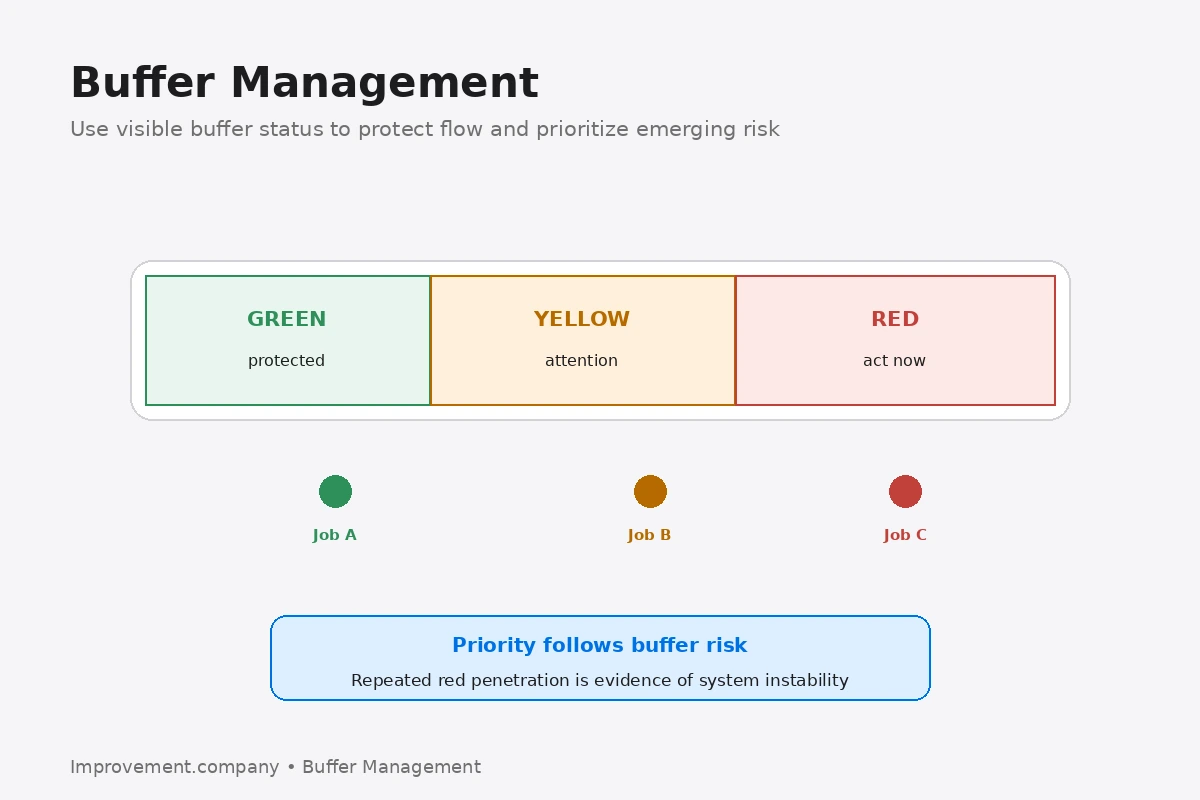
Buffer Management is the active control of time or inventory buffers used to protect important points in a flow.
In Theory of Constraints environments, buffers are often used to protect:
- system constraint;
- shipping commitment;
- critical assembly point.
The objective is not to create excess inventory.
The objective is to absorb normal variability while making emerging risk visible.
Understand what the buffer protects
Drum Buffer Rope uses a buffer to protect the constraint from starvation and to protect delivery from process variability.
A buffer should have a clear purpose.
If no one can explain what a pile of inventory protects, it may simply be excess WIP.
Define buffer size
Buffer size depends on factors such as:
- variability;
- replenishment time;
- reliability;
- demand pattern.
Too small a buffer can cause:
- starvation;
- missed delivery.
Too large a buffer can create:
- long lead time;
- hidden problems;
- excess inventory.
The initial size should be treated as a managed parameter, not a permanent truth.
Use zones
A simple buffer may be divided into:
- green;
- yellow;
- red.
Green indicates sufficient protection.
Yellow indicates attention may be needed.
Red indicates high risk requiring action.
The exact percentages or time bands should reflect the operating system.
Prioritize by buffer penetration
When several jobs compete for attention, buffer status can help determine which requires action first.
A job deep in the red zone may deserve priority over a newer job that is still protected.
This can create a more system-oriented priority rule than first-come-first-served in every situation.
Investigate recurring red-zone penetration
Frequent buffer penetration is useful information.
Possible causes include:
- breakdown;
- quality loss;
- unreliable supplier;
- long setup;
- unrealistic release rule.
Production Loss Analysis can help identify the losses causing repeated risk.
Reduce buffer only after the system improves
A buffer should not be cut simply to meet an inventory target.
Improve the causes of variability first.
Work in Process should be controlled at the system level so buffer reduction does not create instability elsewhere.
Protect the constraint
Theory of Constraints emphasizes protecting the resource that limits system throughput.
Buffer management should therefore pay special attention to conditions that could starve or disrupt the constraint.
Common mistakes
Creating buffers without a defined purpose, increasing inventory whenever service risk appears, shrinking buffers before variability is reduced, using buffer status without clear action rules, prioritizing local efficiency over constraint protection, and failing to investigate repeated red-zone penetration are common mistakes.
Practical sequence
- define what the buffer protects.
- measure variability and replenishment time.
- set an initial buffer.
- define visible zones.
- define action rules by zone.
- prioritize threatened work.
- analyze recurring penetration.
- improve sources of variability.
- adjust buffer size carefully.
- verify throughput and delivery after changes.
The practical lesson
Buffer Management uses limited protection intentionally.
A good buffer absorbs normal variation, exposes emerging risk, and shrinks only as the underlying system becomes more reliable.