
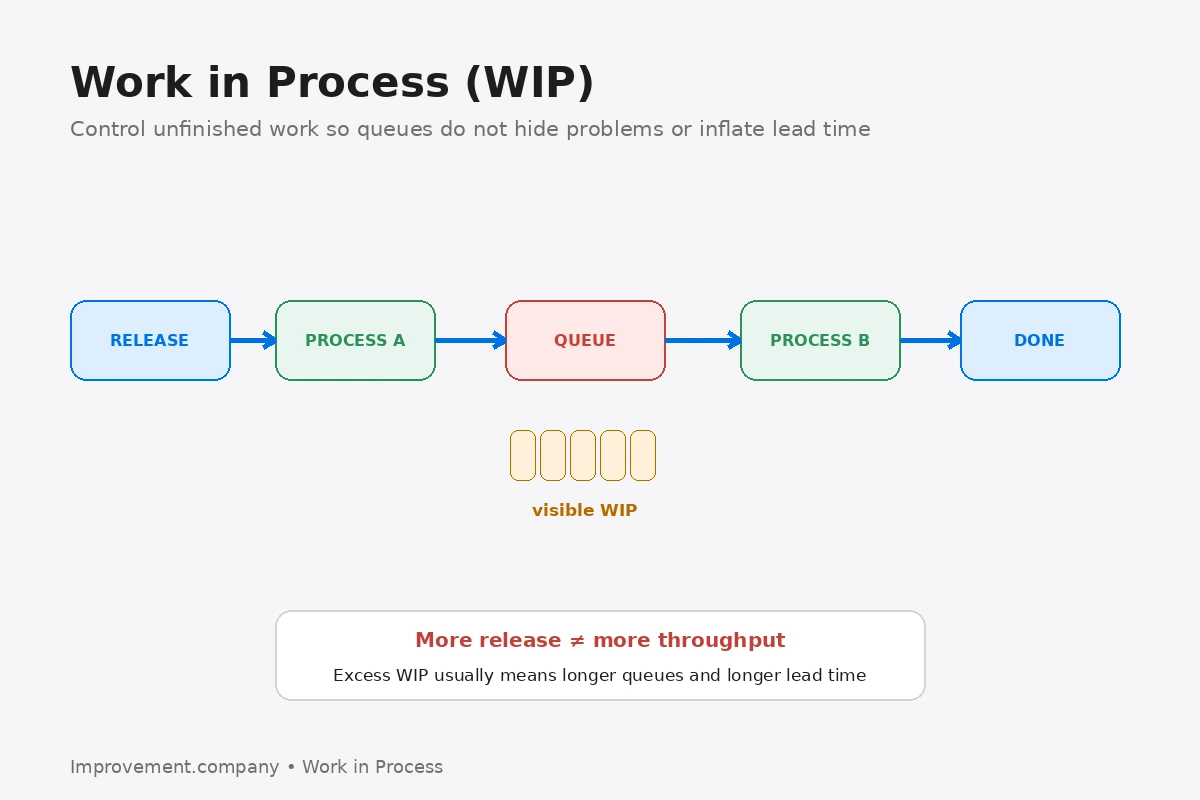
Work in Process, or WIP, is work that has entered a process but has not yet reached the defined completion point.
In manufacturing it may include partially processed material, jobs waiting between operations, or released orders not yet finished. In office and service processes it may include open requests, pending cases, active approvals, or unfinished transactions.
Understand why WIP matters
WIP consumes space, cash, handling, and management attention. It can also hide bottlenecks, quality problems, and uneven flow.
When large queues exist between steps, problems can remain invisible for hours or days.
Connect WIP to lead time
Little’s Law provides the relationship:
WIP = Throughput × Lead Time
If throughput is stable, increasing WIP generally increases lead time. Pushing more work into a constrained system usually creates a larger queue rather than more output.
Distinguish necessary WIP from excess WIP
Some WIP may be required for process physics, transport, replenishment, decoupling, or standard work.
Standard Work includes standard work-in-process as one of the traditional elements used to maintain repeatable flow.
The objective is not automatically zero WIP. The objective is controlled WIP that supports the process without hiding instability.
Use pull to control release
Pull System authorizes work based on downstream demand or available capacity. This prevents upstream processes from creating work simply because they are available.
CONWIP controls total WIP across a larger production flow using a fixed number of authorization signals.
Make queues visible
WIP should be easy to see.
Methods include FIFO lanes, marked locations, Kanban boards, and electronic queue limits.
FIFO Lane controls sequence and makes excess queue visible when the lane reaches its defined capacity.
Measure WIP in the right unit
Useful units may include pieces, containers, jobs, hours of work, or dollars.
The measure should support the management decision. For mixed-product processes, pieces alone may be misleading if work content differs significantly.
Reduce WIP through system improvement
WIP can be reduced by improving changeover time, reliability, quality, replenishment, workload balance, and process stability.
Removing inventory without improving the process can cause starvation and frequent disruption.
Watch for hidden WIP
Some work is physically visible. Other WIP may sit inside spreadsheets, inboxes, ERP queues, or approval systems.
The same flow principles apply.
Common mistakes
Using WIP only as an accounting measure, releasing work without considering system capacity, treating every buffer as waste, removing WIP before stabilizing the process, hiding work in electronic queues, and maximizing local utilization at the cost of larger system queues are common mistakes.
Practical sequence
- define the process boundaries.
- count unfinished work.
- identify where WIP accumulates.
- connect WIP with lead time and throughput.
- define practical WIP limits.
- make limits visible.
- control work release.
- protect the constraint.
- reduce causes of instability.
- lower WIP carefully as the system improves.
The practical lesson
WIP is not just inventory.
It is a visible signal of how much unfinished work the system is carrying and how effectively flow is being controlled.