
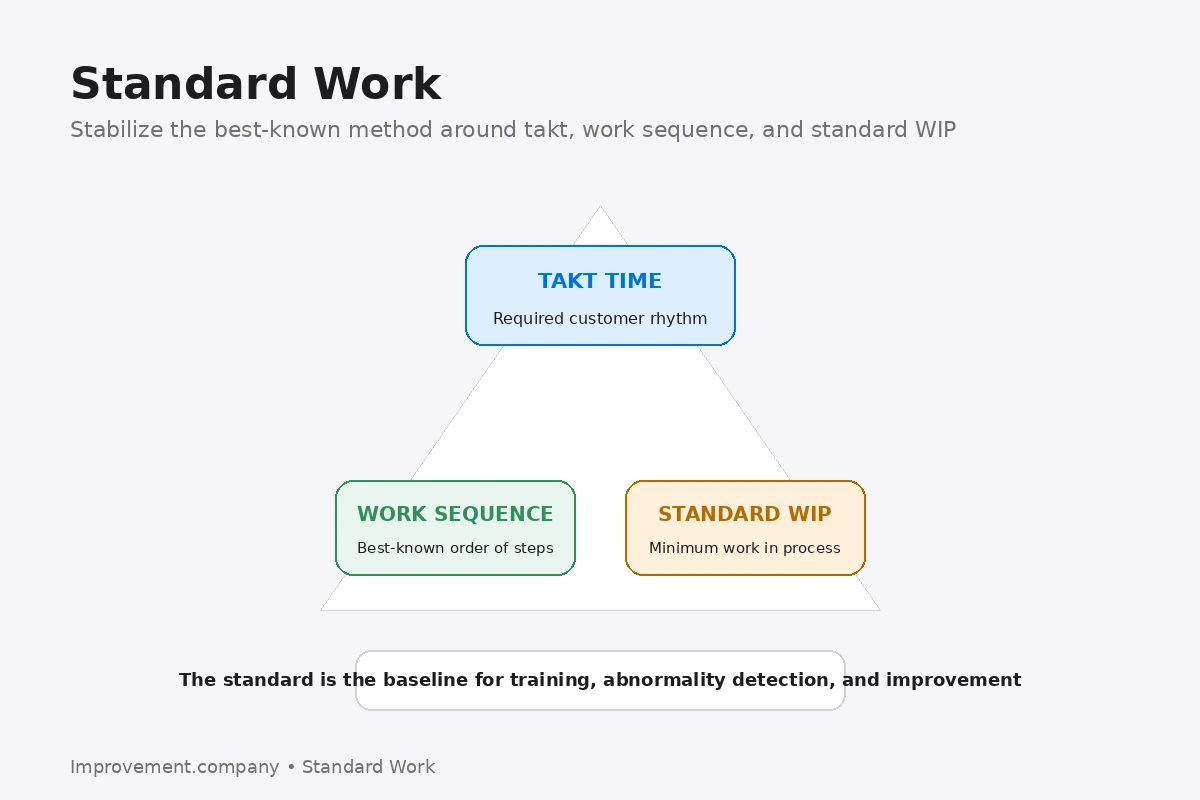
Standard Work defines the current best-known method for performing a process.
It creates a clear baseline for safety, quality, timing and sequence so that abnormalities and improvement opportunities can be recognized.
A standard is not meant to freeze a process forever. It provides the reference point from which improvement can occur.
Three common elements
Standard Work is often described through three core elements.
Takt time
Takt time represents the pace required to meet customer demand.
It helps teams compare process capacity and work content with the rate at which output is needed.
Work sequence
The work sequence defines the order in which tasks should be performed.
A consistent sequence reduces variation and supports training, quality and problem detection.
Standard work in process
Standard work in process is the minimum amount of material or work needed to maintain the defined sequence and flow.
Too little may interrupt the process. Too much can hide problems.
Why standards matter
Without a defined method, it is difficult to determine whether performance changed because of an improvement or simply because people worked differently.
Standard Work supports:
- repeatability;
- training;
- quality;
- safety;
- visual management;
- problem solving;
- process improvement.
Standards should improve
A standard should represent the best-known method today.
When a better method is tested and proven, the standard should change.
This relationship is fundamental:
No standard, no clear baseline. No baseline, no reliable improvement.
Standard Work must be observable
A standard is easier to sustain when the expected method can be seen and confirmed at the workplace.
That does not mean every motion requires a detailed instruction. The level of detail should match the risk and complexity of the work. Critical sequence, quality points, safety conditions and required work in process should be clear enough that a deviation can be recognized and discussed.
If the standard exists only in a document that is rarely used, it cannot function effectively as an improvement baseline.
Standard Work has core elements
In Lean systems, Standard Work is often built around takt time, work sequence and standard work-in-process.
Takt connects the process to demand. Work sequence defines the current best known order for performing the work. Standard work-in-process defines the minimum material needed to keep the sequence flowing.
Together, these elements make the current method visible enough to study and improve.
Standard Work is not a procedure library
A detailed procedure can explain how to perform a task, but Standard Work has a narrower operational purpose.
It should help people understand the expected sequence and key conditions at the point of work.
If the document is too complex to use during normal operations, it may not function as Standard Work even if technically accurate.
Changes need controlled learning
When a better method is proposed, the team should test it before changing the standard.
The new method should improve the process without creating new safety, quality or ergonomic problems.
Once verified, the standard can be updated and the people affected should understand the change.
The standard belongs to the process
Standard Work is strongest when the people performing the work participate in creating and improving it.
That increases practical accuracy and helps expose details that may be missed by someone observing from outside.
The standard should represent the best known method for the process, not simply management preference.
Additional connections
This topic also connects with Standard Work Combination Table and TWI Job Instruction. These relationships are useful when the team needs to extend the method into a wider improvement system.
Related application
This topic also connects with Centerlining. Use that method when the improvement requires the related management or operating discipline.
Related application
This topic also connects with Standardization After Improvement. Use that method when the improvement requires the related operating or management discipline.
Related application
This topic also connects with Standard Work Audit. Use that method when the improvement requires the related operating or management discipline.
Related application
This topic also connects with Standard Work Documentation. Use that method when the improvement requires the related operating or management discipline.
Related application
This topic also connects with Standard Work Abnormality Response. Use that method when the improvement requires the related operating or management discipline.
Related application
This topic also connects with Standard Work Deviation Log. Use that method when the improvement requires the related operating or management discipline.