Overall Equipment Effectiveness, or OEE, is a widely used measure for understanding how effectively equipment is used during planned production time.
OEE combines three factors:
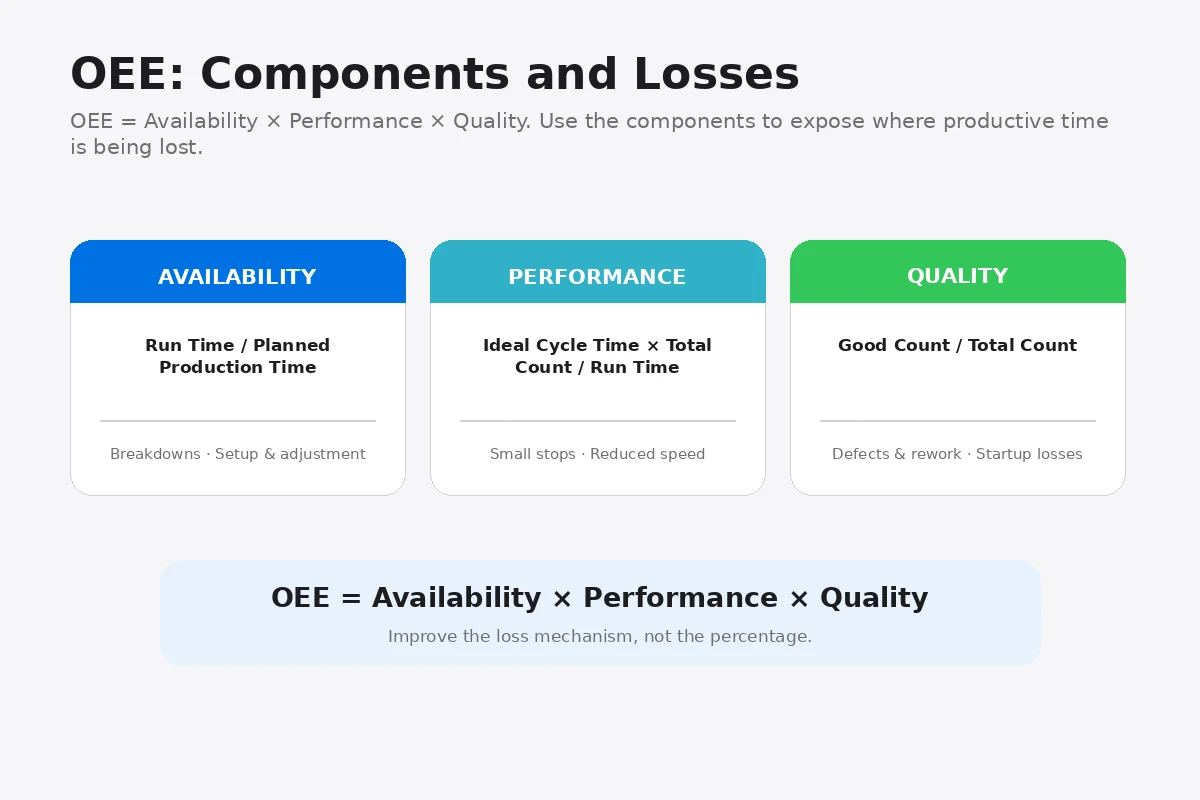
Availability × Performance × Quality
Each factor represents a different type of production loss.
Availability
Availability reflects losses that stop planned production.
Examples include breakdowns, major adjustments and some setup-related downtime depending on how the organization defines planned production time.
A common form is:
Availability = Run Time ÷ Planned Production Time
Performance
Performance reflects losses that occur while equipment is running but producing more slowly than its defined ideal rate.
Examples include minor stops, reduced speed and slow cycles.
Quality
Quality reflects the proportion of output that meets requirements.
A common form is:
Quality = Good Count ÷ Total Count
OEE is diagnostic
OEE is most useful when it helps teams understand where losses occur.
The individual components often provide more improvement insight than the combined percentage.
For example, two machines may have the same OEE but very different loss patterns.
One may suffer from downtime while another suffers from speed loss or defects.
Avoid using OEE blindly
OEE should not automatically be used to compare unrelated machines, plants or processes.
Different equipment roles, demand patterns, constraints, standards and data definitions can make direct comparisons misleading.
OEE is strongest when used consistently to understand and improve a defined process over time.
The purpose is improvement
A high OEE number is not the objective by itself.
The objective is reliable production, quality output, good flow and effective use of capacity in support of customer demand.
The six big losses
OEE is often connected to six major equipment-related losses.
Availability losses include equipment failures and setup or adjustment losses.
Performance losses include minor stops and reduced operating speed.
Quality losses include process defects and startup or yield losses.
Grouping losses this way helps teams move from the overall percentage toward the actual mechanisms consuming capacity.
OEE depends on definitions
The calculation is simple, but the result can change significantly depending on how the organization defines planned production time, ideal cycle time, good product and downtime categories.
Those definitions should be documented and applied consistently.
Otherwise, an apparent improvement in OEE may come from changing the calculation rather than improving the process.
Ideal cycle time needs discipline
Performance is especially sensitive to the ideal cycle time.
If the selected ideal rate is too slow, performance can appear artificially strong. If it is unrealistic, the process may appear permanently weak.
The rate should represent a defensible best demonstrated or engineered condition for the defined product and process.
OEE and the bottleneck
Improving OEE on every machine does not automatically improve system throughput.
If a machine has significant unused capacity and is not constraining the flow, increasing its output may simply create more inventory.
Loss reduction should therefore consider the role of the equipment in the overall production system.
Equipment at or near the constraint often deserves particular attention because its lost time can directly reduce system output.
Use the components to guide action
The combined OEE percentage is a summary.
The improvement work comes from understanding Availability, Performance and Quality separately and then drilling into the specific losses inside each component.
A falling Availability value may direct attention toward breakdowns. Weak Performance may point to minor stops or cycle losses. Weak Quality may require process or material analysis.
OEE becomes useful when it directs investigation toward the real loss.
How OEE connects to the maintenance system
OEE is a loss model, not a complete improvement system. MTBF and MTTR help distinguish reliability and restoration behavior, Focused Improvement provides a structured way to attack chronic equipment and process losses, and Total Productive Maintenance supplies the broader management system for sustaining equipment effectiveness.
Related application
This topic also connects with Production Loss Analysis. Use that method when the improvement requires the related operating or management discipline.