
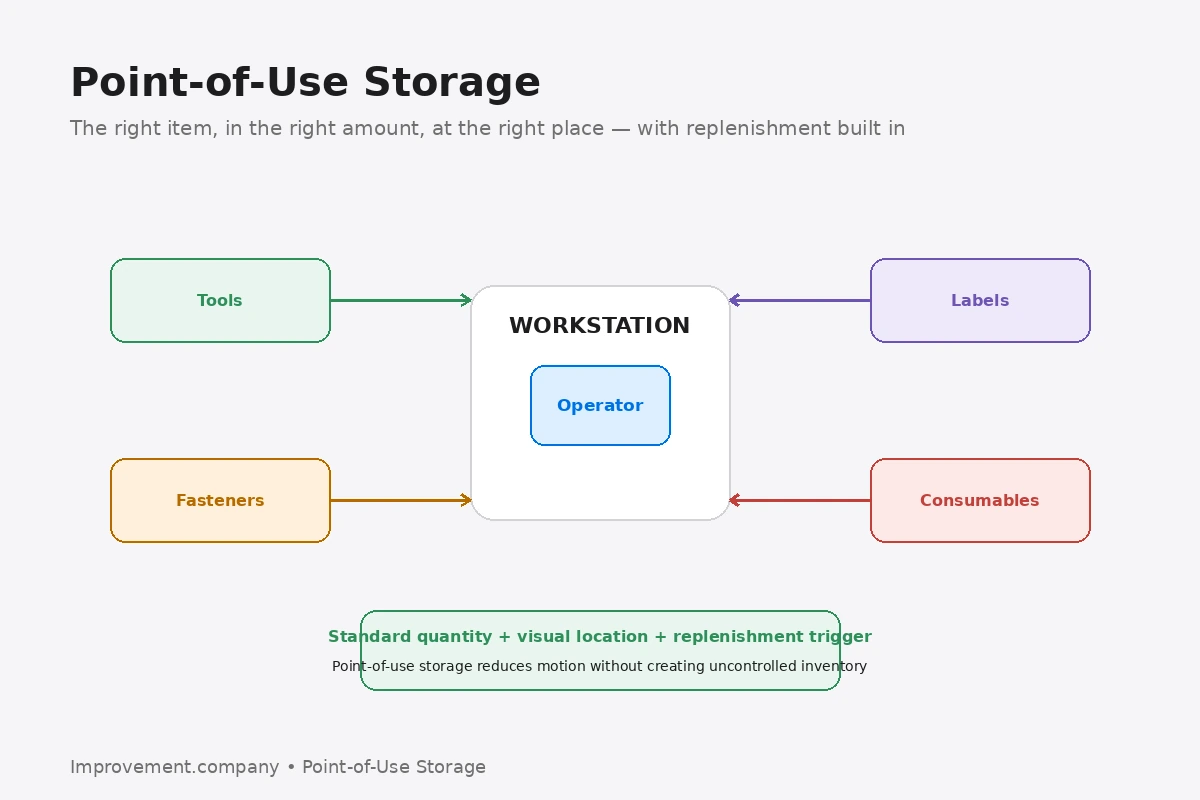
Point-of-Use Storage places frequently used tools, materials, consumables, and information close to the location where they are needed.
The objective is to reduce walking, searching, handling, and interruption.
The principle is simple, but uncontrolled point-of-use storage can quickly become excess inventory and clutter.
Start with actual use
Observe what people repeatedly leave the workstation to obtain.
Spaghetti Diagram can make unnecessary travel and motion visible.
Candidates may include hand tools, gauges, labels, fasteners, cleaning supplies, and standard information.
Do not move everything closer simply because space exists.
Select the right items
Good point-of-use items are used frequently, needed predictably, and safe to store locally.
Rarely used or high-risk items may belong in shared controlled storage.
Define the location
5S Workplace Organization helps create a clear place for needed items and make missing or excess conditions visible.
Useful methods include shadow boards, labeled bins, fixed shelves, and marked locations.
The storage method should support the work sequence.
Control quantity
Local storage should not become uncontrolled inventory.
Define standard quantity, minimum, maximum, and replenishment trigger.
Plan for Every Part helps define handling, storage, quantity, container, and replenishment information for material.
Design replenishment
Line-Side Material Presentation helps connect material availability with ergonomics, visual control, replenishment, and line-side quantity.
The operator should not need to leave the work repeatedly because the storage system has no replenishment rule.
Make abnormal conditions visible
Visual Management helps show an empty location, missing tool, excess quantity, or incorrect item.
A good point-of-use system makes the expected condition obvious.
Protect standard work
Standard Work defines the best-known sequence and method.
Storage location should support that sequence rather than force unnecessary reaching, walking, or backtracking.
Review after product or process changes
New tools, different mix, or changed work sequence may make the old location ineffective.
Point-of-use storage should evolve with the process.
Common mistakes
Putting every item at the workstation, creating excess inventory, locating items without observing actual work, using labels without replenishment rules, storing hazardous or controlled items improperly, ignoring ergonomics, and allowing obsolete items to accumulate are common mistakes.
Practical sequence
- observe repeated travel and searching.
- identify frequently used items.
- decide which items belong at point of use.
- define the location.
- define standard quantity.
- define replenishment.
- make the condition visual.
- check ergonomics and safety.
- confirm support for standard work.
- remove obsolete items and improve the layout as work changes.
The practical lesson
Point-of-Use Storage reduces motion only when location, quantity, replenishment, and visual control are designed together.
The goal is not more material at the workstation; it is the right item, in the right amount, at the right place.