
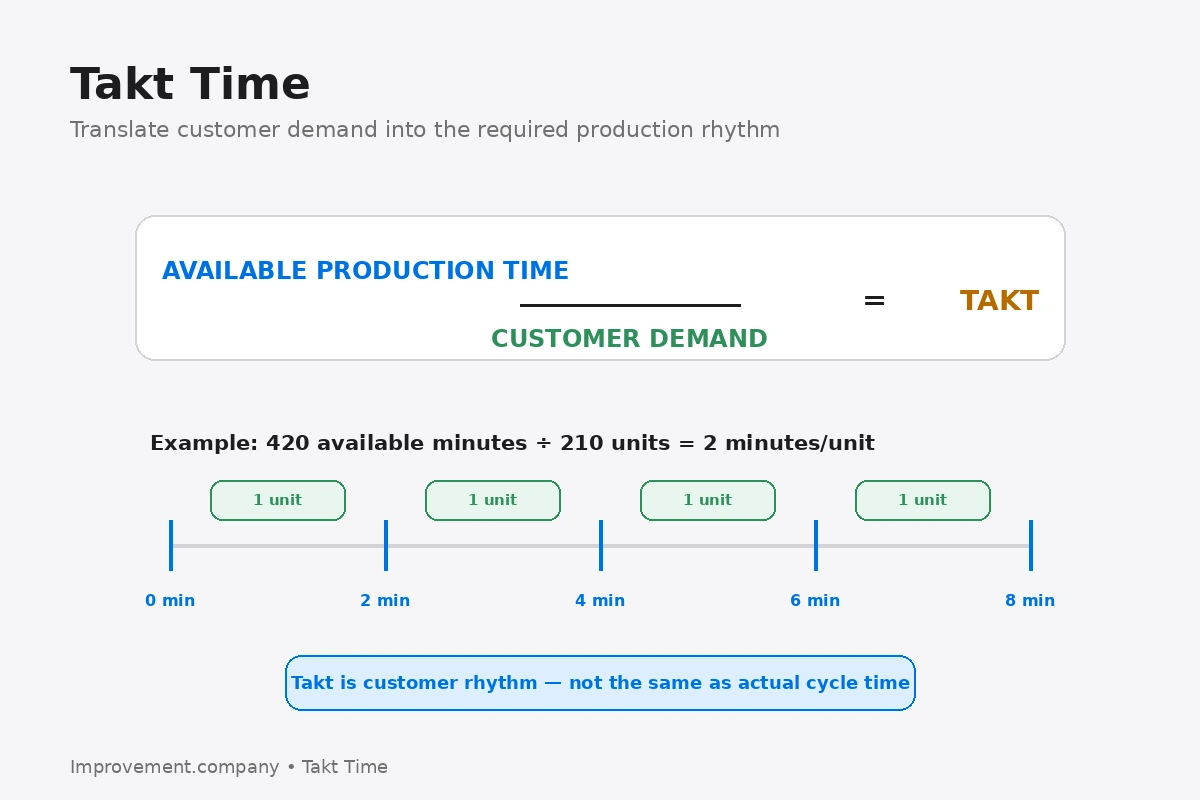
Takt time represents the pace at which a process must produce to meet customer demand.
A common calculation is:
Takt Time = Available Production Time ÷ Customer Demand
If a process has 420 minutes of available production time and demand is 210 units, the takt time is 2 minutes per unit.
Takt is a demand signal
Takt time is not the same as cycle time.
Takt comes from customer demand and available time.
Cycle time describes how long the process actually takes to produce a unit or complete a cycle.
Comparing the two helps teams understand whether the process can meet demand.
Use realistic available time
Available production time should reflect the period in which the process is expected to produce.
Organizations should define consistently how planned breaks, meetings and other non-production periods are treated.
Takt can change
When demand or available time changes, takt changes.
This means staffing, work balance and operating methods may also need adjustment.
Takt supports flow
Takt creates a common pacing reference across the process.
It can support line balancing, Standard Work, staffing decisions and production control.
The objective is not to force every activity into an identical duration.
The objective is to design the system so output can reliably match demand.
Takt time is not an efficiency target
Takt should not be interpreted as a requirement to keep every person or machine busy every second.
Its purpose is to connect the production system to demand. A process may intentionally include small amounts of available capacity, walking, checking or recovery time depending on its design. The important question is whether the total system can meet demand reliably without creating excessive inventory, overburden or instability.
Takt time changes with demand
Takt is not a permanent number.
If customer demand changes or available production time changes, takt changes as well.
That means staffing, line balance, pitch, replenishment and capacity decisions may also need review.
Using an old takt after demand has shifted can distort the entire operating system.
Available time should be defined consistently
The numerator in the takt calculation should reflect the time actually available for production under the defined planning period.
Organizations should be clear about how breaks, planned meetings, maintenance windows and other planned losses are treated.
Inconsistent definitions make comparisons unreliable.
Cycle time and takt answer different questions
Takt represents the pace required by demand.
Cycle time represents how long the process actually takes to complete a unit or work cycle.
Comparing the two helps determine whether the process can meet demand.
A process with cycle time consistently above takt cannot meet the required pace without additional capacity or a change in method.
Takt supports design decisions
Once takt is known, teams can make better decisions about staffing, work allocation, line design and replenishment.
It becomes a reference point for designing flow rather than simply a number displayed on a board.
Connect this concept to the wider system
For deeper application, connect this concept with Bottleneck Analysis and Capacity Planning. These methods help move from understanding the topic to managing it as part of a wider improvement system.
Related application
This topic also connects with Pacemaker Process. Use that method when the improvement requires the related operating or management discipline.
Related application
This topic also connects with Production Pitch. Use that method when the improvement requires the related operating or management discipline.