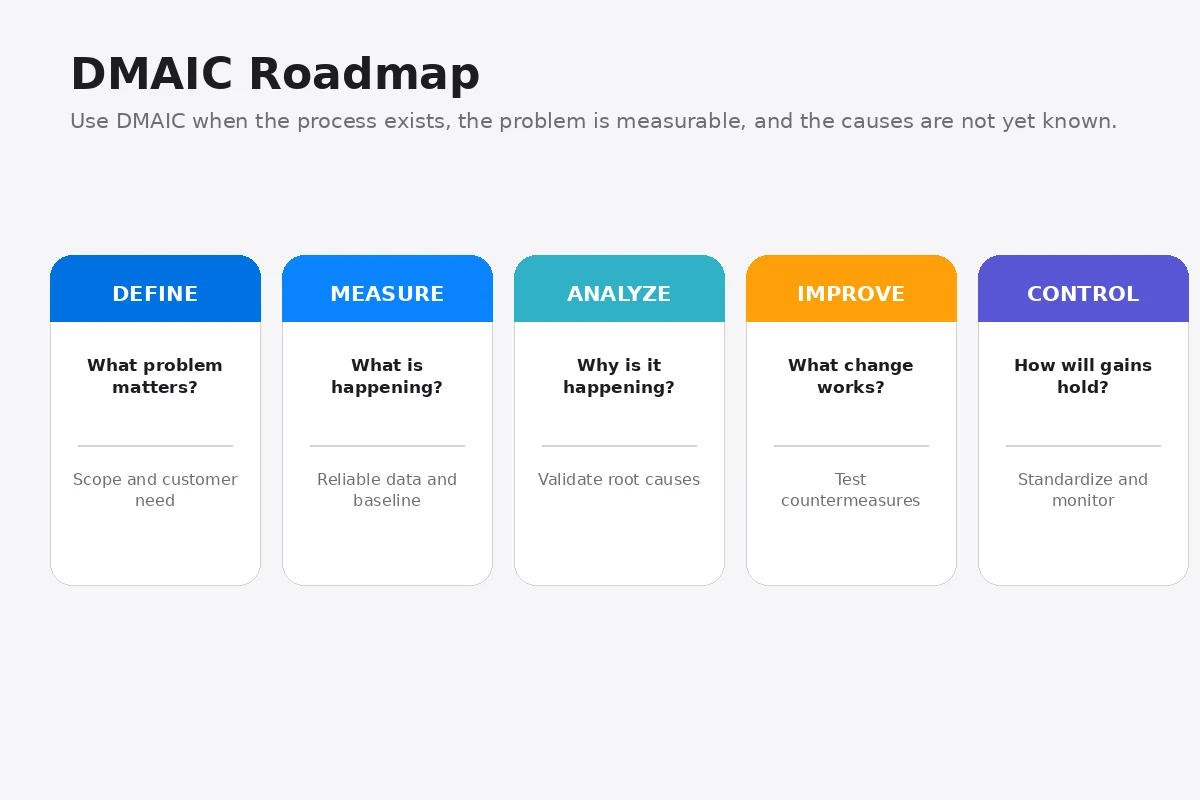
DMAIC stands for Define, Measure, Analyze, Improve and Control.
It is a structured problem-solving method commonly associated with Six Sigma, but its logic is useful well beyond formal Six Sigma projects.
DMAIC is especially valuable when a process problem is measurable, persistent and complex enough that jumping directly to a solution would create unnecessary risk.
Define
Clarify the problem, customer requirement, business impact and project scope.
A strong Define phase answers questions such as:
- What problem are we solving?
- Who is affected?
- What outcome matters?
- Where does the process begin and end?
- What is inside and outside the project?
Measure
Establish how the process performs today.
This may involve operational definitions, data collection plans, baseline performance, process mapping and measurement-system checks.
The goal is to replace assumptions with reliable evidence.
Analyze
Investigate why the problem occurs.
Teams examine patterns, relationships, variation and potential causes.
Tools may include Pareto analysis, cause-and-effect diagrams, process analysis, hypothesis testing or other methods appropriate to the problem.
Improve
Develop and test countermeasures that address verified causes.
Improvement should connect directly to what was learned during analysis.
Pilots and controlled trials can reduce risk before a larger implementation.
Control
Sustain the improved condition.
Control may include Standard Work, visual controls, response plans, monitoring, training and ownership.
Without Control, a successful improvement can gradually disappear.
DMAIC is not a checklist
The phases provide discipline, but the value comes from the thinking within them.
A team should not use tools simply because a template says they belong in a phase.
Use the evidence required to understand and improve the process.
Define the problem before measuring everything
DMAIC projects can become slow when teams begin collecting large amounts of data before clarifying the problem.
The Define phase should establish the business or customer problem, scope, stakeholders and measurable outcome.
This creates boundaries for the Measure phase.
Useful data is data that helps quantify the current condition, validate the measurement system or test the factors that may explain the gap.
Analysis should test relationships
The Analyze phase is not a requirement to use complicated statistics.
The appropriate method depends on the problem and data.
Process observation, stratification, Pareto analysis, graphical analysis and designed statistical tests can all be useful.
The important point is to move from possible causes toward evidence that supports or rejects the relationship.
Control means protecting the improved process
The Control phase should ensure that the gains do not depend on the project team remaining permanently involved.
Controls may include updated standards, process monitoring, visual management, ownership, reaction plans, training and capability checks.
A control plan should identify what must be monitored, who responds and what happens when the process moves away from the expected condition.
DMAIC is complete when the improved process can be managed as normal work.
Additional connections
This topic also connects with Design of Experiments (DOE), Pp and Ppk, and Voice of the Customer. These relationships are useful when the team needs to extend the method into a wider improvement system.
Related application
This topic also connects with Improvement Project Charter. Use that method when the improvement requires the related operating or management discipline.
Related application
This topic also connects with Data Collection Plan. Use that method when the improvement requires the related operating or management discipline.