
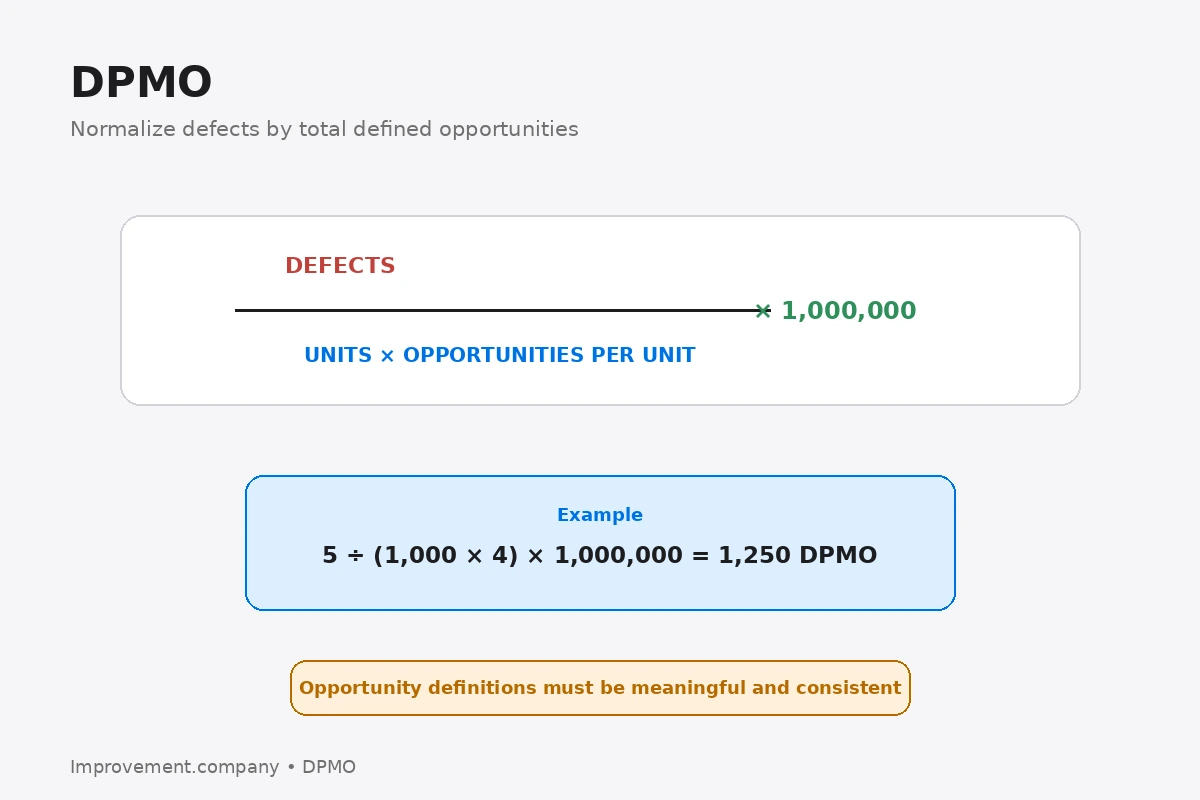
DPMO stands for Defects Per Million Opportunities.
It normalizes defect performance by considering the number of defects, the number of units, and the number of defect opportunities per unit.
The measure is useful when products or processes have different numbers of possible defect opportunities.
The basic calculation
A common formula is:
DPMO = Defects ÷ (Units × Opportunities per unit) × 1,000,000
Suppose there are 5 defects, 1,000 units, and 4 defined opportunities per unit.
Then:
DPMO = 5 ÷ (1,000 × 4) × 1,000,000 = 1,250
Define a defect correctly
A defect is a failure to meet a defined requirement.
Critical to Quality helps connect customer-important requirements with measurable product or process characteristics.
The defect definition should be specific enough that different inspectors classify the same condition consistently.
Define an opportunity carefully
The opportunity count should represent realistic independent chances for a defect.
Inflating the number of opportunities lowers DPMO without improving the process.
For example, a form with ten meaningful required fields may reasonably have ten opportunities for certain error types. Calling every keystroke an opportunity would create a very different measure.
Use operational definitions
Operational Definition should define the unit, defect, opportunity, and counting rule.
Without consistent definitions, DPMO comparisons across departments or periods can be misleading.
Distinguish defects from defective units
One unit can contain multiple defects.
For example, one component may have a scratch, wrong dimension, and missing label. That is one defective unit but three defects.
DPMO is based on defects and opportunities, not simply defective-unit count.
Use DPMO when normalization adds value
DPMO is useful when products differ in complexity, opportunity counts are meaningful, or a common normalized metric is needed.
It may be less useful when there is only one important pass/fail requirement. In that case, defect rate or first-pass yield may be easier to understand.
Connect DPMO with Six Sigma analysis
DMAIC may use DPMO in the Measure phase to establish a baseline and later verify improvement.
Data Collection Plan should define how units, defects, and opportunities will be captured before calculation.
Avoid false precision
A DPMO number can appear highly precise even when defect classification is weak, opportunity counts are arbitrary, or sample size is small.
Measurement quality matters more than the number of decimal places.
Common mistakes
Inflating opportunity counts, confusing defects with defective units, changing the opportunity definition over time, comparing DPMO between processes with fundamentally different definitions, collecting unreliable defect data, and treating DPMO as automatically superior to simpler quality measures are common mistakes.
Practical sequence
- define the unit.
- define the defect.
- define meaningful opportunities.
- collect defects consistently.
- count units.
- calculate total opportunities.
- calculate DPMO.
- stratify important defect categories.
- improve the verified causes.
- keep definitions stable for comparison.
The practical lesson
DPMO can make defect performance comparable across different volumes and complexity.
Its value depends on disciplined definitions of unit, defect, and opportunity.