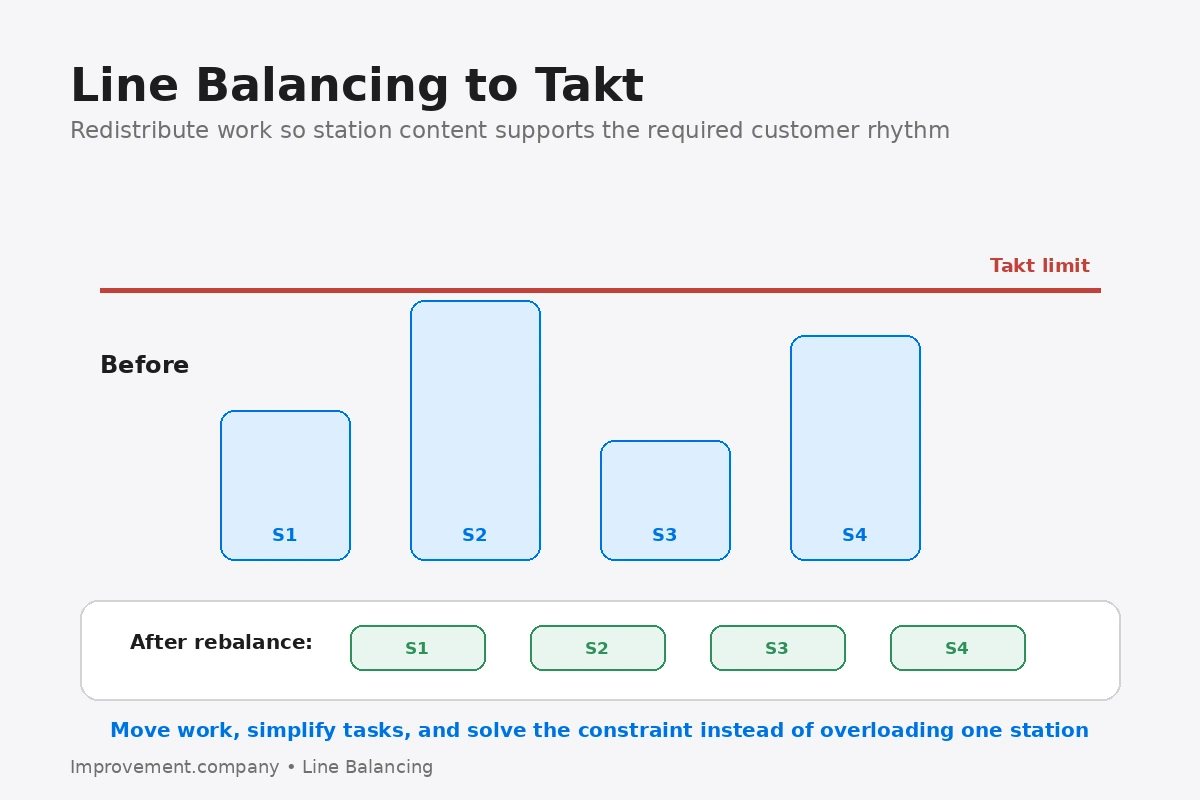
Line balancing is the process of distributing work across stations or operators so that production can meet the required pace with less waiting and unevenness.
It is commonly used in repetitive manufacturing and assembly environments.
Start with work content
Understand the tasks required to produce the product.
Measure or estimate the work content and sequence.
The goal is to see how much work must be distributed across the available resources.
Compare with takt time
Takt time provides the pace required to meet demand.
If a station’s cycle time is consistently above takt, it can become a constraint to flow.
If another station has much less work, the line may experience waiting and imbalance.
Respect precedence
Not every task can be moved freely.
Some work must occur before other work because of product design, process requirements, safety or equipment constraints.
A practical balance must respect those relationships.
Look beyond averages
Average cycle times can hide instability.
Variation, walking, minor stops, rework and material shortages can make a theoretically balanced line perform poorly.
Balance the real process, not just a spreadsheet.
Improve before adding resources
Sometimes the first reaction to an overloaded station is to add labor.
Before doing so, examine method, motion, layout, equipment, quality losses and unnecessary work.
Line balancing works best when combined with process improvement.
Rebalance when conditions change
A line balance is not permanent. Product mix, demand, staffing, equipment reliability, learning and engineering changes can alter the work content.
Teams should revisit the balance when bottlenecks move, overtime grows, waiting becomes visible or takt changes materially. The best result is not simply equal station times on paper; it is a stable system that can meet demand while protecting safety, quality and reasonable workload.
Balance around takt, not averages alone
A line can appear balanced on average while still missing customer demand.
The work content at each station should be considered relative to takt time, product mix and real operating conditions.
Variability, walking, machine interaction and quality checks can all affect the practical balance.
The goal is not mathematical symmetry. It is reliable flow.
Bottlenecks can move
The slowest point in the system may change with product mix, staffing, downtime or sequence.
That is why line balancing should be observed under real conditions rather than treated as a one-time engineering exercise.
A station that is not the constraint today may become one after an upstream improvement.
Use Yamazumi carefully
A Yamazumi chart can make work-element distribution visible and help teams compare station content with takt.
However, the chart depends on accurate work-element times and a stable method.
If the underlying standard is weak, the chart may give a false sense of precision.
Protect ergonomics and quality
Moving work from one station to another can improve balance while creating ergonomic or quality risk.
A good rebalance considers sequence, reach, walking, inspection points, equipment access and operator capability.
The best balance is sustainable for the process and the people performing it.
Connect this concept to the wider system
For deeper application, connect this concept with Bottleneck Analysis, Capacity Planning, and Takt Time. These methods help move from understanding the topic to managing it as part of a wider improvement system.
Related application
This topic also connects with Standard Work Rebalancing. Use that method when the improvement requires the related operating or management discipline.